ADVERTISEMENT
ADVERTISEMENT



U.S. appeals court lifts order curbing immigration agents' tactics against Minnesota protesters
A group of activists opposed to the deportation drive ordered by President Donald Trump in Minnesota's most populous city sued his administration in December.
-
 Reuters
 - Wed, 21, Jan 2026
- 23:30 EST
- 105
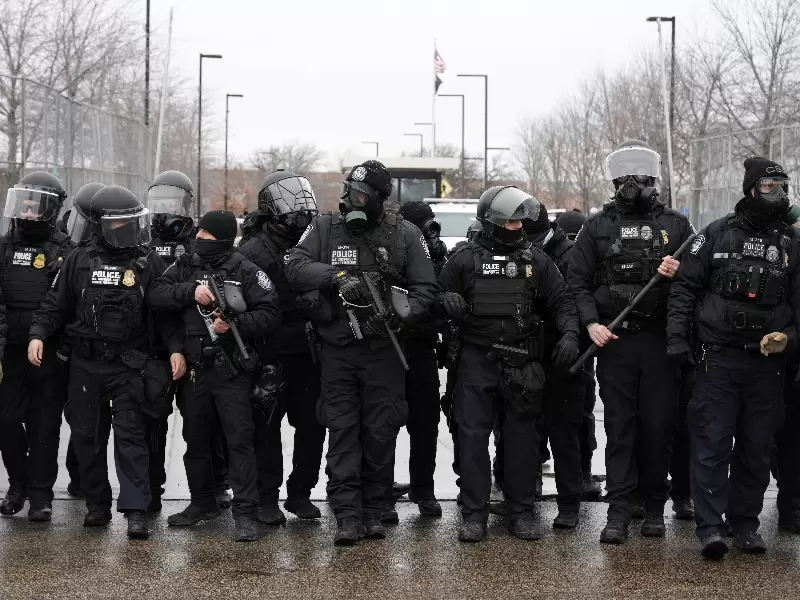 U.S. Customs and Border Protection (CBP) agents stand guard during a protest outside the Whipple Federal Building, more than a week after a U.S. Immigration and Customs Enforcement (ICE) agent fatally shot Renee Nicole Good on January 7, in Minneapolis, Minnesota, U.S., January 16, 2026. / REUTERS/Tim Evans
A U.S. appeals court on Jan. 21 lifted a lower court's order that had restrained federal officers from arresting or tear-gassing peaceful protesters in Minneapolis, where thousands of immigration control agents have been deployed over the wishes of state and local leaders.
A group of activists opposed to the deportation drive ordered by President Donald Trump in Minnesota's most populous city sued his administration in December, saying their constitutional rights to protest and observe the enforcement actions had been infringed.
ALSO READ: Top US immigration judge says bond hearings should be denied despite court rulings, documents show
Last Jan. 16, U.S. District Judge Kate Menendez in Minnesota sided with the plaintiffs, issuing a preliminary injunction barring federal immigration agents from retaliating against individuals engaged in nonviolent, unobstructive protests.
Menendez's order explicitly prohibited federal agents from detaining or using pepper spray, tear gas or other crowd-control munitions against peaceful demonstrators or bystanders who were observing or recording immigration enforcement operations in the Twin Cities of Minneapolis and St. Paul.
The injunction was to remain in effect while the merits of the lawsuit as a whole were under court review. But the U.S. Department of Homeland Security, which oversees immigration enforcement, appealed the district court's ruling.
On Jan. 21, the 8th U.S. Circuit Court of Appeals sided with DHS, blocking the injunction while it weighs whether to issue a longer-term stay or restore Menendez's restrictions on Immigration and Customs Enforcement agents and the Border Patrol.
TWIN CITIES TENSIONS
U.S. Attorney Pam Bondi welcomed the appeals court decision, saying the St. Louis-based 8th Circuit had foiled an attempt by Menendez to "handcuff ICE agents who are enforcing the nation's immigration laws and responding to obstructive and violent interference from agitators."
Trump has sent nearly 3,000 Border Patrol and ICE officers into the Minneapolis area in recent weeks to conduct deportation roundups on an unprecedented scale, sparking numerous violent confrontations with residents and daily protests.
Demonstrations have been mostly peaceful. But tensions have escalated since one ICE agent fatally shot 37-year-old Renee Good, behind the wheel of her car two weeks ago. Good, a U.S. citizen and mother of three, was taking part in neighborhood patrol observations of ICE raids at the time.
On Jan. 18, federal agents broke down the front door of a Minneapolis home with guns drawn, handcuffed the resident and forced him outside in the snow in his underpants and sandals, only to discover that they had the wrong man.
The two "criminal illegal aliens" who DHS said it was seeking in that raid turned out to be elsewhere, one of them behind bars in a Minneapolis-area prison serving a four-year sentence. The man who was mistakenly detained, ChongLy "Scott" Thao, 56, said the officers who arrested him had no warrant.
FOCUS ON WARRANTS
In the days since that incident, a months-old internal ICE memo has surfaced asserting that its officers have been given new leeway by the DHS lawyers to forcibly enter the private home of a person facing deportation "to conduct an administrative immigration arrest" without a court-issued warrant.
"The DHS Office of General Counsel has recently determined that the U.S. Constitution, the Immigration and Nationality Act and the immigration regulations do not prohibit relying on administrative warrants for this purpose," according to the memo from acting ICE Director Todd Lyons, dated May. 12, 2025.
The memo, obtained and circulated to news media by the civil liberties advocacy group Whistleblower Aid and reviewed by Reuters, acknowledges the determination marks a departure from longstanding policy by which DHS "has not historically relied on administrative warrants alone" to make such arrests.
Immigration agents have in the past generally been barred from entering private homes and businesses without a warrant from a federal judge.
ICE often relies on administrative warrants, also known as Form I-205s, that allow its agents to make arrests in public spaces but do not give agents the ability to enter private property without permission.
A person arrested in their home by ICE agents who entered without a judicial warrant could seek to challenge their detention in court by arguing the action violated protections against unreasonable searches and seizures under the 4th Amendment of the U.S. Constitution.
Asked about the newly disclosed memo, Assistant Homeland Security Secretary Tricia McLaughlin said in an email that "every illegal alien who DHS serves administrative warrants/I-205s have had full due process and a final order of removal from an immigration judge.
"For decades, the Supreme Court and Congress have recognized the propriety of administrative warrants in cases of immigration enforcement."
TRUMP VS MINNESOTA
Judge Menendez was also presiding over a separate but related lawsuit filed this month by the governments of Minnesota and the Twin Cities of Minneapolis and St. Paul.
The state government asked Menendez to restrain the surge in immigration enforcement, telling the court the administration was violating residents' rights, including forced entries into homes without a warrant and arresting people, including U.S. citizens, without probable cause.
The Trump administration has said its operations are lawful. Trump has said the surge is necessary to combat fraud and the theft of federal funding for social services, which Trump blames on people of Somali origin in Minnesota. Trump has attacked the state's Somali community, the largest in the U.S., as "garbage."
Further straining relations between the federal government and state and local leaders, the Trump administration has launched a criminal investigation of some of his loudest political opponents, including Minnesota Governor Tim Walz and Minneapolis Mayor Jacob Frey, both Democrats.
On Jan. 20, the U.S. Justice Department served their offices with grand jury subpoenas, probing whether their opposition to the ICE surge amounts to criminal obstruction of federal law enforcement.
Walz and Frey have appealed for calm, while condemning ICE operations as reckless political theater that puts the public at risk. They say Trump wants the agents to provoke chaos that he can use to justify an even greater show of force.
Leave A Comment
Related




ADVERTISEMENT

ADVERTISEMENT
E Paper
Video

Comments
Start the conversation
Become a member of New India Abroad to start commenting.
Sign Up Now
Already have an account? Login