ADVERTISEMENT
ADVERTISEMENT



Indian indicted in Maryland bridge collapse
The indictment alleges the vessel lost power twice before striking the Francis Scott Key Bridge, causing billions of dollars in damage.
-
 Malvika Choudhary
 - Wed, 13, May 2026
- 18:03 EDT
- 1313
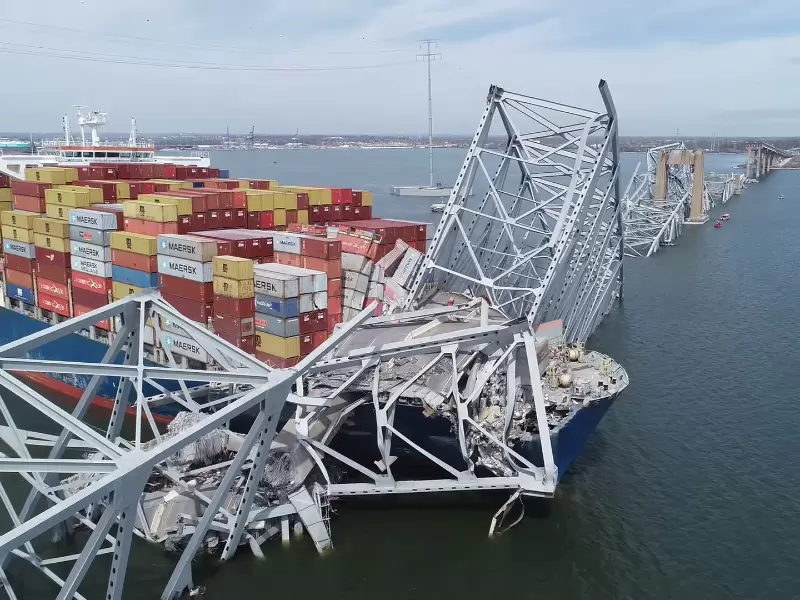 Francis Scott Key Bridge collapse / Wikipedia
An Indian-origin technical superintendent was among three defendants indicted by federal prosecutors over the 2024 collapse of Baltimore’s Francis Scott Key Bridge, which killed six construction workers and caused more than $5 billion in economic damage.
The indictment, unsealed in Maryland federal court, charged Radhakrishnan Karthik Nair, 47, an Indian national, along with Singapore-based Synergy Marine Pte Ltd and Chennai-based Synergy Maritime Pte Ltd, in connection with the crash of the container vessel M/V Dali.
Also Read: Indian-origin man convicted in London attack
Federal prosecutors said Nair worked for both companies as the technical superintendent for the Dali, a 900-foot Singapore-flagged cargo vessel that crashed into the bridge while departing the Port of Baltimore on March 26, 2024.
The defendants were charged with conspiracy to defraud the United States, willfully failing to immediately inform the U.S. Coast Guard of a known hazardous condition, obstruction of an agency proceeding, and making false statements.
The two Synergy companies were also charged with misdemeanor violations of the Clean Water Act, Oil Pollution Act, and Refuse Act for allegedly discharging pollutants, including oil, shipping containers, and bridge debris, into the Patapsco River following the collapse.
According to the indictment, the Dali lost power twice within four minutes as it navigated out of Baltimore Harbor before striking the bridge. Prosecutors alleged that a loose wire in a high-voltage switchboard likely caused the first blackout.
The indictment further alleged that the defendants altered the ship’s systems and relied on a flushing pump to supply fuel to two of the vessel’s four generators, despite the pump not being designed to automatically restart after a blackout. Prosecutors said the generators could not operate without a fuel supply, leading to a second blackout before the collision.
Authorities alleged that if the Dali had used the proper fuel supply pumps, the vessel “would have regained power in time to safely navigate under the Key Bridge.”
Nair and the companies were also accused of obstructing the National Transportation Safety Board’s investigation into the disaster. Prosecutors alleged Nair falsely stated that he did not know the flushing pump was being used to provide fuel to two generators aboard the vessel.
“The collapse of the Francis Scott Key Bridge was a preventable tragedy of enormous consequence,” Acting Attorney General Todd Blanche said in a statement announcing the charges. “Six construction workers lost their lives, critical infrastructure was destroyed, pollutants were released into the Patapsco River and Chesapeake Bay, and the economic damage now exceeds five billion dollars.”
If convicted, Nair faces up to five years in prison for conspiracy charges, six years for each Ports and Waterways Safety Act violation, 10 years for each count related to misconduct or neglect of ship officers, and additional penalties for obstruction and false statements. The companies could face probation and significant fines.
An indictment is not a finding of guilt, and the defendants are presumed innocent unless proven guilty in court
Discover more at New India Abroad.
Leave A Comment
Related











ADVERTISEMENT

ADVERTISEMENT
E Paper
Video

Comments
Start the conversation
Become a member of New India Abroad to start commenting.
Sign Up Now
Already have an account? Login