ADVERTISEMENT
ADVERTISEMENT



Desi community unhappy over chances of fewer Indian Americans in U.S. Congress
While the U.S. Congress is the top of the pyramid in electoral politics, the number of Indian Americans in Congress is only one measure of the community’s political progress
-
1747754650.png) Ishani Duttagupta
Ishani Duttagupta - Thu, 13, Aug 2026
- 05:09 EDT
- 32
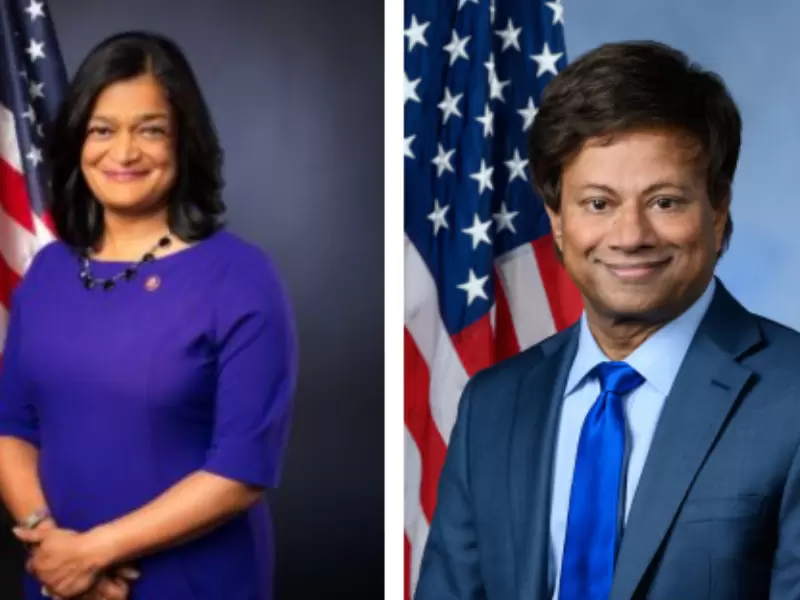 Pramila Jayapal and Shri Thanedar / File Photo
There is disappointment among the Indian American community after Democratic Congressman Shri Thanedar, who has served as the incumbent since January 2023, lost the primary election on Aug. 4 in Michigan’s 13th Congressional District.
Earlier this year, Congressman Raja Krishnamoorthi — who had won every general election for Illinois' 8th Congressional District since 2016 — lost his Democratic primary bid for the U.S. Senate. As a result, the informal “Samosa Caucus” in the U.S. House of Representatives — a term coined by Krishnamoorthi to describe Indian American lawmakers — could shrink from seven members to five.
While a smaller presence in Congress is a setback for many, community leaders see reason for long-term optimism. “While it is indeed disappointing that our community’s representation in the U.S. Congress is shrinking, we are waiting to see what the November election brings,” says Sanjeev Joshipura, executive director, Indiaspora, a nonprofit organization comprising global Indian leaders across diverse sectors.
Still, he remains optimistic about the future. “At the school board, district, county and state levels, political participation among our community is demonstrably increasing. Five, 10 or 20 years from now, some of these individuals could potentially become members of Congress, senators or governors,” he adds, emphasizing that progress is rarely linear and requires sustained effort for the long haul.
The good news is that in Washington state, Democratic Congresswoman Pramila Jayapal advanced to the November general election in the 7th Congressional District, which she has represented since 2017. Joining Jayapal on the ballot is Republican challenger Nirav Sheth, a fellow Indian American who immigrated from Gujarat and served in the U.S. Marine Corps.
In California, Democratic Congressmen Ro Khanna, who represents the 17th Congressional District, and Dr. Ami Bera, who represents the 6th Congressional District, are both on the general election ballot for Nov. 3. Representative Bera has served in the U.S. House of Representatives since 2013, while Representative Khanna has served since 2017. Khanna will face Republican Ritesh Tandon, another Indian American candidate, in November.
Additionally, Democratic Congressman Suhas Subramanyam, who has represented Virginia’s 10th Congressional District since 2025, is also seeking re-election in the upcoming midterm elections. Indian American physician and former member of the Arizona House of Representatives Amish Shah is running for election to the U.S. House to represent Arizona’s 1st Congressional District, having advanced from the Democratic primary in July.
Despite disappointment over the likelihood of a reduced number of Indian Americans in Congress heading into 2027, political analysts do not see this as part of a broader anti-Indian trend.
“We should not read too much into the defeats of Thanedar and Krishnamoorthi. They occurred under very different political circumstances,” explains Robinder Sachdev, president of Delhi-based think tank Imagindia Institute. “Thanedar represented a predominantly Black constituency in Detroit and lost to Donavan McKinney, a locally rooted African American candidate whose campaign focused heavily on restoring Black representation to the city. Krishnamoorthi, on the other hand, gave up a relatively safe House seat to run in a far more competitive statewide Senate primary, where he lost to Illinois Lieutenant Governor Juliana Stratton.”
Sachdev adds that the Indian American electorate is simply undergoing a broader stress test as it becomes further integrated into American politics. “Indian American voters are becoming less politically monolithic and predictable,” he notes. “National debates around immigration, race, religion, education and identity are forcing both voters and aspiring political leaders within the community to define more clearly where they stand.”
Former Seattle City Council member and labor rights activist Kshama Sawant (Independent), too, has lost out in the primary for U.S. House of Representatives (Washington District 9), while nonprofit founder Purnima Nath lost the Republican primary to represent Wisconsin’s 4th Congressional District. Indian American physician Dr. Tina Shah, who had announced her campaign for New Jersey’s 7th Congressional District in July 2025, too, lost out in the Democratic primary in June.
While the U.S. Congress is the top of the pyramid in electoral politics, the number of Indian Americans in Congress is only one measure of the community’s political progress. “At other levels, Indian American participation continues to grow. More are entering state legislatures, mayoral and city-council positions, school boards, local administrations, political parties and the federal executive branch,” feels Sachdev.
He adds that Indian American candidates are increasingly being judged on their record, ideology and connection with local voters, rather than simply as representatives of an ethnic community. “They will win some elections and lose others. That does not mean the momentum is fading. It means the community is becoming part of the normal political life of America. As more children of Indian immigrants enter public life, this participation will continue to grow.”
While the Indian American community is still largely seen to be Democratic, that support is no longer automatic, feel analysts. The Democratic advantage narrowed in 2024 as alignment with independent candidates grew, though there has been no major shift toward the Republican Party.
“The Indian American community is not monolithic in its political outlook, nor should it be,” says Joshipura of Indiaspora. “There are some issues that our community, generally speaking, cares deeply about. Unsurprisingly, a survey by the Carnegie Endowment for International Peace found that these are the usual kitchen-table issues: jobs, prices, health care and immigration.”
As the community becomes increasingly diverse across generations, religions, professions and ideologies, it rarely behaves as a single political bloc. Still, concerns over racial or religious discrimination, anti-Indian hostility, equal opportunity and fair treatment continue to resonate across demographics.
“The rise of white-nationalist and openly anti-Indian rhetoric has made this shared concern more visible,” notes political analyst Sachdev. “Immigration and U.S.-India relations may carry greater emotional weight for first-generation immigrants, whereas American-born Indian Americans are generally more influenced by domestic issues such as the cost of living, jobs, reproductive rights, education, public safety and broader cultural debates. Anti-Indian hostility may bring the community together in certain moments, but it will not erase its political differences.”
Community-based organizations, too, are seen to have become more visible in supporting Indian American candidates in the midterm polls. “Community organizations need to develop stronger political muscles, financially and operationally. Forming effective political action committees (PACs), grassroots organizations and perhaps policy think tanks is the order of the day. On the Democratic side, there are a few organizations like Impact, AAPI Victory Fund and South Asians for America that are moving the needle. It would help our community if similarly effective organizations were to be built on the Republican side,” Joshipura feels.
Discover more at New India Abroad.
Leave A Comment
Related


ADVERTISEMENT

ADVERTISEMENT
E Paper
Video

Comments
Start the conversation
Become a member of New India Abroad to start commenting.
Sign Up Now
Already have an account? Login