ADVERTISEMENT
ADVERTISEMENT



Palaces, tigers and temples: Journey through India’s living past
From Gwalior’s palaces to Varanasi’s sacred ghats, a journey through India’s heartland fuses royal heritage, wilderness, and spirituality.
-
 Ram Kelkar
 - Sat, 21, Feb 2026
- 10:01 EST
- 134
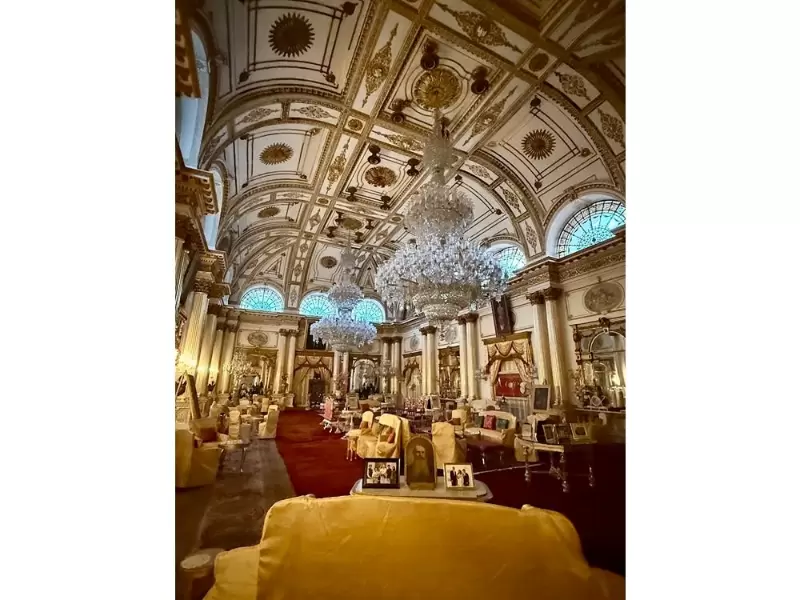 Darbar Hall at the Jai Vilas Palace, Gwalior / Courtesy: Ram Kelkar
Between the opulent palaces and formidable forts of Gwalior, the temples of Khajuraho, the jungles of Bandhavgarh where the Royal Bengal Tiger reigns, and the Eternal City that promises salvation, a journey through India’s heartland rivals a Grand Tour of Europe or even the Golden Triangle of Delhi, Agra, and Jaipur.
Our journey began in Gwalior, dominated by a hill fort so formidable that Mughal Emperor Babur called it the “pearl amongst the fortresses of Hind.” Within its walls stands the 9th-century Chaturbhuj Temple, dedicated to Lord Vishnu and housing the world’s oldest known inscription of the number zero.
The Jai Vilas Palace, built in 1874 by Maharaja Jayajirao Scindia, is a stunning architectural hybrid—Tuscan, Italian-Doric, and Corinthian influences layered over an unmistakably Indian soul. Its Durbar Hall features two of the heaviest chandeliers in the world, so massive that elephants were once used to test the roof before they were hung.
ALSO READ: Somnath: India’s timeless temple of courage and devotion
A traditional taat paat bhojan hall where guests sit on the floor exists alongside a Western banquet room, complete with a solid silver model train serving liquor and dry fruits. We stayed at the Usha Kiran Palace, a regal sanctuary reflecting the enduring grace of the Scindia dynasty.
Leaving Gwalior, we crossed into Uttar Pradesh toward Jhansi on NH-44, India’s longest highway, stretching nearly 4,000 kilometers from Srinagar to Kanyakumari. Jhansi evokes the memory of Rani Lakshmibai, heroine of the 1857 uprising, whom British General Hugh Rose called “the most dangerous of all Indian leaders.” Nearby Orchha feels frozen in time, with its riverside chhatris and the Ram Raja Temple—India’s only temple where Lord Ram is worshipped as a king.
Khajuraho followed, where the scale of the temple complex rivals Angkor Wat and is far better preserved. Built by the Chandela dynasty between 950 and 1050 AD, its carvings are a dizzying celebration of life, portraying gods, mythic creatures, and the divine union of masculine and feminine.
From stone to wilderness, we entered Bandhavgarh National Park. After several bone-jarring safaris with no sightings, we finally encountered the Royal Bengal Tiger. Watching it emerge from the greenery just a few feet from our open vehicle was awe-inspiring in the moment—and petrifying in hindsight.
We then arrived in Prayagraj during the Magh Mela of 2026. With over 120 million devotees descending upon the city, traffic ground to a halt; the only way to get around was by motorcycle taxi—Uber Moto, it turns out, is very real.
We stayed at the 400-year-old Badi Kothi, a haveli that has hosted figures as varied as Saint Mirabai, Prime Minister Lal Bahadur Shastri, and Rabindranath Tagore. Watching devotees bathe at the Triveni Sangam—the confluence of the Ganga, Yamuna, and mythical Saraswati—was memorable.
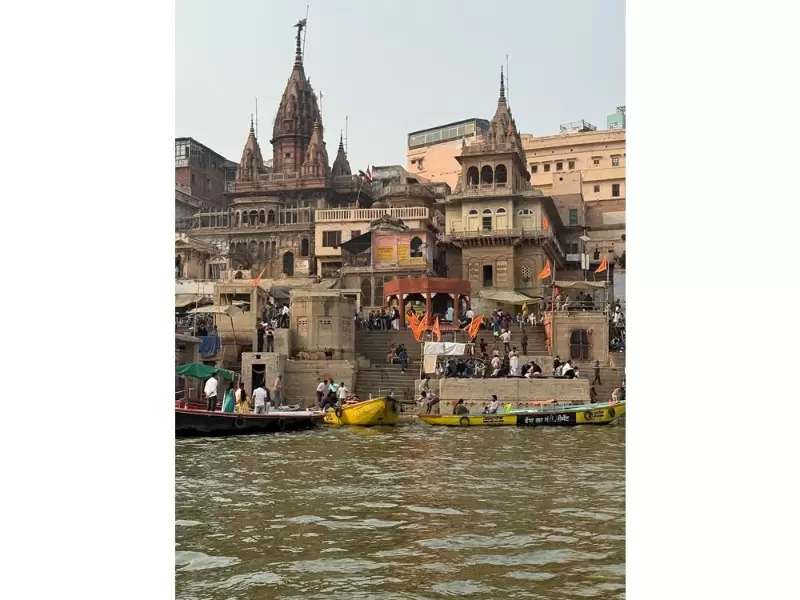 The Manikarnika Ghat at Kashi, Uttar Pradesh / Courtesy: Ram Kelkar
The journey culminated in Varanasi, the Eternal City, where we stayed at Brijrama Palace, built in 1812 by the Maharaja of Darbhanga. One of the world’s oldest continuously inhabited cities, Varanasi embodies India’s contradictions: life and death, divinity and commerce, and the sacred and the profane.
Manikarnika Ghat, where funeral pyres burn beside ghats alive with prayer and celebration, is not for the faint-hearted. Despite modernization efforts—the reconstructed Namo Ghat and the Kashi Vishwanath Corridor—Kashi remains fundamentally unchanged. The pre-dawn Mangala Arti at the Kashi Vishwanath Temple, marking the waking of Lord Shiva, is an unforgettable spiritual experience.
Sailing past Manikarnika Ghat reminded me of crossing the Hudson after 9/11, when the smoldering ruins of the World Trade Center felt like a vast funeral pyre.
And yet life goes on, as happened after 9/11 and happens every day in Kashi!
Discover more at New India Abroad.
Leave A Comment
Related










ADVERTISEMENT

ADVERTISEMENT
E Paper
Video

Comments
Start the conversation
Become a member of New India Abroad to start commenting.
Sign Up Now
Already have an account? Login