ADVERTISEMENT
ADVERTISEMENT


UN opens Secretary-General selection to public scrutiny with candidate dialogues
The latest round of discussions, held over two days and concluding April 22, featured key contenders Rebeca Grynspan and Macky Sall
-
1764791215.jpg) Mohammed Jaffer
Mohammed Jaffer - Sat, 25, Apr 2026
- 17:16 EDT
- 89
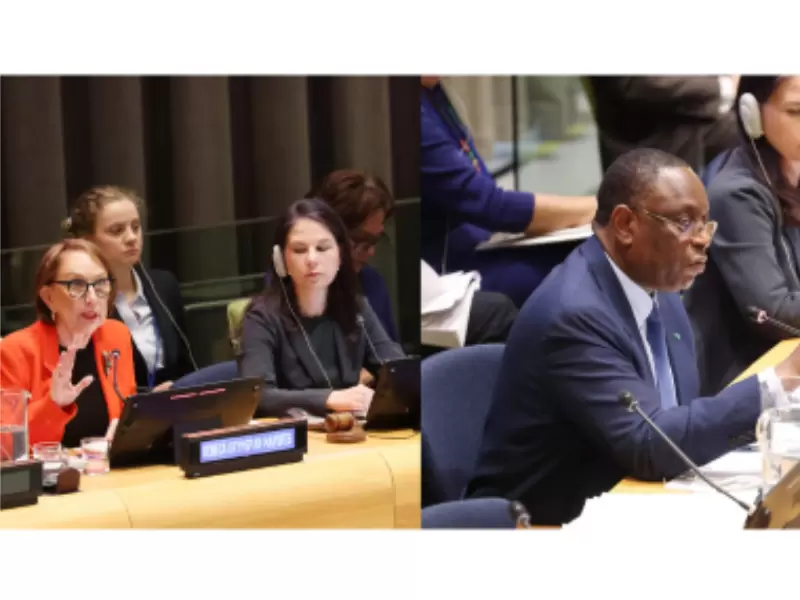 Rebeca Grynspan Current head of United Nations Conference on Trade and Development (UNCTAD) and Former Vice President of Costa Rica and (R) Former President of Senegal (2012–2024) Former Chair of the African Union / Mohammed Jaffer / SnapsIndia
The United Nations has entered a critical phase in its leadership transition process, as informal interactive dialogues hosted by Annalena Baerbock brought leading candidates for Secretary-General before member states and civil society. Convened under the auspices of the United Nations General Assembly, these sessions represent a growing effort to inject transparency, inclusivity, and accountability into a selection process that has historically been conducted behind closed doors.
The latest round of discussions, held over two days and concluding on April 22, offered a substantive examination of the visions and leadership approaches of two prominent contenders: Rebeca Grynspan and Macky Sall.
Also Read: UN debuts public forums for secretary general race transparency
The format of the dialogues was deliberately rigorous. Each candidate participated in extended question-and-answer sessions, fielding inquiries from a wide spectrum of stakeholders, including diplomats representing member states and voices from civil society. This structure was designed to test not only the candidates’ policy positions but also their ability to respond under pressure, articulate coherent strategies, and demonstrate diplomatic acumen. Baerbock emphasized that these dialogues are part of a broader reform effort aimed at strengthening trust in the selection of the next leader of the United Nations.
Grynspan, currently serving as Secretary-General of the United Nations Conference on Trade and Development, presented herself as a seasoned multilateralist with deep institutional knowledge and a track record of navigating complex global challenges. A former vice president of Costa Rica, she temporarily stepped aside from her UN role in line with expectations of impartiality during the campaign.
Her remarks during the dialogue reflected both urgency and conviction, as she warned of a deteriorating international order marked by increasing violations of international law, protracted conflicts, and a perceived erosion of the UN’s relevance.
Central to Grynspan’s message was the need to restore trust in multilateral institutions. She argued that the UN must reposition itself as an effective and credible actor capable of addressing the world’s most pressing crises. Drawing on her personal history as the child of refugees displaced by World War II, she underscored the human cost of geopolitical instability and the moral imperative of collective action. Her professional experience, including her role in facilitating the 2022 Black Sea Grain Initiative, was cited as evidence of her ability to broker agreements even in highly polarized environments.
Grynspan outlined a series of concrete reform proposals. Among her top priorities is the restructuring of the Secretary-General’s executive office to improve coordination and strategic coherence. She highlighted the need to better integrate the work of political and peacekeeping departments, which she argued currently operate in silos. Additionally, she proposed a comprehensive review of the UN’s network of special envoys and representatives to enhance their effectiveness and ensure alignment with organizational priorities.
On financial matters, Grynspan emphasized the importance of protecting development and humanitarian funding, particularly for the world’s most vulnerable countries. She cautioned against reforms that would disproportionately impact least-developed nations and stressed the importance of maintaining impartiality in aid delivery. Her approach to peacekeeping reform includes advocating for clearer mandates and stronger integration of human rights considerations into operational frameworks.
Another key pillar of her platform is improving the UN’s communication strategy. Grynspan called for a cultural shift in how the organization engages with global audiences, emphasizing transparency, accessibility, and multilingual outreach. She argued that rebuilding public trust—especially among younger generations—requires not only effective action but also clear and inclusive communication.
Grynspan also addressed the longstanding issue of implementation gaps within the UN system. She noted that the organization’s credibility is often undermined by its inability to follow through on adopted resolutions. To address this, she proposed the development of alternative metrics, such as vulnerability indices, to guide resource allocation and ensure that assistance reaches those most in need. Her overarching vision is that of a “delivery-focused” Secretary-General—one who prioritizes tangible results over rhetoric.
In contrast, Sall approached the dialogue from the perspective of a national leader and regional statesman. Having served as President of Senegal from 2012 to 2024 and as Chair of the African Union, he emphasized his experience in governance, reform implementation, and consensus-building. Despite encountering challenges in securing formal endorsement from the African Union, Sall positioned himself as a pragmatic leader capable of bridging divides within the international system.
Sall’s proposals centered on institutional efficiency and financial discipline. He argued that the UN must first demonstrate internal accountability and streamline its operations before seeking increased financial contributions from member states. This includes reducing duplication across the organization’s numerous agencies, funds, and programs, and ensuring that expenditures align with clearly defined priorities.
A distinctive element of Sall’s platform is his commitment to leadership diversity. He pledged to appoint a woman from the Global North as Deputy Secretary-General, signaling an effort to balance geographic representation and gender equity within the organization’s senior leadership. He also addressed the issue of accountability among powerful member states, stating that he would not hesitate to publicly call out violations of international law, including by permanent members of the Security Council, while maintaining a commitment to diplomatic engagement.
Sall placed significant emphasis on strengthening partnerships with regional organizations, particularly in the realm of peacekeeping. He argued that the UN should support and empower regional initiatives, such as those led by the African Union, rather than maintain a centralized monopoly on peace operations. His approach reflects a broader vision of shared responsibility and decentralized problem-solving within the international system.
In addition, Sall highlighted the potential of emerging technologies to enhance the UN’s effectiveness. He proposed leveraging artificial intelligence to expand the organization’s linguistic capabilities, enabling it to communicate more effectively across diverse populations. This, he argued, would not only improve operational efficiency but also contribute to greater inclusivity.
Both candidates acknowledged the profound challenges facing the UN, including escalating conflicts, climate change, economic inequality, and rapid technological transformation. Their presentations revealed differing but complementary approaches to reform—Grynspan emphasizing institutional coherence and delivery, and Sall focusing on efficiency, accountability, and partnership.
The dialogues also underscored the broader geopolitical dynamics that will shape the final selection. While the General Assembly plays an important role in facilitating discussion and promoting transparency, the ultimate decision will rest heavily with the five permanent members of the Security Council: the United Kingdom, China, France, Russia, and the United States. Their influence will be decisive in determining who succeeds António Guterres when his term concludes.
As the selection process moves forward, additional candidates may enter the race, potentially reshaping the competitive landscape. Nevertheless, the interactive dialogues have already marked a significant step toward a more open and participatory process. By providing a मंच for candidates to articulate their visions and engage directly with stakeholders, the United Nations is taking meaningful steps to strengthen the legitimacy of its leadership selection at a time when global cooperation is more essential than ever.
Discover more at New India Abroad.
Leave A Comment
Related



ADVERTISEMENT

ADVERTISEMENT
E Paper
Video

Comments
Start the conversation
Become a member of New India Abroad to start commenting.
Sign Up Now
Already have an account? Login