ADVERTISEMENT
ADVERTISEMENT



UN debuts public forums for secretary general race transparency
Discussions leaned heavily on U.N. reforms, leadership styles and institutional priorities.
-
1764791215.jpg) Mohammed Jaffer
Mohammed Jaffer - Sat, 25, Apr 2026
- 04:52 EDT
- 87
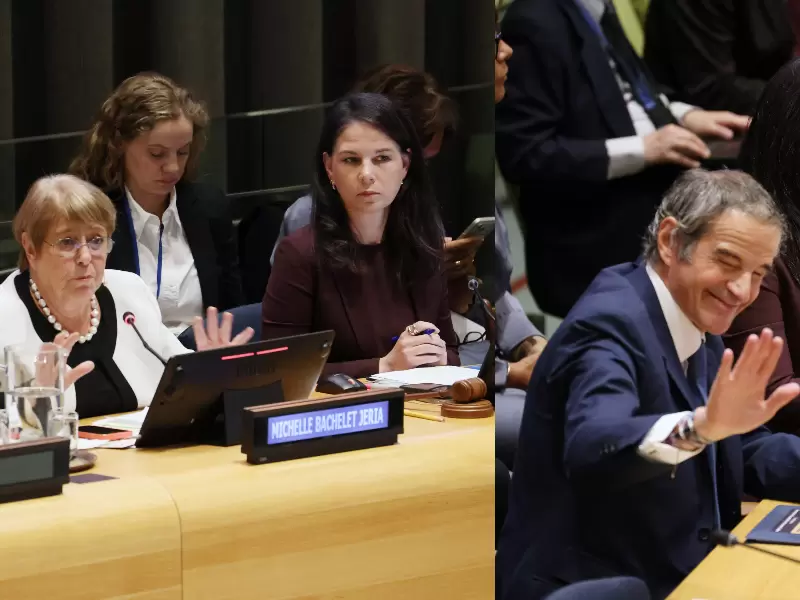 Candidates Michelle Bachelet and Rafael Grossi during the debate for United Nations secretary General / Mohammed Jaffer Snapsindia
The United Nations General Assembly recently held its debut public dialogues for the next secretary-general, starting with candidates Michelle Bachelet and Rafael Grossi.
Over three hours each, the contenders answered questions from member states and civil society in a transparency effort led by General Assembly President Annalena Baerbock. Discussions leaned heavily on U.N. reforms, leadership styles and institutional priorities.
ALSO READ: U.S. Democrats seek probe into visa curbs
Surprisingly, there were few direct references to active conflicts like those in Gaza, Ukraine or Sudan, as diplomats opted to keep the conversation focused on the inner workings of the 80-year-old institution.
Michelle Bachelet, a two-time former president of Chile and a former U.N. high commissioner for human rights, was jointly nominated by Brazil and Mexico. She opened her dialogue by greeting the assembly in the U.N.’s six official languages and shared personal anecdotes, including her goal to improve her French.
Drawing on her father’s suffering under a dictatorship in Chile, she highlighted the vital need for international pressure and global solidarity to uphold the rule of law. She argued that the U.N.’s three pillars of peace and security, development, and human rights are inseparable, warning against any reform that subordinates human rights or development to cost-cutting measures.
In her platform, Bachelet made several key promises. She pledged to make the UN80 reform a nonnegotiable, member-state-driven priority aimed at reducing duplication, improving financial transparency, protecting the development pillar and empowering resident coordinators.
For the Security Council, she committed to using her office to build political viability for better representation, particularly for Africa and other underrepresented regions. Regarding climate change, she vowed to sustain urgency around the global temperature goals, championing grant-based climate finance and supporting the loss and damage fund for vulnerable nations.
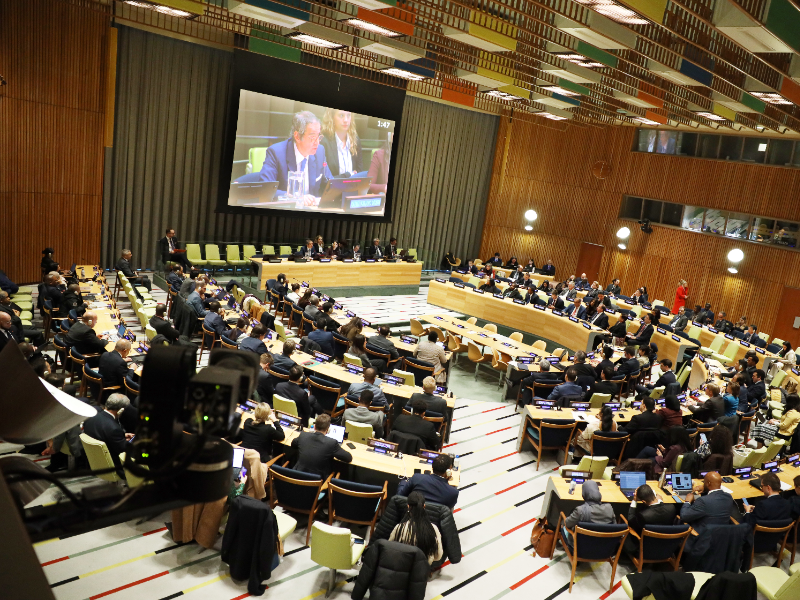 The United Nations General Assembly recently held its debut public dialogues. / Mohammed Jaffer Snapsindia
She also promised to break national monopolies on senior posts, prioritize geographical diversity and gender parity, and treat women’s empowerment as central to peace and development. Finally, she pledged to direct the resident coordinator system to actively include young people at all levels as genuine participants in decision-making and peacebuilding.
Rafael Grossi, a diplomat endorsed by Argentina, currently serves as the director-general of the International Atomic Energy Agency. He leaned heavily into his track record, framing his experience managing a frontline agency during global conflicts as proof he can handle volatile geopolitics.
He cited navigating nuclear chapters in the Middle East and deploying specialists to protect glaciers in Central Asia as examples. Addressing calls for the first-ever female secretary-general, Grossi highlighted his success in achieving gender parity at his agency, noting he increased female representation from 28% to 53% since taking over in 2019.
Grossi also outlined main promises for his potential tenure. He promised to treat UN80 reform as an ongoing road rather than a finished product, pledging an open-door policy and a permanent channel with the Security Council to treat it as a constant partner rather than an emergency-only body.
When pressed on whether he would cave to powerful nations, he promised strict impartiality, vowing to resist political pressure, engage with all parties without taking sides, and reject hierarchies of importance among global conflicts.
He committed to ending conflicting narratives between New York and Washington by cooperating with the World Bank and International Monetary Fund, ensuring that fiscal cuts would not disproportionately impact development mandates in the global South.
Acknowledging that the U.N. struggles to reach younger generations, he promised to overhaul communications by listening first and adapting to the platforms youth actually use. Lastly, he pledged to deepen institutional cooperation between the U.N. and the African Union, calling for more active interaction between the two bodies regarding peacekeeping and conflict response.
Discover more at New India Abroad.
Leave A Comment
Related





ADVERTISEMENT

ADVERTISEMENT
E Paper
Video

Comments
Start the conversation
Become a member of New India Abroad to start commenting.
Sign Up Now
Already have an account? Login