ADVERTISEMENT
ADVERTISEMENT


Trump's regional goals in 'America First' global strategy
The paper voices enthusiasm for growing ties with India, which has been courted by successive US presidents but has seen friction with Trump.
-
 AFP
AFP - Fri, 05, Dec 2025
- 10:18 EST
- 89
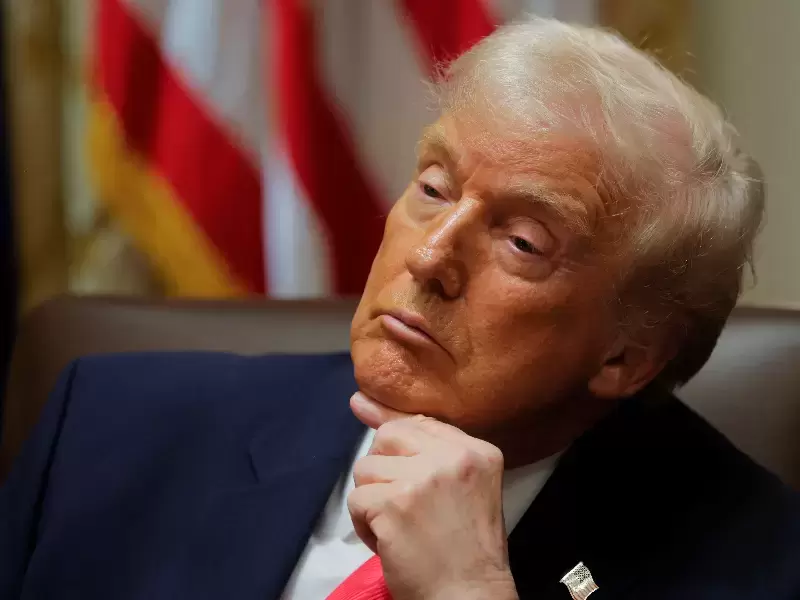 U.S. President Donald Trump attends a cabinet meeting at the White House in Washington, D.C., U.S., December 2, 2025. / REUTERS/Brian Snyder
President Donald Trump's administration released Dec. 5 a long-awaited national security strategy that sharply changes US priorities in line with his "America First" worldview.
Here are some of the key takeaways by continent.
Europe
The strategy reserves harsh language for Europe, backing far-right claims that the continent faces "civilizational erasure" due to migration.
"It is more than plausible that within a few decades at the latest, certain NATO members will become majority non-European," it said, casting nationality in starkly racial terms.
The paper calls for "cultivating resistance" within Europe, in extraordinary language in addressing key allies.
The administration also denounces European "censorship of free speech and suppression of political opposition," an allusion to efforts to constrain far-right voices including those who have railed against migrants.
The paper also vows that there would be no expansion of NATO, the transatlantic alliance in which the United States is the key power, again dashing Ukraine's hopes as it endures a Russian invasion.
Latin America
The strategy describes Trump as reviving the Monroe Doctrine, the 1823 declaration by the United States that Latin America is off-limits to foreign powers.
In what it calls the "Trump Corollary" to the doctrine, it says the United States would seek access to resources and strategic locations in Latin America and ensure that governments are "reasonably stable and well-governed enough to prevent and discourage mass migration to the United States."
Alluding to China, the strategy says the United States "will deny non-Hemispheric competitors the ability to position forces or other threatening capabilities, or to own or control strategically vital assets."
Asia
After decades in which the United States has focused on the rise of China, the strategy describes the Asian power as a competitor but largely focuses on economics.
"We will rebalance America's economic relationship with China, prioritizing reciprocity and fairness to restore American economic independence," it says.
On Taiwan, the self-governing democracy claimed by Beijing, the paper sticks to US calls to maintaining the status quo.
But it calls on Japan and South Korea, treaty-bound US allies, to contribute more to ensure the defense of Taiwan.
The paper voices enthusiasm for growing ties with India, which has been courted by successive US presidents but has seen friction with Trump.
The strategy calls for the United States to encourage New Delhi, historically non-aligned but which has fraught relations with China, "to contribute to Indo-Pacific security."
Middle East and Africa
The Middle East has long dominated US foreign policy, but the paper -- much like those in previous administrations -- calls for less emphasis.
It says that growing energy independence means that the United States will not be as dependent on Gulf oil, and points to the weakening of Iran in US and Israeli attacks.
The strategy says relatively little about Israel, long a top priority for the United States, only saying that it should be "secure."
It says even less about Africa other than calling for a transition away from aid and instead focusing on securing critical resources.
Leave A Comment
Related









ADVERTISEMENT

ADVERTISEMENT
E Paper
Video

Comments
Start the conversation
Become a member of New India Abroad to start commenting.
Sign Up Now
Already have an account? Login