ADVERTISEMENT
ADVERTISEMENT



Trump-backed voting act could hurt women, minorities the most
The White House argues that the SAVE America Act is necessary to combat voter fraud, and prevent non-citizens from voting -- though current US law already forbids that.
-
 AFP
AFP - Sat, 18, Apr 2026
- 23:53 EDT
- 69
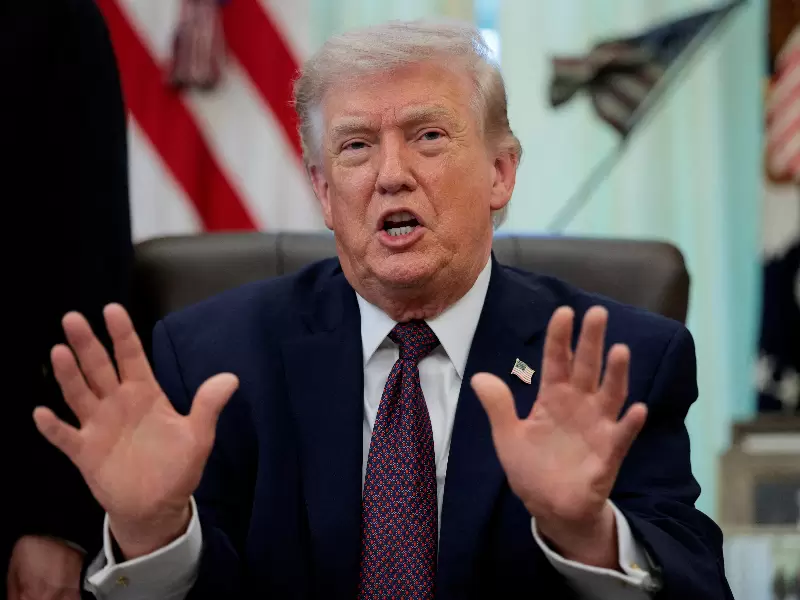 U.S. President Donald Trump speaks during the signing ceremony for an executive order on mail ballots, in the Oval Office of the White House. / REUTERS/Evan Vucci/File Photo
Millions of married women and transgender Americans could find their ability to vote more complicated than ever if the "SAVE America Act" promoted by US President Donald Trump, currently being debated in the Senate, were to pass.
The draft law would require Americans to prove their citizenship when registering to vote in federal elections and present identification materials when casting a ballot, such as a passport, driver's license or birth certificate.
But many women change their names when they get married, meaning the names on their birth certificates no longer match what they currently use -- forcing them to provide additional documentation to justify the discrepancy.
ALSO READ: U.S. political battle over SAVE Act intensifies
The same issue would affect transgender voters, whose documentation may not consistently reflect their current identity.
According to the Brennan Center for Justice, a public policy institute at New York University, "more than 21 million Americans lack ready access to those documents. Roughly half of Americans don't even have a passport."
For Rick Hasen, an expert on election law at the University of California, Los Angeles, "women and transgender people are the ones who are most likely to be affected," along with low-income and working class Americans who do not have passports.
Republicans in the House of Representatives have already passed a version of the Safeguard American Voter Eligibility (SAVE) America Act, but it faces steep obstacles in the Senate, where it appears Democratic opposition will be too strong to overcome.
Name changes
Letitia Harmon, the policy and research director at the grassroots voting activist group Florida Rising, was married and then divorced in Washington state, she told AFP. She changed her name twice.
"So the problem is I don't know which name is in the database records," Harmon said, making it difficult to know which set of documents she would need to take to her polling place.
Harmon said she will likely need to order proof of divorce from Washington state -- a costly and time-consuming process.
The White House argues that the SAVE America Act is necessary to combat voter fraud, and prevent non-citizens from voting -- though current US law already forbids that.
As for the issue of married women, White House Press Secretary Karoline Leavitt said last month: "They just have to go through their state processes to update that documentation."
Voting gender gap
The prospect of millions of women struggling to vote matters because historically, men tend to skew Republican.
According to the Pew Research Center, 52 percent of men surveyed said they identified with or leaned toward the Republican Party in 2024, while only 44 percent of women said the same.
"There has been a trend over the last decade and a half of mostly Republican states passing laws that make it harder to register or to vote, and mostly Democratic states passing laws that make it easier to register," Hasen explained.
As of now, a handful of mainly Republican-led states have asked residents to prove citizenship in order to register to vote in at least some cases, according to Ballotpedia.
In 2014, Harmon was living in Kansas and said she could not vote in primary elections that year because officials demanded to see her birth certificate, not just a valid photo ID.
Four years later, a federal judge declared that state law unconstitutional after more than 30,000 people were unable to register.
Earlier this month, Florida Governor Ron DeSantis signed into law his own version of the SAVE America Act, which will go into effect in January 2027, after the midterm elections.
Harmon said it was senseless to disenfranchise thousands, just to find a handful of cases of fraud.
Indeed, in 2025, two people were charged in Florida over lying about their citizenship in order to cast ballots.
But such cases remain extremely rare.
A Washington Post investigation unearthed 31 "credible incidents" of fraud out of one billion ballots cast from 2010 to 2014.
Discover more at New India Abroad.
Related
.png)

ADVERTISEMENT

ADVERTISEMENT
E Paper
Video

Comments
Start the conversation
Become a member of New India Abroad to start commenting.
Sign Up Now
Already have an account? Login