ADVERTISEMENT
ADVERTISEMENT



Two-Factor Theory of Civilizational Dynamics: Intellect, Coherence & Discovery
A civilization’s comprehensive trajectory can be ascribed to the interplay of two primary factors: Intellect and Emotional Excellence (or internal coherence).
-
 Pradeep B. Deshpande
 - Fri, 22, May 2026
- 11:55 EDT
- 44
 Representative Image / Generated using AI
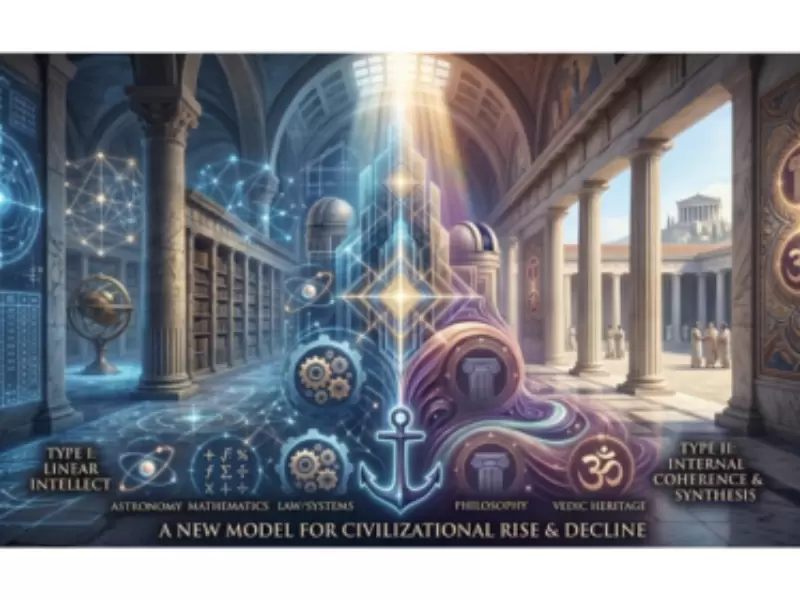
The rise, stagnation, and collapse of human civilizations have long puzzled historians, sociologists, and systems thinkers. Traditional historical models—such as Arnold Toynbee’s theory of “challenge and response” or Oswald Spengler’s biological lifecycle of cultures—describe the symptoms of civilizational shifts but frequently fail to isolate the underlying variables. To understand why societies achieve extraordinary heights of innovation and subsequently fracture into irrelevance, we must look to a deeper, internal architecture.
A civilization’s comprehensive trajectory can be ascribed to the interplay of two primary factors: Intellect and Emotional Excellence (or internal coherence). While pure intellect drives linear, material progress necessary for societal infrastructure, it is only when intellect is synthesized with high levels of internal emotional excellence that a civilization unlocks its ultimate creative and philosophical potential.
Taxonomy of Discovery: Type I vs. Type II
To understand the mechanics of civilizational achievements, we must define the two distinct outputs generated by human consciousness:
Type I Discoveries The Domain of Pure Intellect
Driven by linear, logical reasoning, empirical observation, and external analysis. Intellect alone is capable of cataloging the physical world, creating transactional efficiencies, building legal frameworks, and developing tools. It is outward-facing and metrics-driven—the engine of external excellence. A society rich in Type I capacity can amass immense material wealth, achieve complex engineering feats, and create formidable organizational structures.
However, pure intellect lacks an intrinsic moral compass or a mechanism for long-term equilibrium; without a stabilizing counterweight, it eventually succumbs to fragmentation, hubris, and short-termism.
Type II Discoveries The Synthesis of Intellect and Coherence
The transcendent, non-linear breakthroughs that redefine human consciousness, ethics, and cosmic understanding. These achievements require intellect, but they cannot be realized without Emotional Excellence—scientifically understood as a state of high internal coherence, low mental fluctuation, and emotional alignment. When individual and collective minds achieve this state of stillness, they gain access to deep intuition and universal truths that logic alone cannot deduce.
Type II discoveries do not merely exploit the material world; they harmonize human life with cosmic and natural laws, providing the long-term philosophical scaffolding required to sustain a civilization over millennia.
Historical Validations: The Vedic and Classical Eras
The two-factor model finds its most robust empirical validation in the twin peaks of ancient human thought: Vedic India and Classical Greece.
The Vedic Synthesis of Ancient India
The profound contributions of India during the Vedic period provide the premier historical example of a Type II environment. The ancient rishis (seers) were not merely passive meditators; they possessed exceptionally sharp, rigorous intellects. They mapped grammar, mathematics, and astronomy with flawless logic.
However, their unique genius lay in their simultaneous mastery of internal coherence. By cultivating absolute emotional and mental stillness, they synthesized Type I observation with Type II metaphysical realizations, culminating in the Vedas and Upanishads—texts that treat external cosmology and internal consciousness as a unified whole.
“When these two factors were at high levels, Indian civilization flourished as a global beacon of wealth and wisdom. Conversely, subsequent centuries of foreign subjugation and internal stagnation correspond directly to a period where both factors bottomed out.”
The Athenian Resonance and the Modern Gap
A parallel trajectory occurred in Classical Greece. In the Golden Age of Athens, intellectual vigor was inextricably linked to philosophical and emotional cultivation. For the school of Socrates, Plato, and Aristotle, philosophy was not an abstract academic exercise; it was a living practice aimed at achieving harmony of the soul and alignment with the “Ideal Good.” The city square of Athens was a high-density zone of internal coherence and raw intellectual power, yielding timeless breakthroughs in ethics, geometry, aesthetics, and political theory.
Yet, a walk through that same geographic space today reveals a stark reality. While modern humans possess identical genetic intellectual capacity, the specific coherence density that characterized ancient Athens has vanished. When the emotional excellence of Greek civilization fractured into political infighting and moral decay, the Type II environment collapsed. The physical space remains, but the unique synthesis of mind and soul that birthed Western philosophy is absent.
The Modern Cycle: The Dynamics of Rebirth
The two-factor model is not merely a retrospective tool; it is highly predictive. Civilizations are not static; they undergo deep transformations over thousands of years as these two variables fluctuate.
Currently, we are witnessing this dynamic play out in the shifting global landscape, most notably in the contemporary resurgence of India. The current rising phase of Indian civilization can be traced directly to the synchronized ascendancy of both factors. The nation is rapidly scaling its Type I intellectual and technological infrastructure, while simultaneously reclaiming and exporting its historical heritage of internal systems-thinking, mindfulness, and consciousness-based practices.
|
Phase / Era |
Intellect (Type I) |
Emotional Excellence |
Result |
|
Vedic / Golden Age |
High |
High |
Type II Breakthroughs |
|
Decline & Decay |
Low |
Low |
Stagnation & Collapse |
|
Renaissance / Rebirth |
Ascending |
Ascending |
Civilizational Rebirth |
For a renaissance to be sustainable, a rising power cannot rely on intellect alone. If a nation builds economic and technological might (Type I) without a corresponding anchoring in internal emotional excellence (Type II), it creates a volatile, high-stress society prone to internal friction and eventual decay. True civilizational longevity requires a balanced architecture where technological precision is guided by internal human flourishing.
Conclusion
The achievements of human civilization cannot be mapped on a single axis of intelligence. By separating progress into the distinct domains of Type I and Type II discoveries, the two-factor theory provides a clear blueprint for the future of societal design. It reminds us that the ultimate metric of a civilization’s health is not merely its gross domestic product or its technological output, but its internal coherence.
To prevent the cyclical declines that have claimed the great empires of the past, modern leadership must look inward—fostering a framework where external intellectual mastery is perpetually balanced by internal emotional excellence.
External Mastery + Internal Excellence = Civilizational Longevity
The author is Professor Emeritus and former Chairman of the Chemical Engineering Department at the University of Louisville. He is also president of Six Sigma and Advanced Controls based in Louisville, Kentucky.
(The views and opinions expressed in this article are those of the author and do not necessarily reflect the official policy or position of New India Abroad.)
Discover more at New India Abroad.
Related






.JPG)


ADVERTISEMENT

ADVERTISEMENT
E Paper
Video

Comments
Start the conversation
Become a member of New India Abroad to start commenting.
Sign Up Now
Already have an account? Login