ADVERTISEMENT
ADVERTISEMENT



Tuning your engine
How Smartwatches and Quiet Minds Can Supercharge Your Life
-
 Pradeep B. Deshpande
 - Wed, 24, Jun 2026
- 19:06 EDT
- 28
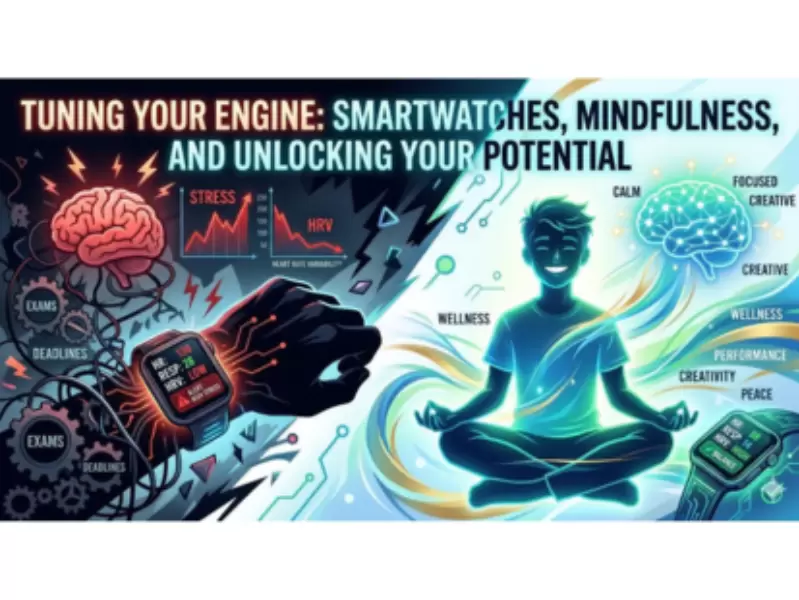 Representative Image / Generated using AI
Imagine driving a high-performance sports car. If you keep the engine redlining at maximum speed for days without a break, what happens? It overheats, the parts wear out, and eventually, it breaks down. Our bodies and minds work the same way.
In today's fast-paced world, many of us are constantly “redlining” due to stress. Whether it's hitting a wall of upcoming exams, juggling sports and clubs, or just managing everyday life, stress can sneak up on us and take a massive toll.
The Hidden Cost of “Redlining”
Stress isn't just an annoying feeling; it actually carries a massive price tag for our health and happiness.
-
The Big Picture: Global polling organizations like Gallup have found that stress levels worldwide are hitting record highs, affecting how millions of people work, learn, and live.
-
The Health Impact: Doctors and researchers estimate that a staggering 60% of all human ailments and illnesses are directly tied to high levels of stress.
When you stay stressed for too long, your body spends all its energy on survival mode, leaving very little fuel for things like immune defense, clear thinking, or deep sleep.
Your Wrist Has the Data
The cool thing about living in the digital age is that most of us already carry a miniature health laboratory right on our wrists. Millions of people own smartwatches like Garmin Venu SQ2, Apple, etc., and fitness trackers. While we might use them to count steps or check texts, these devices are actually powerful windows into our nervous systems.
A standard wearable device can track three crucial internal metrics:
-
Heart Rate: How fast your heart is beating.
-
Respiration Rate: How many breaths you take per minute.
-
Heart Rate Variability (HRV): This is the secret weapon metric. HRV measures the tiny, millisecond changes in time between each heartbeat. When you are calm and balanced, your HRV is typically higher and more resilient. When you are stressed, your HRV drops, signaling that your body is stuck in “fight or flight” mode.
By simply looking at your watch, you can get a real-time report card on how stressed your body actually is—even if your mind hasn't consciously realized it yet.
The Ultimate Reset Button: Contemplative Practices
Once your watch alerts you that your stress levels are climbing, what can you do about it? You don't just have to sit there and take it. You can actively lower your stress using simple, secular contemplative practices like coherent breathing, mindfulness and meditation.
Mindfulness isn't anything mystical or complicated. It can be as simple as sitting quietly for 10 minutes or so, closing your eyes, and focusing entirely on the sensation of your breath moving in and out without judgement. If your mind wanders off, gently bring it back to your breath.
And in coherent breathing, sit comfortably, close your eyes and slow down your breathing to about 6 breaths a minute (one inhalation and one exhalation is counted as 1 breath). Continue this for ten minutes.
Through these you practices, you actively shift your nervous system out of “panic mode” and back into balance. It acts as an immediate brake on that overheating engine.
The Calibration Phase: Optimizing Your Human Engine
In the industrial world, we never run equipment without first ensuring it is calibrated and operating within its defined control limits. Yet, we frequently start our day without any assessment of our internal system status. The "Calibration Phase" is a brief, data-driven ritual designed to align your physiology with the requirements of your work.
By utilizing the Health Snapshot feature on your device to measure your HRV before and after a 10-minute session of coherent breathing (6 cycles per minute), you can track your "System Recovery." When you see your RMSSD (a key HRV metric) improve following the session, you are verifying that your "human engine" has successfully shifted from "system noise" to high-efficiency Internal Coherence. Think of your HRV not as a static number, but as a dynamic variable to be optimized; when your physiological systems are synchronized, your professional output becomes the inevitable result of a finely tuned process.
Why Schools and Organizations Are Stepping Up
Because stress is such a widespread challenge, it's no longer just up to individuals to handle it alone. Forward-thinking high schools, universities, and major companies are beginning to deploy these stress-busting tools for their students and employees.
By introducing short mindfulness breaks or wellness programs, organizations can help entire populations reset their internal engines.
The Payoff: Wellness, Success, and Less Drama
When individuals and schools team up to lower stress, the benefits are immediate and game-changing:
-
Wellness & Health: Your body functions better, your immune system stays strong, and you feel more energized.
-
Peak Performance: A calm brain is a sharp brain. You'll find it easier to focus during tests, remember information, and excel in sports or arts.
-
Unlocking Creativity: Original, creative ideas happen when the mind has space to wander. Stress crowds those insights out; mindfulness lets them shine.
-
Less Discord: When people are less stressed, they are less irritable. This means fewer arguments, better communication, and a much more peaceful community at school and at home.
Your smartwatch can show you the data, but your mind holds the power. By taking just a few minutes a day to practice mindfulness, you can take control of your health, supercharge your performance, and navigate life with a lot more ease. As is prudent with the ideas in this article, do get your physician’s approval before putting them into practice.
The author is Professor Emeritus and former Chairman of the Chemical Engineering Department at the University of Louisville. He is also president of Six Sigma and Advanced Controls based in Louisville, Kentucky.
(The views and opinions expressed in this article are those of the author and do not necessarily reflect the official policy or position of New India Abroad.)
Discover more at New India Abroad.
Related










ADVERTISEMENT

ADVERTISEMENT
E Paper
Video

Comments
Start the conversation
Become a member of New India Abroad to start commenting.
Sign Up Now
Already have an account? Login