ADVERTISEMENT

ADVERTISEMENT



The terrestrial turn: Reviving India’s agrarian landscapes through civilizational logic
In India, this shift is unfolding through a blend of modern scientific approaches and older ecological traditions that treated land as something to be sustained, not exhausted.
-
 Dr. Vinay Nalwa
 - Thu, 05, Feb 2026
- 01:50 EST
- 22
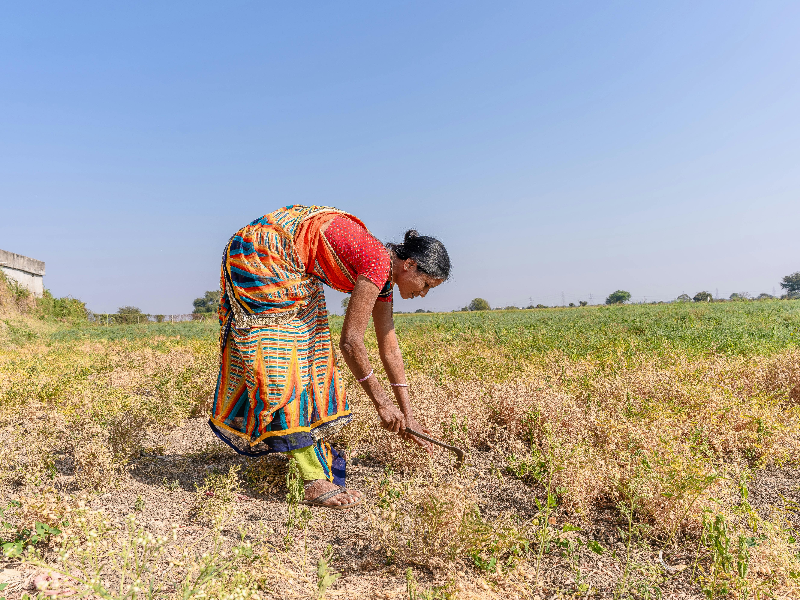 Representative image / Pexels
Global environmental thinking is quietly but decisively shifting. Attention is moving away from abstract climate targets toward something far more immediate—the condition of the land itself.
The World Atlas of Desertification notes that nearly 75 percent of the world’s land is already degraded, affecting 3.2 billion people, and warns that this figure could rise to 90 percent by 2050 if current trends continue. The United Nations Convention to Combat Desertification (UNCCD) echoes this concern, estimating that around 40 percent of the planet’s land has already lost significant ecological function. As these realities become harder to ignore, climate conversations are beginning to move beyond carbon markets to the soil beneath our feet.
In India, this shift is unfolding through a blend of modern scientific approaches and older ecological traditions that treated land as something to be sustained, not exhausted.
The science of "vrikshayurveda": Ancient soil stewardship
In ancient India, soil was not considered "dirt" but "Mrt" the living earth. The care of land was a ritualized science known as Vrikshayurveda (the "Ayurveda of Plants"). Ancient texts like the Krishi-Parashara and Surapala’s Vrikshayurveda detail a sophisticated understanding of biological life that was far ahead of its time:
Kunapajala (The First Bio-fertilizer): Ancient farmers utilized Kunapajala (a fermented liquid manure) made from organic waste and herbal extracts—to "feed the soil, not the crop." This prioritized microbial life long before modern soil biology was codified.
The Silt-Cycle (Kudimaramathu): Under dynasties like the Cholas, de-silting temple tanks was a sacred communal duty. This nutrient-rich silt was returned to the fields, creating a perfect circular economy of minerals that maintained fertility for centuries.
Tree-Linked Watersheds: The Varahamihira’s Brihatsamhita identified specific trees as "groundwater indicators," ensuring that riverbanks were stabilized by deep-rooted indigenous species to prevent the very "river-drying" we witness today.
While contemporary soil-regeneration initiatives such as Save Soil are articulated through modern scientific and policy frameworks, their underlying emphasis on soil vitality, organic inputs, and tree-based land use closely parallels principles articulated in classical Indian agronomic texts such as
Surapala’s Vṛkṣāyurveda, which treated soil as a living foundation of ecological and social stability.
The state as architect:Modern policy revivals
This civilizational logic is not just a matter of history, it is being re-operationalized through the Government of India’s massive digital and agricultural missions. The Soil Health Card (SHC) Scheme, which has issued over 25 crore cards, is effectively a modern, data-driven version of the ancient Mrid-Pariksha (soil testing). By tracking Soil Organic Carbon (SOC), the state has institutionalized the goal of moving India’s soil from a depleted 0.5 percent organic matter back toward a resilient baseline.
ALSO READ: From Malvani to Millets: Inside India’s changing restaurant landscape
Furthermore, the National Agroforestry Policy and the PM-Rashtriya Krishi Vikas Yojana (RKVY) provide the fiscal backbone for a "Viksit Bharat" that is ecologically sound. These schemes provide the "Hardware" the labs, the subsidies, and the saplings necessary to scale ancient wisdom to a population of 1.4 billion.
Civil society as the modern "mobilizer"
In this national ecosystem, civil society organizations act as the "Software" or the "Will" that drives adoption. For instance, the ecological outreach associated with the Isha Foundation notably the Save Soil and Cauvery Calling initiatives functions as a bridge between state policy and grassroots movement.
By utilizing Farmer Producer Organisations (FPOs) the agricultural cooperatives that empower smallholders to implement Tree-Based Farming, these initiatives revive the ancient Vanaspati (polyculture) tradition. This medium allows smallholders to transition from chemical-heavy monocultures to profitable timber-and-fruit systems. The Foundation’s advocacy for a global 3–6 percent organic matter standard directly mirrors the FAO’s scientific targets, proving that civilizational "devotion" to the land can be measured in precise, modern percentages.
The scaling of these hybrids where ancient logic meets modern NGO mobilization naturally invites institutional scrutiny. A significant legal clarification occurred on February 28, 2025, when the Supreme Court of India affirmed the status of such cultural centres as "educational institutions." In its ruling, the Court recognized their foundational role in the mental, moral, and physical development of the citizenry. By underscoring that centres of heritage act as "educational nodes," this judicial clarity ensures that civil society interventions remain firmly integrated within the nation’s regulatory framework, allowing for a stable, law-abiding path toward ecological restoration.
Translating theory to field realities
The transition from ancient logic to modern landscape restoration is best viewed through the lens of recent pilot outcomes. In regions where soil-centric interventions have been deployed such as the outreach efforts in the Cauvery basin, the data serves as an indicative roadmap for decentralized ecology. Reported figures suggest that over 160,000 hectares have been brought under restoration practices, with tree-based agroforestry models adopted by more than 235,000 farmers.
The "medium" for this shift is a localized support infrastructure like a soil diagnostics hub in Coimbatore and a network of Farmer Producer Organisations (FPOs) spanning hundreds of villages in Tamil Nadu and Karnataka. These structures primarily serve small and marginal farmers by providing technical guidance and market-linked institutional support.
While outcomes are best interpreted as a demonstration of the potential for soil-centric interventions rather than as a uniform result across all topographies, the analytical significance is clear.
Conclusion: A hybrid future
India’s response to the climate crisis suggests that the future of sustainability is a hybrid. By leveraging the social capital of spiritual movements to achieve the scientific targets of soil health, India is presenting a unique model of "Civilizational Ecology." In this model, the land is restored because of a revived recognition that the soil is not an asset to be exploited, but the literal basis of human life.
Discover more at New India Abroad.
The writer is an author and columnist
(The views and opinions expressed in this article are those of the author and do not necessarily reflect the official policy or position of New India Abroad.)
Related










ADVERTISEMENT

ADVERTISEMENT
E Paper
Video

Comments
Start the conversation
Become a member of New India Abroad to start commenting.
Sign Up Now
Already have an account? Login