ADVERTISEMENT
ADVERTISEMENT



Recounting the horror of Pahalgam attack: Stories that need to be remembered
The Pahalgam terror attack stands out not just for its sheer scale of killings, but also for calculated method of terrorist operation.
-
1744362597.jpeg) Arun Anand
Arun Anand - Sat, 25, Apr 2026
- 11:16 EDT
- 33
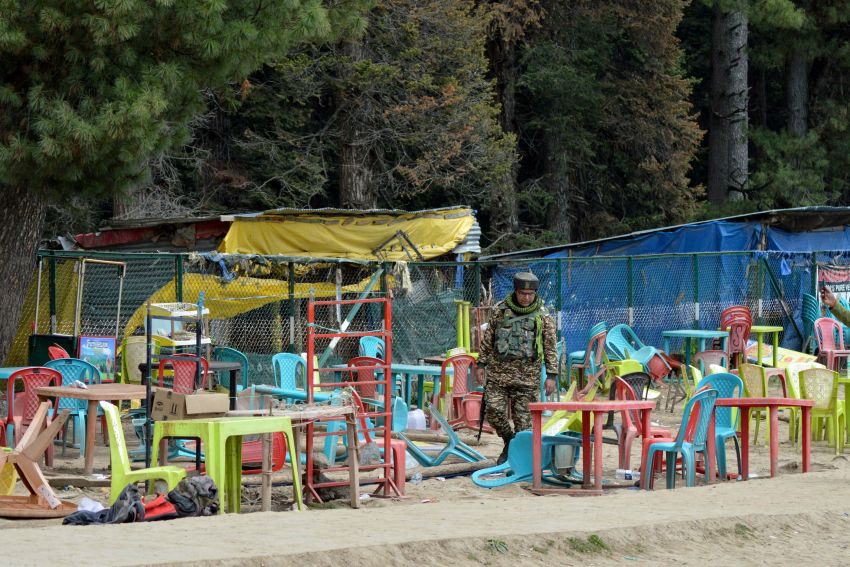 An Indian security force personnel walks amid toppled chairs and tables at the site of a terrorist attack on tourists in Baisaran near Pahalgam in south Kashmir's Anantnag district, April 23, 2025. / REUTERS/Stringer
April 22 marked one year of the horrific and cowardly terror attack by Pakistan terror group Lashkar-e-Taiba (LeT) in Baisaran Valley of Pahalgam in Kashmir that took the lives of 26 civilians.
The devastating cold-blooded attack on innocent civilians, mostly tourists, has been one of the most gruesome attacks India has witnessed in years. The attack once again unmasked Pakistan’s consistent denial of it not harbouring, sheltering and sponsoring anti-India terrorist groups in its soil.
The Pahalgam terror attack, therefore, leaves a deep trail of Pakistan’s state-facilitated behind cross-border terrorism, despite its name being removed from Financial Action Task Force (FATF) Grey List in 2022.
The Pahalgam terror attack stands out not just for its sheer scale of killings, but also for calculated method of terrorist operation. The attackers deliberately targeted unarmed civilians hailing from all over India (and one from Nepal) at a tourist spot and chose its targets through a faith determination test. A deliberate segregation ensued first—separating men from women, Hindus from Muslims.
Also Read: The Human Cost of Terror: Pahalgam, 9/11 attacks feature in US exhibition
Thus, the attack was not indiscriminate as conventionally seen in terrorist attacks. Rather, militants first interrogated victims, asked for their religion, even forced them to recite Islamic kalma to prove if they were Muslims. Some were even forced to remove their trousers (to check if they are circumcised). Those men who failed to recite or those found uncircumcised were then shot point-blank.
The most haunting image is that of a benumbed Himanshi Narwal sitting beside the lifeless body of her husband Lieutenant Vinay Narwal of the Indian Navy etched deep into Indian public consciousness as a visual reminder of the Pahalgam attack. The newlyweds married just six days prior to the ill-fated day in Kashmir had reached there as honeymooners.
Himanshi Narwal recalled how the militants approached them while they were eating bhelpuri, asked Lt. Vinay if he was a Muslim before gunning him down.
Subham Dwivedi, a businessman based in Kanpur was in the valley on a family holiday and was scheduled to return on 23 April. Subham was with his wife when one militant came from behind and asked for their religion, and to recite the first kalma.
Taken aback, Shubham’s wife Eshanaay told them they are Hindus, following which Shubham was shot dead, the first of the Pahalgam victims. A shocked Eshanaay pleaded with the militant to kill her as well. However, she was spared so that she can ‘convey’ the message to PM Modi as a witness.
Shailesh Kalathiya, an SBI employee originally from Gujarat was on a family vacation with his wife and children was shot a day before what would have been his 44th birthday. Shailesh’s wife recalled how the terrorist shot her husband after knowing his Hindu identity and was laughing as Shailesh was bleeding to death in front of his wife and children.
For hair salon owner Yatishbhai Parmar, his wife Kajalben Pramar and their and his 17-year-old teenage son Sumit from Bhavnagar, visiting Pahalgam was part of a brief sight-seeing following their spiritual trip to attend Morari Bapu’s Ram Katja in Srinagar, before their return to Gujarat.
The attackers, donning outfits similar to army uniforms, opened fire at Yatisbhai first, and then killed his son, leaving Kajalben as the only survivor who had to see her husband-son killed.
Retired pharma firm staff 64-year-old Dilip Desale from Mumbai left for Kashmir on 21 April with his wife, choosing Kashmir to enjoy his post-retirement travelling. Desale was killed on the first day of his arrival in the valley while his wife Usha Desale survived unharmed. J. Chandramouli from Visakhapatnam was in Pahalgam on his well-earned retirement holiday.
Eyewitness recalled the 68-year-old attempting to flee before the terrorists chased him down and shot him despite him reportedly pleading for his life, making him the oldest victim of the Pahalgam terror attack.
IAF Officer Corporal Hilyang from Arunachal was another newlywed vacationing with his wife who was asked about his religion and stripped at gunpoint. Hilyang was nearing his transfer out of Kashmir to Dibrugah. On having discovered his IAF identity card, and his non-Muslim religious identity, Hilyang was shot dead. IB officer Manish Ranjan was in Kashmir on a government leave travel concession trip with his wife and two children when he was killed.
Shushil Nathaniel from Indore, an LIC regional manager, had come to Pahalgam on vacation with his wife and two children. Before the attack, Nathaniel was demanded to recite the kalma.
When Nathaniel identified himself as a Christian, he was shot immediately. While his wife and son remained unharmed, Nathaniel’s daughter was shot in the leg but survived. The targeted attack revealed that armed assailants were on a hunting spree against non-Muslims.
However, the Pahalgam terror attack took the life of one Muslim. Syed Adil Hussain Shah, a local Kashmiri pony ride guide and a lone earner of his family, succumbed to the bullets when he tried to confront the attackers while attempting to save tourists. Shah was killed by the very people who claimed to spare the life of his community.
A year into the Pahalgam terror attack and the trauma for the rescued; survivors and families of victims still continue to linger. The black marble memorial engraved with the names of all 26 victims, on the banks of Lidder river, stands as solemn tribute to the innocent lives lost in the Pahalgam attack. Heartfelt tributes poured on the first anniversary of Pahalgam terror attack from ministers across central and state-levels.
PM Modi vowed that “India will never bow to any form of terror”, while Home Minister Amit Shah stated that “India will continue its zero-tolerance policy against terrorism and those who harbour it.” The Indian Army, too, sent a strong message this 22 April, reaffirming its resolve to fight cross-border terrorism until justice is served, noting that “some boundaries should never be crossed. India does not forget.”
The accounts of lives lost in the Pahalgam terror attack shook the collective conscience of every Indian. India’s response to this attack—Operation Sindoor—on the other hand, shifted New Delhi’s counter-terrorism measures from a strategic restraint to an active offensive security maximiser..
The writer is an author and a columnist. He has authored more than 15 books including 'Taliban: War and Religion in Afghanistan'.
Discover more at New India Abroad.
Related





ADVERTISEMENT

ADVERTISEMENT
E Paper
Video

Comments
Start the conversation
Become a member of New India Abroad to start commenting.
Sign Up Now
Already have an account? Login