ADVERTISEMENT

ADVERTISEMENT



Milano Cortina 2026: Canada’s 1-2-3 on penultimate day while Australia emerges as a new Winter Olympic power
While the European dominance continued unabated, two North American powerhouses – the USA and Canada – also carry home both sweet and sour memories.
-
 Prabhjot Paul Singh
 - Sun, 22, Feb 2026
- 00:45 EST
- 14
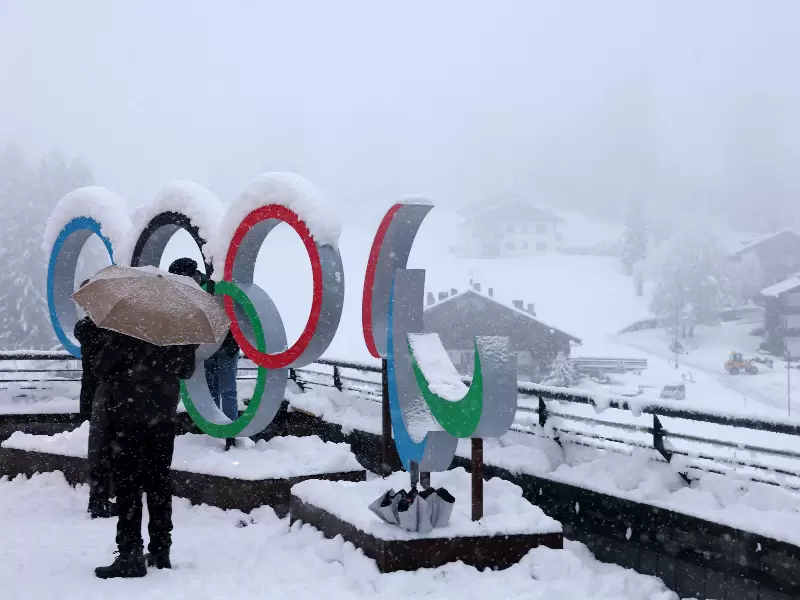 Milano Cortina 2026 Winter Olympics - Previews - Cortina d'Ampezzo, Italy - January 25, 2026 General view of the Olympic rings and the Paralympics Agitos logo covered in snow ahead of the Milano Cortina 2026 Winter Olympics / REUTERS/Claudia Greco
When the curtain is finally rung down on the Milano Cortina 2026 games on Feb. 22, it will leave behind a trail of new success stories besides throwing up new sporting icons and nations, as Norway continues to hold its supremacy.
Johannes Hoesflot Klaebo, the new icon of the Winter Olympics, not only got his sixth gold of the Milano Cortina 2026 Games, but also took his personal tally to a record 10 golds, a feat that may not be easy to equate or overtake.
ALSO READ: Milano Cortina 2026: New nations have emerging Winter Olympic icons
While the European dominance continued unabated, two North American powerhouses – the USA and Canada – also carry home both sweet and sour memories, sharing among themselves 16 gold medals with a titanic struggle for men’s ice hockey gold reserved for the concluding day on Feb. 22.
Norway maintained its position at the top of the table with 18 gold medals in a total of 40 medals, while the USA held its number two position with 11 golds in a tally of 32 medals, while Canada remained stuck atthe number 11 position with 20 medals, including five gold. Brazil scripted history by becoming the first South American nation to win a gold medal at the Winter Olympics.
It is not only Norway as a superpower in the Winter Olympics, but also its athlete, Johannes Hoesflot Klaebo, who becomes the greatest Winter Olympics athlete with six gold medals as the Olympic overall champions Norway dominates the 50km classic.
Johannes Høsflot Klæbo capped a remarkable Milano Cortina 2026 campaign, winning the men’s 50km mass start classic to claim his sixth gold medal of the Games — becoming the first athlete in any sport to win six Olympic gold medals at the same Winter Olympics. He stopped the clock at 2:07:07.1, pulling away late to beat compatriot Martin Løwstrøm Nyenget by 17.5 seconds, with Emil Iversen completing an all-Norwegian podium in third, 46.2 seconds back.
The trio broke clear early in the 50km endurance test and gradually distanced themselves from the field, transforming the Olympic marathon into a controlled three-man contest. Iversen set much of the tempo in the closing kilometres, but on the decisive final hill,l Klæbo unleashed a perfectly timed surge to break clear and seal victory.
Johannes Høsflot Klæbo capped a remarkable Milano Cortina 2026 campaign, winning the men’s 50km mass start classic to claim his sixth gold medal of the Games — becoming the first athlete in any sport to win six Olympic gold medals at the same Winter Olympics. He also equalledthe the Winter Olympic record of eight golds with a 10km interval start triumph. With the victory, he eclipsed a mark that had stood for nearly half a century. His sixth gold medal at a single Winter Olympic Games surpasses the previous benchmark of five, set by USA speed skater Eric Heiden at Lake Placid 1980.
“It’s hard to find the words. It’s unbelievable,” Klæbo said when asked about winning all six men's cross-country events at the Games. “After the world champs last year, we knew that it was possible, but to be able to do it — it’s hard to find the right words — and there were so many emotions when I crossed the finish line.
“It’s a lot of sacrifices, but on the other hand, when you’re starting to feel that it’s sacrifices, I think it’s time to find something else to do,” he explained. “There are choices to make, and we’ve made all the right choices this year. Mentally, I’ve been in a better place than I was last year,r and I have a lot of fun racing out there now.”
“Even though I’ve been nervous at some of the competitions, it still feels really good to race, and I’m always looking forward to going out there, fighting for the medals. I have a very supportive family and fiancée, and together we’re making the right choices. The result of that is six gold medals.”
The triumph also brought Klæbo’s overall Olympic medal tally to 13, further cementing his legacy as one of the most successful cross-country skiers of all time. Behind him, Nyenget secured his third Olympic medal of Milano Cortina 2026, skiing strongly throughout before being unable to respond to Klæbo’s final acceleration.
For Iversen, bronze marked a milestone: his third Olympic medal overall and his first individual Olympic podium. After driving the pace deep into the final kilometres, he held on to complete Norway’s sweep of the marathon event.
It was Norway’s first Olympic podium sweep since the men’s skiathlon in 2018 and the third sweep of Milano Cortina 2026, following Sweden in the women’s cross-country sprint and Germany in the two-man bobsleigh.
The 1-2-3 finish was also Norway’s 14th Olympic podium sweep in history — all of them achieved at the Winter Games. The three medals pushed Norway’s total at Milano Cortina 2026 to 40, surpassing their previous best Winter Olympic tally of 39 set at PyeongChang 2018.
Equally distinguishing has been the performance of Australia, a snow sports nation on the rise. Across two weeks in Italy, its cohort of athletes delivered consistency, composure, and champions.
With six medals and potential for another on the final day of action in Europe, the Aussies have officially recorded their best-ever return at any Games. Three of those were gold, which marks the most titles Australia have won in a single edition of the Olympics, all of which came on the snow.
It marks a significant shift for the nation. Despite being known for its sandy beaches as opposed to snow-covered mountains, its athletes showcased what is possible at Milano Cortina in a tournament defined by history and breakthroughs.
For Canada, the games turned out to be a pleasant blend of sweet and sour. The penultimate day of the competitions turned out to be most rewarding as a gold in the men’s section and a bronze in the women’s section put it on the Curling podium as a new force. In the cross-countrymass start for women, Canada got a silver to make it 1-2-3. All eyes are, however, glued on today’s titanic clash with arch-rival and neighbour, the USA, for the ice hockey men’s gold, an event that may have the U.S. President, Donald Trump, as a guest.
Team Brad Jacobs beat Great Britain’s Bruce Mouat 9-6 to give Canada its first Olympic men’s curling gold medal since 2014. Jacobs also won that Olympic title with another rink in 2014. It is Canada’s fifth gold medal at Milano Cortina 2026, one more than the country won in 2022. It’s also the 20th medal overall for Canada at these Games.
Jacobs, Marc Kennedy, Brett Gallant, and Ben Hebert exacted revenge on Mouat after losing to the Scottish rink in last year’s semifinals at the world championships. Mouat went on to win his second world while Jacobs took bronze in Moose Jaw, Sask.
It is the second straight silver for Mouat at the Olympics. He barely qualified for the semifinals this year, getting help in the final draw to eke in with a 5-4 record. Jacobs, who finished second in the round-robin at 7-2, is the first men’s skip to win two Olympic gold medals.
Not only did Canada have an Olympic drought in men’s curling, tbut he country hadn’t won a gold at the world championship since 2017. Trailing 6-5, Jacobs scored three in a dominant ninth end to take command. He chipped out a Mouat stone on the last rock for the three-ender.
Jacobs then left Mouat with an extremely tough double on the last rock in the 10th. Mouat couldn’t make it, and the celebration was on for Canada. Jacobs overcame early adversity in the tournament when Sweden accused Kennedy of double-touching on his release, leading to a profanity-laced dispute between Kennedy and his Swedish counterpart.
The controversy caused World Curling to change its umpiring set-up to further enforce the rule, leading to two double-touch calls in other games. Several curlers were livid about the calls, and World Curling eventually relented, going back to a more traditional umpiring set-up.
Earlier, Canada’s Team Rachel Homan won bronze in women’s curling.
Canadian speedskater 35-year-old Ivanie Blondin rom Ottawa, won a silver medal in the women’s mass start at the Milan Cortina Games. She was also a silver medallist in the event in 2022. It was her second medal of the 2026 Winter Olympics.
Blondin, Valérie Maltais and Isabelle Weidemann captured gold in the women’s team pursuit earlier in the Games. The Canadians were the defending Olympic champions. Blondin’s result gave Canada its fifth long-track speedskating medal in Milan. Maltais fell at the beginning of the mass start race, but recovered to place fifth. She won three medals in Milan, adding bronze in both the 1,500 and 3,000 metres to her team pursuit gold. Antoine Gélinas-Beaulieu finished sixth in the men’s mass start final.
Jorrit Bergsma of the Netherlands won the gold, Denmark’s Viktor Hald Thorup took silver, and Italy’s Andrea Giovannini claimed bronze.
In Curling for women, Canada scored three in the eighth end to break the game apart and secure its 10-7 bronze-medal victory over the United States’ Team Tabitha Peterson at Milano Cortina 2026.
The Ottawa-based rink made up of skip Homan, third Tracy Fleury, second Emma Miskew, and lead Sarah Wilkes has officially become Olympic medallists.
Team Homan escaped the eighth end with the lead after Peterson’s triple takeout attempt fell short and only moved one. Homan made a perfect draw with her last shot to lock in a three-point edge and give the Canadians an 8-5 lead. The U.S. battled back in the ninth end to score a deuce and close the gap to one, but Canada, up 7-6, had the hammer for the 10th.
In the first half of the game, neither rink dared to take costly risks in such a close medal contest, leading to just a single point being scored by the team holding hammer eat ach end. Team Peterson had a one-point lead at the fifth-end break, but from there it was all Canada.
In the sixth end, Canada scored three to take the first significant lead. But in the seventh, Peterson shot a well-managed draw through a tight port to score two and tie it up. Canada outcurled the U.S. 89 -79 per cent and scored eight of its 10 points in the final five ends. The Americans only had four points through the second half.
After struggling to deliver consistent draws throughout the tournament, Fleury finally found her draw weight in this last all-important medal game.
This was Homan’s third Olympic Games and her first medal. In both 2018 and 2022, she missed the playoff round in the women’s and mixed disciplines, respectively. Going into Milano Cortina 2026, she was ranked No. 1 in the world, a position she’s held for 83 weeks since the start of the 2023-24 season. This is Canada’s first women’s curling medal since Jennifer Jones won gold in Sochi 2014.
Discover more at New India Abroad.
Related





ADVERTISEMENT

ADVERTISEMENT
E Paper
Video

Comments
Start the conversation
Become a member of New India Abroad to start commenting.
Sign Up Now
Already have an account? Login