ADVERTISEMENT
ADVERTISEMENT



Matt Ortega’s Campaign: Amplifying Accusations Against an Indian American Woman Candidate
He raised $34,000, received 2,604 votes, lived outside the district, and had never held elected office. Yet his campaign focused on amplifying accusations against one Indian American woman before he endorsed the candidate who benefited from those attacks. This is not a political biography; it is a documented pattern.
-
 Gaurang D
 - Thu, 09, Jul 2026
- 12:52 EDT
- 9
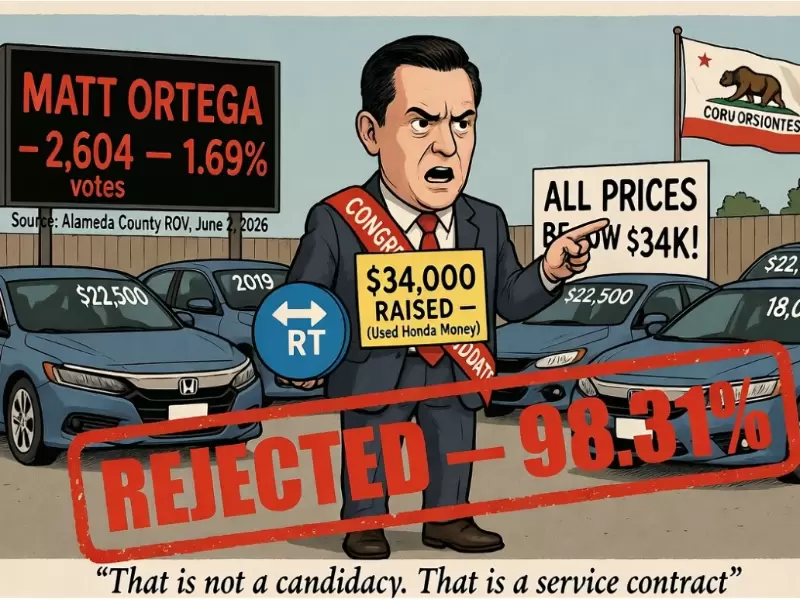 Matt Ortega AI generated image / Gaurang Desai
It takes a certain kind of audacity to run for Congress when you have never won a single elected office in your life, when the district you claim to represent is not the district where you live, and when your entire campaign budget amounts to less than the asking price of a 2019 Honda Accord. Most people in that situation would call it a miscalculation. Matt Ortega called it public service.
The voters of CA-14 had a simpler word for it. According to official Alameda County election results, Ortega received 2,604 votes - 1.69% of the total in the June 2 primary. In a nine-candidate field of 154,240 ballots cast, he finished seventh. Not last, because even irrelevance has a hierarchy, but close enough that the distinction hardly matters.
For context: Rakhi Israni, the Indian-American attorney from Fremont whom Ortega spent his campaign attacking, received 19,972 votes - nearly eight times what he got. Nineteen thousand, nine hundred and seventy-two people in this district looked at their ballots and chose her. Two thousand, six hundred and four looked at theirs and chose Ortega. That is not a race. That is a ratio. And the ratio tells you everything you need to know about what this campaign actually was.
19,972 people trusted Rakhi Israni with their vote. 2,604 trusted Matt Ortega. The voters were, as usual, right.
Who, Exactly, Is Matt Ortega?
According to his campaign website, Ortega is a graphic designer, small business owner, union member, and proud progressive who taught himself to code at twelve and "grew up" in Hayward. His professional highlight listed with unironic pride, is serving as digital communications director for Hillary Clinton's 2016 primary campaign.
Hillary Clinton lost that primary. She lost it to Bernie Sanders, a candidate whose entire brand was running against the political establishment that Clinton and her digital team represented. Ortega's contribution to that loss was, presumably, digital. He then spent years as a freelance consultant before founding E23 Digital in 2022. He is, in the most precise sense of the term, a man who makes graphics for other people's campaigns. He has never run for office. He has never been elected to anything. Not a school board. Not a city council seat. Not a water district. Not so much as a neighborhood association board.
The California Secretary of State's official candidate list describes his occupation as "Graphic Designer/Businessman." That is what ran for Congress. A graphic designer who once made social media posts for a losing presidential campaign decided he was ready for the United States House of Representatives. CA-14 respectfully disagreed, to the tune of 2,604 votes.
A Small Problem: He Doesn't Live Here
CA-14 encompasses Fremont, Hayward, Union City, San Leandro, Dublin, Pleasanton, Livermore, and Castro Valley. Matt Ortega lives in San Leandro and while San Leandro technically borders the district's edge, his children attend schools in the San Lorenzo Unified School District, which is not in CA-14. He was running to represent a district whose schools his own children do not attend.
When challenged on his connection to the district in a Patch interview, Ortega offered this: he "grew up in Hayward," once worked as a consultant in Pleasanton, and has "family that are longtime residents" of the area. By this geographic standard, anyone who has family in a zip code, once drove through for a meeting, and remembers the neighborhood they grew up in before moving away is a credible congressional candidate. The families of Fremont and Hayward were being asked to send to Washington a man whose children go to school in a different congressional district. They declined.
The Finances of a Man Nobody Funded
The fundraising tells the story most efficiently. According to FEC data and reporting from the Pleasanton Weekly, Ortega raised approximately $34,000 over the entire course of his campaign, less than the sticker price of a new Honda CR-V. His final cash on hand, per FEC filings, collapsed to $5,423 - roughly what a used Civic goes for at a San Leandro dealership with 90,000 miles and no warranty.
Compare this to Rakhi Israni, who raised nearly $977,000, including a $1.2 million personal loan that she put into the campaign as a statement of conviction - her own money behind her own community. She funded her campaign the way someone funds a mission: with everything she had. Ortega funded his campaign the way someone funds a hobby: barely, and apparently without much enthusiasm from anyone else.
A Working Families Party internal poll conducted April 1 to 4 with 400 respondents placed Ortega at 2%, tied for last. No subsequent poll moved that number. By every financial and electoral metric available, Ortega was not a viable candidate from the moment he filed. He knew this. And yet he stayed in the race.
Rakhi Israni put $1.2 million of her own money into this race because she believed in the people of CA-14. Matt Ortega's donors collectively trusted him with $34,000. One of these is a candidate. The other is a footnote.
Very Busy, for a Man Going Nowhere
Here is where the story becomes less pitiful and more troubling. While raising almost nothing, polling dead last, and campaigning in a district his own family does not fully inhabit, Ortega found remarkable time to dedicate his campaign's public presence almost entirely to attacking one specific candidate.
Not Aisha Wahab, the frontrunner who led by 25 points and represented everything Ortega claimed to oppose about establishment politics. Not Melissa Hernandez, who was his direct competition for the non-Wahab progressive vote. Not the two Republican candidates whose policy positions were presumably antithetical to everything in Ortega's progressive platform.
Just Rakhi Israni. The Indian-American attorney from Fremont. The first-generation outsider who raised nearly a million dollars from individual donors and spent her campaign talking about housing, healthcare, jobs, security and BART. That is the candidate Matt Ortega decided required his relentless attention.
Social media monitoring of the CA-14 race captured the pattern in detail. From Ortega's Twitter account, @MattOrtega, from late April through June 13 - eleven days after the primary ended and Ortega had lost - a sustained, systematic amplification of anti-Rakhi content played out. The attacks targeted her in every direction simultaneously; trying hard to smear her reputation but failing miserably.
Not one of these attacks was original Ortega content. He never put his name on a single direct accusation. Every post was a retweet or amplification of third-party accounts, the digital operative's oldest and most cowardly trick. He outsourced the attacks, laundered them through proxies, and called it a Twitter feed. For a man who made his career managing other people's digital communications, the mechanics were unsurprisingly professional.
The attacks on Rakhi Israni were not just dishonest. They were ethically indefensible. Rakhi is a public interest attorney who has spent her career fighting for working families, a nonprofit advisor, a temporary judge in Santa Clara Superior Court, and a first-generation Indian-American who entered this race without establishment support, without PAC money, and without the machinery of incumbency behind her.
To brand someone with that record as an extremist and to do it through anonymous proxies, hiding behind a retweet button is not political debate. It is targeted character assassination against a well-respected member of the Indian-American community. And it raises an uncomfortable question about why a candidate with no chance of winning, and no apparent interest in any other issue, chose her specifically as the target.
The Question Nobody Should Be Afraid to Ask
On June 8, 2026, six days after finishing seventh in the primary Matt Ortega withdrew from the race and, according to reporting by The Independent, endorsed Aisha Wahab. His statement called her "the only candidate with the values, the tenacity, and the breadth of vision" to serve the district.
Let that land for a moment. The man who spent months amplifying coordinated attacks on Rakhi Israni, the Indian-American candidate who represented the most credible non-Wahab threat in the race, endorsed Aisha Wahab the instant his own candidacy was finished.
The attacks targeted Rakhi. The endorsement went to Wahab. The beneficiary of one was the recipient of the other.
There is no evidence of formal coordination between Ortega and the Wahab campaign. What the record shows, documented in granular detail, is a candidate who attacked none of the actual frontrunners, who continued amplifying anti-Rakhi content for the entire duration of his campaign, and nearly two weeks after his own race was over, and who endorsed the one candidate those attacks were designed to benefit.
Voters deserve to ask: was Aisha Wahab who was holding a commanding lead but watching a credible Indian-American outsider build momentum in communities she assumed were hers, afraid of what Rakhi represented? Was a last-place candidate with a Twitter account and a retweet button the answer to that fear?
What the Verdict Means
CA-14 deserves candidates who actually live here, serve here, and intend to win. It deserves a political culture that does not weaponize false accusations against accomplished Indian-American women to protect the interests of the powerful. And it deserves voters who ask hard questions about who funds the attacks, who amplifies them, and who benefits when they land.
CA-14 voters rejected Matt Ortega with something more eloquent than anger. They rejected him with indifference. 2,604 votes out of 154,240 cast. That is not a statement. That is a rounding error.
Which is, in its own way, the most accurate political verdict of all.
(The views and opinions expressed in this article are those of the author and do not necessarily reflect the official policy or position of New India Abroad.)
Discover more at New India Abroad.
Leave A Comment
Related





ADVERTISEMENT

ADVERTISEMENT
E Paper
Video

Comments
Start the conversation
Become a member of New India Abroad to start commenting.
Sign Up Now
Already have an account? Login