ADVERTISEMENT
ADVERTISEMENT



Leaders urge action against anti-Indian hate at FIIDS event
Delegates from 25 states pressed lawmakers on immigration, trade and strategic ties during FIIDS' Capitol Hill advocacy summit
-
 Malvika Choudhary
 - Wed, 24, Jun 2026
- 18:52 EDT
- 65
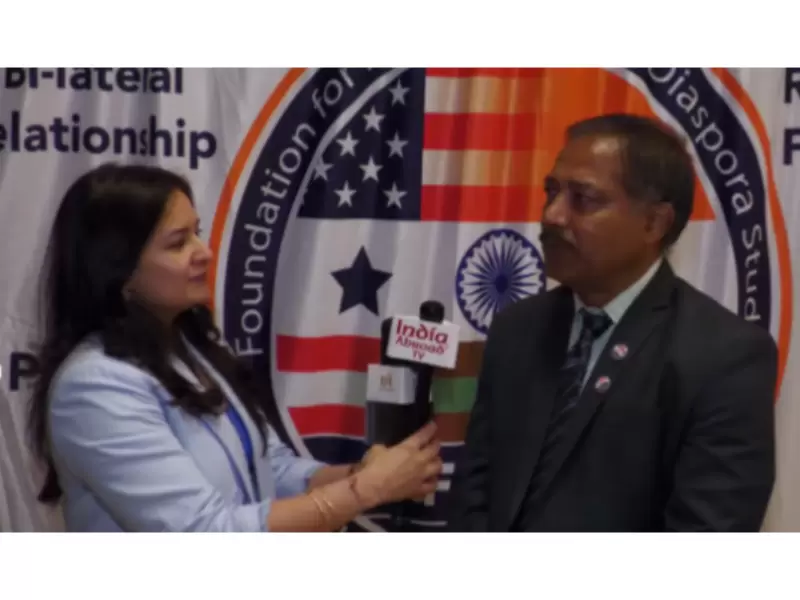 New India Abroad's correspondent speaking to Khanderao Kand / New India Abroad
Rising anti-Indian sentiment and ways to counter it took center stage during Foundation for India and Indian Diaspora Studies' (FIIDS) Capitol Hill Advocacy Day, where lawmakers urged greater engagement and education to combat hate.
Speaking on the sidelines of the event, Congressman Brad Sherman was among the lawmakers who directly addressed concerns about anti-Indian and anti-Hindu bias, saying efforts to counter hate must remain a priority.
Also Read: As India rises, Indian Americans seek a stronger voice in Washington
"We have to combat hatred against Indo-Americans and Hindu-Americans at every step," Sherman said, adding that the success and contributions of Indian Americans demonstrate the community's importance to the United States.
Sherman also called for addressing long-standing immigration backlogs affecting legal immigrants.
"We can fight about what our immigration policy should be. But once that is set, it needs to be implemented and adequately staffed," he said. "That's why we have to have the staff necessary to eliminate backlogs."
Congressman Bill Huizenga said education remains one of the most effective tools for strengthening support for the US-India relationship and addressing misconceptions.
"It is about education," Huizenga said. "People need to understand at all levels how important this relationship that India and the United States has."
Congressman Rob Bresnahan Jr. echoed those sentiments, encouraging Indian Americans to engage directly with elected officials and remain active in public life.
"The first step is having these conversations and talking with your electeds," Bresnahan said. "Be involved inside of the community. Keep these conversations front and center."
He said civic participation is critical to ensuring community concerns are heard and represented in government.
In a similar vein, U.S. Senator Roger Marshall highlighted the outsized role Indian Americans play in American society, pointing to their contributions in healthcare, business and the broader economy.
"They make up 1.5 percent of the population. They're 9 percent of the doctors," Marshall said. "What I value is that they share the same values I do, values like faith and family, community, education, hard work."
Marshall said the Indian American community's contributions make it an important bridge in the growing US-India relationship.
U.S-India ties
Beyond discussions on hate and representation, lawmakers repeatedly highlighted the growing strategic importance of the US-India partnership.
Congressman James Walkinshaw described people-to-people ties as one of the strongest pillars of the relationship.
"The US-India relationship has been critical for many decades — the technology partnerships, the defense partnerships, and most importantly, the people-to-people ties," Walkinshaw said.
"I represent almost 60,000 Indian Americans in Northern Virginia, and those folks across the country, millions, bind our two nations together."
Walkinshaw said cooperation between Washington and New Delhi has become increasingly important amid growing geopolitical challenges.
"In a time where the United States and India face real threats and real strategic adversaries – China, Russia and others – it's more important than ever that we work together," he said.
He also praised organizations such as FIIDS for helping policymakers better understand the relationship and develop policy solutions.
Also Read: Capitol Hill backs stronger India-US partnership
"It's so important to have organizations like this to bring people together, to help policymakers here in Washington understand the importance of the relationship, to build those ties and develop solutions to move forward," Walkinshaw said.
Senator Marshall also called for addressing trade imbalances between the two countries and expanding economic ties.
"The fastest-growing economy in the world, we're always looking for markets," he said. "There's a little bit of a trade imbalance right now, so I hope we can address these trade imbalances and continue to grow this relationship."
"As the two largest democracies in the world, surely we can make this a better place for everyone to live," he said.
India's Deputy Chief of Mission to the United States, Namgya C. Khampa, praised FIIDS' efforts to bring together policymakers and community leaders and said people-to-people engagement remains central to the bilateral relationship.
"As a democracy we get power from the people on both sides," Khampa said. "It's so important to have people in the middle of those conversations about how we can strengthen our partnership."
Khampa said both governments remain committed to advancing a bilateral trade agreement and welcomed the role played by organizations such as FIIDS in strengthening ties between the two countries.
"I want to applaud FIIDS for the work it does," she said. "To bring 152 people from 25 states is pretty impressive."
"We really appreciate the role of the Indian American community, appreciate the role of people on both sides in India as well as in the United States, and take strength from it to carry the relationship forward," Khampa added.
Immigration and advocacy
For FIIDS delegates, immigration remained one of the most important issues discussed during meetings on Capitol Hill.
Shivani, a FIIDS member, said she focused her conversations on legal immigration pathways, including green card caps, H-1B visas and STEM OPT provisions.
"Getting high-skilled immigrants here is one of our greatest strengths," she said. "It helps with innovation, helps with our economy, really helps us get our competitive edge against all the other countries."
She said lawmakers were receptive to discussions on immigration and other issues affecting the Indian American community.
Khanderao Kand, director of FIIDS, said the organization's advocacy efforts are aimed at ensuring elected officials understand and respond to issues affecting Indian Americans while strengthening awareness of the US-India relationship.
"We need to make sure that our elected officials listen to our viewpoints and reflect on that," Kand said.
Kand said FIIDS continues to organize Capitol Hill advocacy efforts because lawmakers and congressional staff change regularly, making continued outreach and education essential.
"Every two years, the House is changing. New members come. New staff members come. They don't know about both countries' relationship, how the relationship is strong," he said.
He argued that stronger US-India relations are ultimately in America's interest, pointing to growing cooperation in trade, technology, security and the Indo-Pacific region.
"We strongly believe that being strong India, strong U.S.-India relationship is always good for American interest," Kand said.
The discussions highlighted a common message from lawmakers, diplomats and community leaders: combating hate, expanding civic participation and strengthening US-India ties require sustained engagement from both governments and the Indian American community.
Discover more at New India Abroad
Related




ADVERTISEMENT

ADVERTISEMENT
E Paper
Video

Comments
Start the conversation
Become a member of New India Abroad to start commenting.
Sign Up Now
Already have an account? Login