ADVERTISEMENT
ADVERTISEMENT



International Day of Yoga: An American instructor's perspective
Yoga instructor Caren Plummer discusses grief, community, commercialization and yoga's evolving role in America.
-
 Pranavi Sharma
 - Sun, 21, Jun 2026
- 00:30 EDT
- 69
 Caren Plummer / Instagram
As yoga continues to grow in popularity across the United States, questions about its origins, meaning and evolution remain central to conversations around the practice. While yoga traces its roots to ancient India, millions of Americans today encounter it through fitness studios, wellness spaces and community programs.
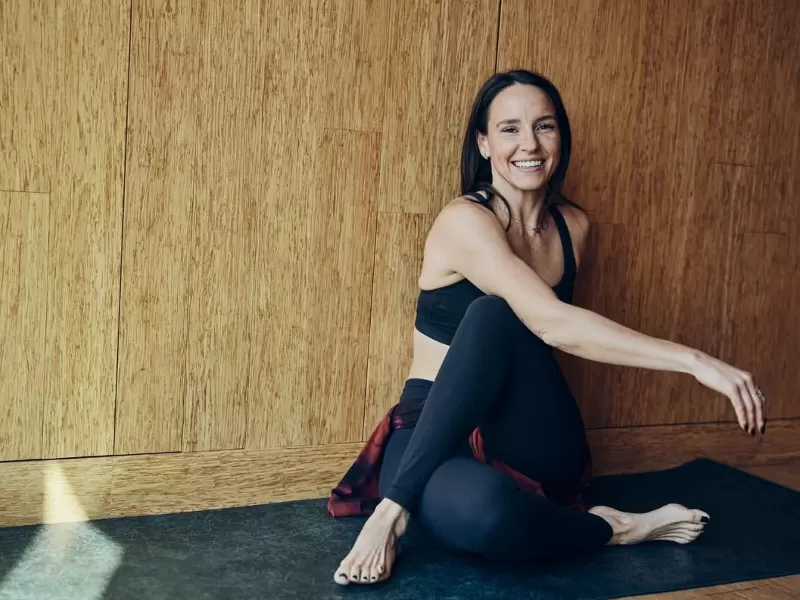
In an exclusive conversation with India Abroad, Washington, D.C.-based yoga instructor Caren Plummer reflects on her personal journey with the practice, from childhood exposure and profound experiences with grief to building a community-centered yoga initiative focused on accessibility and service. She discusses the state of yoga in America, the challenges of commercialization, and why she believes the practice remains a powerful tool for connection and healing. EXCERPTS:
1. You were born and raised in the Washington, D.C., area, far from yoga's traditional roots in India. What first drew you to yoga, and at what point did it become something deeper than fitness for you?
I was first exposed to the practice of yoga when I was very young. My godmother, whom I admired very much, was a practitioner and later a teacher herself. She had fallen in love with it during the '80s and her travels throughout India. She spoke so highly of its healing properties and ability to help those who practiced better understand themselves, so naturally my curiosity took over as a young woman with so much admiration for her. I'd find myself moving in and out of different spaces until 2015, when my brother passed away from a drug overdose. Yoga was suddenly not an option, but a necessity to help me process the loss of my baby brother and only sibling.
2. A lot of yoga in the U.S. is tied to wellness culture, branding and luxury spaces. Do you ever feel tension between yoga as a spiritual discipline and yoga as an industry?
Absolutely. How could you not?
3. Where did you actually learn yoga — from teachers, lineages, books or communities? Was there a moment when you realized the practice carried a history much larger than what most Americans see in studios?
Most of my education came from my incredible instructors, the classes they taught and my teacher training, which presented a healthy balance between the physical asanas and philosophical teachings of yoga. I recall one session specifically, though, that sent me down a rabbit hole. It was when I first learned that yoga was initially only allowed to be practiced by men. As you can imagine, as a woman practicing yoga in the States, the majority of my teachers had been women. Learning that women were not initially allowed to practice yoga blew my mind and sent me down a historically enriching rabbit hole.
4. As someone teaching in America for seven years, how would you describe the current yoga scene in the U.S.? What are people genuinely searching for when they come into class right now?
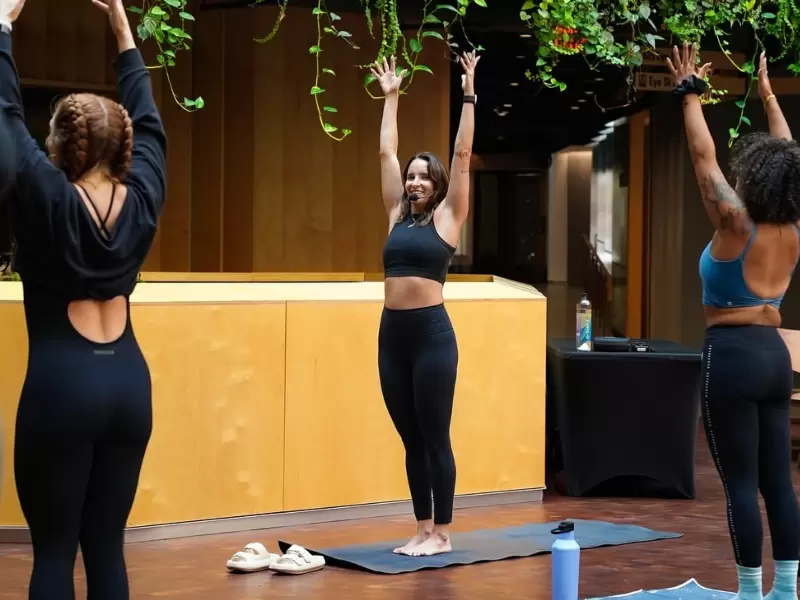
I've been teaching since 2015, so 11-ish years, and I would say that the yoga scene in the States is diverse. There is something for everyone, depending on what you are looking for, and this varies from what I can tell. When I look at the different spaces where I teach classes, and each of them is very different, I see one through line, which is that yoga is still associated with the idea of finding a little space to intentionally breathe, which many people are looking for. Some do it and practice with a desire to spend solo time with themselves, while others are showing up in spaces to be a part of a bigger whole.
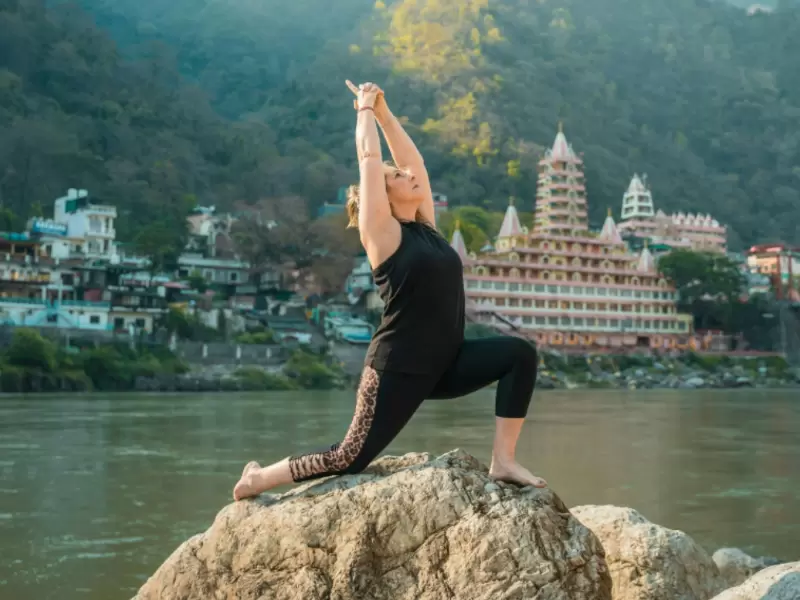
 Caren Plummer teaching yoga. / Instagram
 5. Have Indian teachers, practitioners or members of the Indian diaspora ever shaped your understanding of yoga? What have those interactions been like, especially given ongoing conversations around authenticity and cultural ownership?
It's an interesting question, and I can only speak to my own experience, but there is a massive underrepresentation of Indian teachers and practitioners in the communities around me. In general, this is an issue in boutique fitness and wellness, in my opinion. So while there are fundamental Indian principles and teachings that have influenced me as a teacher, this has been done via books, documentaries and other non-direct forms of education.
6. You've built CP:YOGA around community and fundraising, not just instruction. Why was it important for you to connect yoga with civic responsibility and giving back?
CP:YOGA has evolved some since the COVID era, but yes, initially it was created to bring folks together, to move as a community in support of the community. Every dollar we made from events hosted would go to a different nonprofit. Now I'm focused more and more on creating opportunities for people to come together and take class either for free or with a very low barrier to entry to help create accessibility to the practice and bring folks together. At its core, the focus is on community and being in service of others. Yoga isn't just for the wealthy, it isn't just for folks with access to aesthetically pleasing studio spaces, it's for everyone!
7. Your biography talks openly about grief, especially losing your father during COVID. Did yoga change for you after that loss? Did it stop being about discipline and become something else entirely?
The loss of my brother pushed me into yoga headfirst. I went from being in studio spaces once a week to being in studio spaces six to seven days a week. It was the only way I knew how to quiet my mind and created a great appreciation for moving meditation and yoga's ability to soothe my nervous system. This is ultimately what pushed me into teacher training. I felt that if yoga could help me process this deep, painful loss, then I could use it to help others begin to heal as well.
When my dad passed during COVID, I was in some ways grateful that I had already started my business, CP:YOGA, because I had tools already available to me to help me process. Unfortunately, yoga wasn't enough at that time, so I started down my boxing journey and ended up competing in a charity boxing match, but that's a story for another time.
8. International Day of Yoga is approaching. Do you celebrate it or engage with it in any way? And do you think the day meaningfully honors yoga's Indian origins, or has it become more symbolic and commercial in the West?
It is! I'll be leading a free class on Saturday, June 20, a day before International Day of Yoga, in partnership with Lululemon and calling out its importance. I'll also be encouraging folks to sit down with me afterward at a local coffee shop and chat about their yoga journey. On International Day of Yoga, June 21, I'll be leading a class at Equinox and doing the same, encouraging folks to share why they started practicing. Lastly, I'll be sharing my journey on social media. I think creating a dialogue is important, as it's often what sparks curiosity to learn more and explore yoga as an individual.
9. You balance corporate work, yoga teaching, boxing and community organizing. What personal mantra or philosophy keeps all those identities connected instead of fragmented?
I attempt to balance. There are plenty of moments where I feel deeply overwhelmed, but I feel a great deal of social responsibility to create. So whether it be in my corporate job or teaching yoga, I remain focused on creating with purpose and moving with integrity.
10. When you look at the future of yoga in America, what worries you most and what still gives you hope?
Let me start with what gives me hope. While many people are profiting off the concept of community, I am seeing community-based spaces growing in popularity and creating meaningful connections, which gives me a lot of hope that yoga can still serve as a space to educate and empower those who practice. Leadership in those spaces is a major component of their success, though. Only time will tell!
Lately, I've become extremely concerned with all the "hybrid" or fusion-style classes. People are taking a beautiful practice and twisting it to meet the ever-changing desires of the fitness space in America. I recently took a preview class at a well-known reformer Pilates studio in the States that is planning to launch a series of mat classes, one of which is called Flow. It has essentially merged mat Pilates with yoga-inspired movement and will be led by individuals without yoga certifications.
This is not a uniquely American problem. This is a growing issue, I think, globally. We are always searching for the "next thing" and often forgetting the beauty that exists within the thing that is right in front of us.
Discover more at New India Abroad.
Related
.png)





ADVERTISEMENT

ADVERTISEMENT
E Paper
Video

Comments
Start the conversation
Become a member of New India Abroad to start commenting.
Sign Up Now
Already have an account? Login