ADVERTISEMENT
ADVERTISEMENT


PM Modi highlights success of AI Impact Summit 2026
He was referring to an article on X, written by Union Minister Hardeep Singh Puri on the achievements at the AI Impact Summit 2026.
-
 IANS
IANS - Tue, 24, Feb 2026
- 16:59 EST
- 70
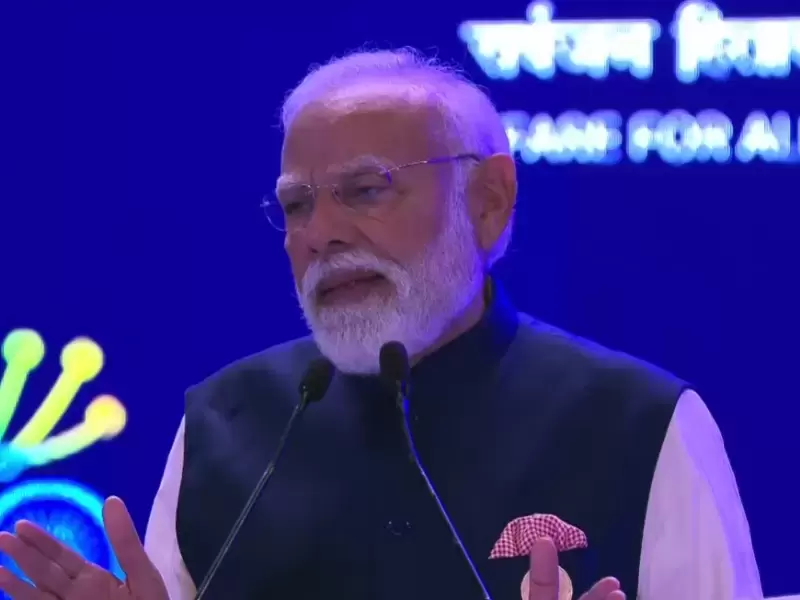 PM Modi at the AI Impact Summit 2026 / Courtesy: YouTube/Narendra Modi
Prime Minister Narendra Modi on Feb. 24 highlighted that, at the AI Impact Summit held in Delhi, India drew inspiration from its own civilizational impulse in putting forward its organizing ideas: sovereignty over data, inclusion by design, and accountability by default.
PM Modi was referring to an article on X, written by Union Minister Hardeep Singh Puri on the achievements at the AI Impact Summit 2026, which was attended by over 20 heads of state and more than 500 AI leaders from over 100 countries and was the largest conference of its kind ever held in the Global South.
ALSO READ: Shaping a human-centric future for AI – AI Impact Summit 2026
The minister wrote that under Prime Minister Modi’s leadership, the first Global South nation to host the global AI summit series did not merely convene a conversation but laid out the terms on which it intends to compete: A Delhi Declaration that rewrites the rules of AI governance, digital infrastructure processing nearly half the world’s real-time payments, investment commitments in the hundreds of billions, sovereign models built from scratch, and entry into the supply chain security architecture of the AI age.
Puri highlighted the PM’s MANAV vision: ethical guardrails, accountable governance, sovereignty over data so that the raw material of intelligence is not extracted the way commodities once were, broad access so that benefits reach a farmer in Madhya Pradesh as surely as an engineer in Bengaluru, and legal validity so that every deployed system is subjected to democratic scrutiny.
The minister further stated that PM Modi’s formulation about giving AI an open sky while keeping command in human hands draws a line that many advanced economies have been reluctant to draw.
Those principles now carry multilateral weight through the Delhi Declaration, adopted at the summit and already being called the first major AI governance blueprint from the Global South, taking a development-oriented view anchored in a techno-legal approach that favors flexible guardrails over rigid compliance. It organizes global collaboration around three pillars: people, planet, and progress.
Population-scale solutions like BharatGen, which supports 22 Indian languages, acknowledge that most of the world does not operate in English.
A proposed global compute bank, modelled on India’s subsidized GPU access at INR 65 per hour (US $0.71), lowers entry barriers everywhere. The insistence on data sovereignty challenges AI extractivism: the pattern in which developing nations’ data is harvested to train models they must then pay to use, Puri added.
Discover more at New India Abroad.
Related











ADVERTISEMENT

ADVERTISEMENT
E Paper
Video

Comments
Start the conversation
Become a member of New India Abroad to start commenting.
Sign Up Now
Already have an account? Login