ADVERTISEMENT
ADVERTISEMENT



Pakistan not a "neutral mediator" Israeli expert on ceasefire role
Lauren Dagan Amos says Pakistan’s role was limited to facilitation, while warning Iran-backed proxies remain a long-term threat despite a ceasefire.
-
1759953093.png) Staff Reporter
Staff Reporter - Fri, 10, Apr 2026
- 15:55 EDT
- 63
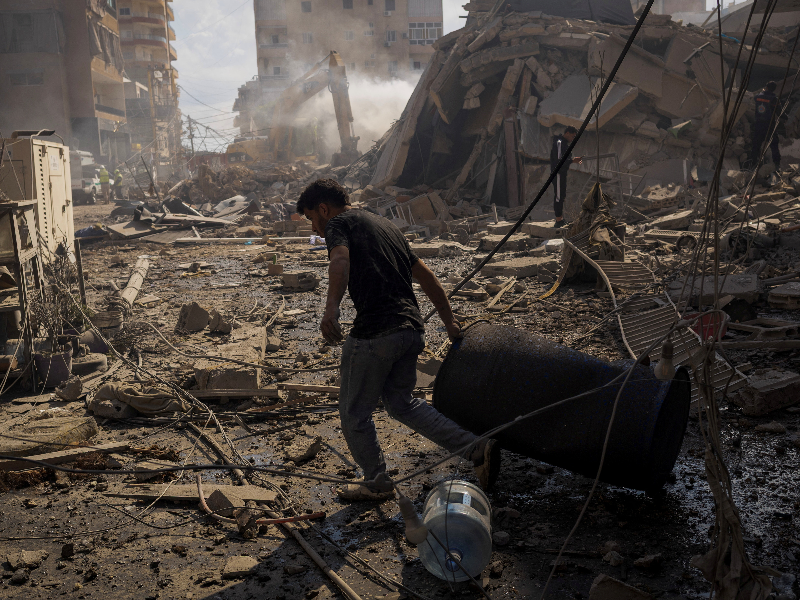 A man pulls a drum at the site of an Israeli strike in Tyre, Lebanon, April 8, 2026. / REUTERS/Adnan Abidi
Pakistan's role in mediating a ceasefire involving the United States, Israel, and Iran is being viewed with caution, with Israeli scholar Lauren Dagan Amos arguing that it was far more limited than suggested.
“I must say that we don't know really what was the Pakistan play in this meditation, except to deliver messages or to give a chair and a table for the both sides,” said Amos, a researcher at the Begin-Sadat Center for Strategic Studies and lecturer at Bar-Ilan University.
Also Read: US Vice President Vance heads to Pakistan for Iran talks
While Pakistan may have gained diplomatic visibility by being associated with the process, Amos cautioned against interpreting that as strategic influence. She was particularly direct on the question of neutrality.
“It's also important to remember that Pakistan did not enter the crisis as a neutral mediator. In the abstract, it comes with its own interests,” she said.
She underscored that Israel itself was not directly part of the mediation framework. “It's important to emphasize that the US and Iran are involved in this meditation, not Israel. Israel is not a part of this deal,” she said.
Beyond the mediation debate, Amos pointed to a more enduring concern for Israel and the region: the future of Iran-backed proxy groups such as Hezbollah, Hamas, and the Houthis.
“They've definitely been weakened from, if we could see the three years ago, but it will be a serious mistake to treat weakened as neutralized,” she said.
Highlighting Hezbollah as a key example, she noted that ongoing Israeli military activity signals the group remains a live threat. “Hezbollah is the clearest example right now because the Lebanon's front is still active… so that tells us that Israel still sees Hezbollah as an active and distinctive threat,” she said.
Amos argued that these groups have evolved beyond being simple extensions of Iran, developing their own capabilities and networks over time.
“That means that they can absorb damage and still survive in an altered form,” she said, warning that their resilience makes them harder to eliminate.
She added that while coordination among these groups may have weakened, the threat they pose persists. “These actors may be less effective as a tightly connected coordinated instruments of Iranian power, but they can still remain long-term semi-automatic… threat ecosystem,” she said.
Pointing to the Houthis as an example, Amos noted their relative autonomy. “They have their own ecosystem, their own mechanism, their own capabilities. They are not dependent only on Iran. And this is very dangerous,” she said.
Taken together, Amos’s assessment suggests that while Pakistan’s role in recent diplomacy may be overstated, the deeper security challenges in the region—from proxy networks to shifting power dynamics—remain far from resolved.
Discover more at New India Abroad.
Leave A Comment
Related





ADVERTISEMENT

ADVERTISEMENT
E Paper
Video

Comments
Start the conversation
Become a member of New India Abroad to start commenting.
Sign Up Now
Already have an account? Login