ADVERTISEMENT
ADVERTISEMENT



Juneteenth through a dharmic lens: Shared humanity, shared destiny
As we honor Juneteenth, may we celebrate not only the resilience and contributions of Black Americans, but also the enduring human aspiration for freedom, equality, and justice.
-
1781639013.png) Ganesh Ramakrishnan
Ganesh Ramakrishnan - Fri, 19, Jun 2026
- 17:02 EDT
- 536
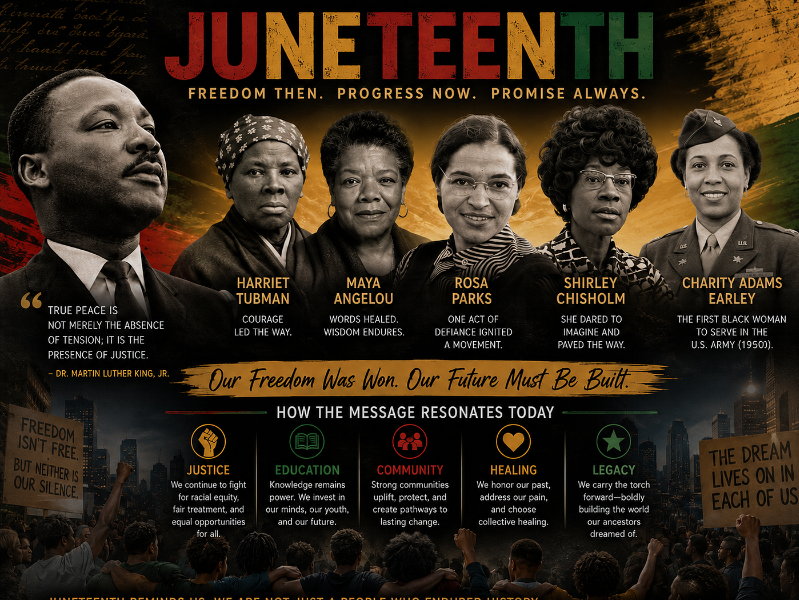 Representative Image / Generated using AI
“Injustice anywhere is a threat to justice everywhere. We are caught in an inescapable network of mutuality, tied in a single garment of destiny. Whatever affects one directly, affects all indirectly.”
— Martin Luther King Jr., Letter from Birmingham Jail
These words were born from lived experience, but they speak to something universal. They are not merely a reflection of one man’s struggle; they are a reminder of our shared conscience and interconnected humanity.
More than sixty years after Dr. King’s letter, they continue to resonate because they articulate a truth that transcends race, geography, religion, and time: our destinies are bound together.
As a child growing up in India, America felt distant and larger than life. Comics, movies, basketball, and cultural icons such as Michael Jackson were part of the image of America that reached us across oceans. Yet one conversation with my father, a voracious reader (who passed away last year ) left a lasting impression on me.
He spoke about the oppression endured by Black Americans. I was young, and the details of history were still beyond my grasp, but the very idea that a people could be denied dignity, freedom, and equal opportunity simply because of the color of their skin stirred something within me.
Also Read: Reflecting on Juneteenth: What Freedom Means to Me as an Indian American
It awakened a sense of empathy. Looking back, I find it remarkable that years later I would become a hyphenated American myself, living in the very nation whose history we had discussed from afar.
As life unfolded, those early reflections deepened. In the early 2000s, while living in Maryland, I became friendly with several African American acquaintances through regular tennis sessions.
Between games and casual conversations, stories would emerge — memories of experiences in school, encounters with prejudice, or observations about how race shaped everyday interactions. These were not dramatic speeches or formal lectures. They were personal accounts shared in ordinary moments, and perhaps because of that, they were all the more powerful.
Books, films, documentaries, and historical accounts further broadened my understanding of the Black American experience. Over the years, I also had opportunities to meet community leaders, educators, authors, human rights advocates, public servants, and elected officials.
Listening to their stories revealed not only the historical weight carried by individuals and families, but also the resilience with which they transformed pain into purpose and adversity into achievement.
It is through this lens that Juneteenth holds such profound significance.
On June 19, 1865, Union troops arrived in Galveston, Texas, and announced the enforcement of emancipation in Texas, more than two years after President Abraham Lincoln issued the Emancipation Proclamation. For many enslaved African Americans in Texas, freedom had been legally declared long before it became a lived reality.
The delay itself serves as a powerful reminder that justice delayed is often justice denied. News traveled slowly, enforcement was uneven, and many formerly enslaved people continued to labor under coercive conditions long after emancipation had been proclaimed. Yet when freedom finally arrived, it brought with it hope, reunion, and renewal.
Many newly freed individuals began searching for family members from whom they had been separated, embarking on journeys to reconnect with loved ones. Communities gathered to celebrate their newfound freedom through prayer services, music, education, and public gatherings. As early as 1866, Juneteenth celebrations emerged across Texas and beyond, becoming a living testament to resilience, remembrance, and hope.
One of the enduring traditions of Juneteenth is the celebration of “red foods” and drinks , red velvet cake, red punch, watermelon, and barbecued meats. Rooted in West African cultural traditions, the color red symbolizes sacrifice, strength, perseverance, and ancestral memory. These traditions remind us that freedom is not merely a legal status; it is also a cultural inheritance preserved through generations.
Texas became the first state to recognize Juneteenth as an official holiday in 1980. More than four decades later, in 2021, Juneteenth was designated a federal holiday, allowing the nation as a whole to reflect upon both the tragedy of slavery and the triumph of human dignity.
The history of Black Americans is marked by extraordinary hardship, slavery, segregation, disenfranchisement, discrimination, and the long struggle for civil rights. It is also a history of remarkable courage, creativity, leadership, and perseverance. The wounds of the past do not disappear simply because laws change. Generational trauma often requires generations of healing. That is why commemorations such as Juneteenth and Black History Month remain so important. They are opportunities not only to remember heroes and sacrifices, but also to continue conversations about justice, opportunity, reconciliation, and healing.
Among the towering figures of this history stands Dr. Martin Luther King Jr. Standing before the Lincoln Memorial in 1963, he delivered words that continue to echo across generations:
“I have a dream that one day this nation will rise up and live out the true meaning of its creed: ‘We hold these truths to be self-evident, that all men are created equal.’”
There is something profoundly symbolic about those words being spoken in the shadow of Abraham Lincoln’s memorial. It was a call not merely to remember America’s ideals, but to fulfill them.
As a Hindu American, I do not claim the lived experience or historical burden borne by Black Americans. Their journey is unique and deserves to be understood on its own terms. Yet, as an immigrant and fellow traveler in the “land of the free,” I have occasionally experienced moments of prejudice and exclusion.
While such experiences cannot be compared to centuries of systemic oppression, they have helped me appreciate how deeply human dignity matters and how easily it can be diminished when we fail to see one another fully.
It is here that the Dharmic traditions I grew up with offer a perspective that resonates deeply with the spirit of Juneteenth.
The Mahabharata teaches:
Atmavat Sarvabhuteshu i.e See all beings as oneself.
This simple yet profound principle asks us to recognize our shared humanity. It invites us to move beyond labels, divisions, and superficial differences, and to see the same intrinsic worth in others that we see in ourselves.
Similarly, the Rig Veda (5.60.5) proclaims:
“Ajeysthaso akanisthasa ete sam bhrataro vavrdhuh saubhagaya.”
“None is superior. None is inferior. All are brothers and companions. Together they strive for prosperity and well-being.”
This ancient verse affirms human dignity, mutual respect, and collective flourishing. It rejects the notion that differences in race, status, ethnicity, or social role imply differences in intrinsic worth. Long before modern discussions of equality and human rights, it articulated a vision of society grounded in shared humanity.
These teachings do not erase historical injustices, nor do they replace the need for laws, institutions, or social reform. Rather, they remind us of the moral foundation upon which lasting justice must stand.
Many injustices begin when one group believes itself superior to another or when human beings are reduced to categories rather than recognized as individuals worthy of dignity and respect.
In many ways, the Dharmic ideal echoes Dr. King’s vision of the “inescapable network of mutuality.” Both recognize that our well-being is interconnected. Both challenge us to see beyond divisions. Both call us toward a society in which justice is not reserved for a few but extended to all.
Juneteenth is therefore more than a historical commemoration. It is an invitation to reflection. It asks us to remember that freedom delayed is freedom diminished, that dignity denied leaves lasting scars, and that progress requires both remembrance and action.
As we honor Juneteenth, may we celebrate not only the resilience and contributions of Black Americans, but also the enduring human aspiration for freedom, equality, and justice. And may we continue striving toward a future in which, as both Dr. King and the ancient sages envisioned, we recognize that our destinies are intertwined and that the flourishing of one is inseparable from the flourishing of all.
The writer is a technology executive, community leader, and thought contributor.
(The views and opinions expressed in this article are those of the author and do not necessarily reflect the official policy or position of New India Abroad.)
Discover more at New India Abroad.
Leave A Comment
Related





.jpg)






ADVERTISEMENT

ADVERTISEMENT
E Paper
Video

Comments
Start the conversation
Become a member of New India Abroad to start commenting.
Sign Up Now
Already have an account? Login