ADVERTISEMENT
ADVERTISEMENT



Jayapal warns of ‘devastating’ immigrant health care cuts
The changes could leave thousands of immigrants without coverage and disrupt long-term care for vulnerable Washington residents.
-
 Malvika Choudhary
 - Mon, 10, Aug 2026
- 14:31 EDT
- 28
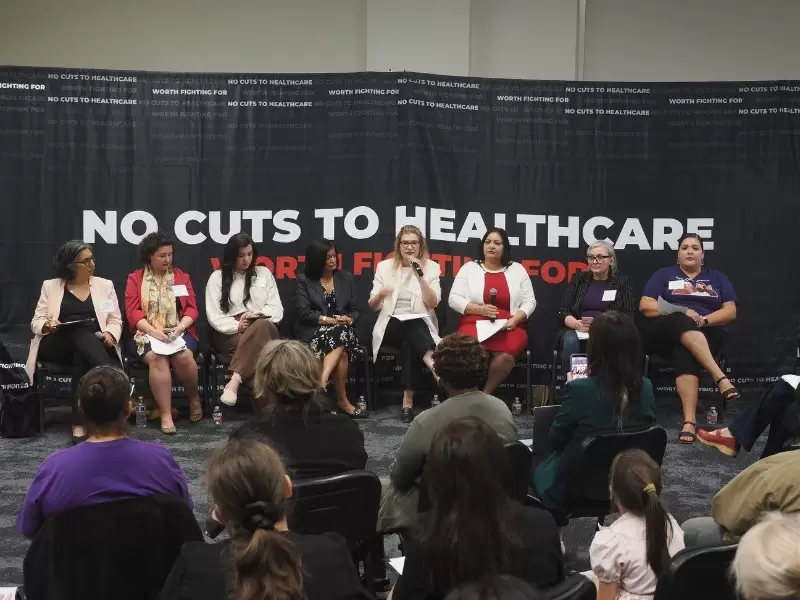 No Cuts to Healthcare coalition's roundtable / Photo Credit: Andrew Villeneuve
Congresswoman Pramila Jayapal warned Aug. 4 that immigrant families in Washington face potentially devastating health care cuts as new federal restrictions take effect Oct. 1.
Jayapal made the remarks at a roundtable hosted by SEIU 775 in Seattle, where caregivers, state officials, health care organizations and community advocates discussed the potential loss of coverage.
Also Read: Jayapal introduces bill to protect hospitals from climate disasters
The No Cuts to Healthcare Coalition said about 15,000 immigrants in Washington are expected to lose health care, while 1,300 older adults and people with disabilities could lose long-term care services beginning Oct. 1.
Jayapal, a Democrat representing Washington’s 7th Congressional District, criticized President Donald Trump and congressional Republicans over the federal legislation, which she has called the “Big Bad Betrayal Bill.”
“When Trump and Republicans passed their Big Bad Betrayal, they stripped healthcare from millions of people in this country – and also specifically targeted immigrant communities,” Jayapal said.
The democrat said the coalition was bringing together affected families, caregivers and community organizations to highlight the impact of the changes in Seattle and across the country.
“The No Cuts to Healthcare Coalition is bringing voices together from across our community to show just how devastating this will be in Seattle and nationwide,” Jayapal said.
She thanked caregivers, community organizations and state and local officials working to protect people who could lose coverage.
“I am grateful to have state and local partners who are fighting to protect the most vulnerable in our communities,” Jayapal said.
Jayapal said she would continue pressing in Congress for the federal cuts to be reversed.
“In Congress, I will be standing strong to demand a reversal to these cuts that are devastating families,” she said.
She also criticized Republican spending priorities, arguing that federal resources could instead be used to protect health care.
“We have the money to take care of all people, as evidenced by the billions of dollars Republicans are greenlighting for Trump’s war of choice in Iran,” Jayapal said. “It is time we actually invest at home to save lives.”
The roundtable included Washington state Sen. Manka Dhingra, Washington Department of Social and Health Services Secretary Angela Ramirez, representatives from the Washington State Hospital Association and Neighborhood House, as well as immigrant caregivers and clients.
State seeks additional funding
Sterling Harders, president of SEIU 775, said Washington has already taken steps to protect people affected by the federal changes. He said Gov. Bob Ferguson and the Legislature appropriated about $20 million in state funds to help cover the cost of care for people losing coverage.
Harders said, however, that the federal government is implementing the changes faster and more severely than expected, leaving the state funding insufficient to protect everyone at risk.
“While we appreciate what has been done thus far, we are asking the Governor and legislature to step up again and do everything possible to avoid the crisis of 1300 vulnerable seniors and people with disabilities losing care,” Harders said.
“We urge them to authorize emergency spending to stop this catastrophe before it happens and allow the legislature more time to find a long-term solution,” he said.
Dhingra said lawmakers had intended to prevent people at risk of losing long-term care from being caught without services.
“Our intent as compassionate lawmakers was to pass a budget that prevented everyone at risk of losing their long-term care from this horrific situation,” Dhingra said.
She said protecting long-term care was also financially responsible because losing coverage could create greater costs elsewhere in the health care system.
Hospitals warn of wider impact
Health care providers at the roundtable warned that the loss of coverage could place additional pressure on Washington hospitals.
Zosia Stanley, senior vice president and deputy general counsel at the Washington State Hospital Association, said hospitals continue to provide care regardless of a person’s ability to pay but cannot absorb unlimited costs resulting from coverage losses and funding cuts.
“When people lose health insurance, their health care needs do not disappear,” Stanley said.
She warned that the resulting funding shortfalls could affect services beyond the people directly losing coverage.
“These shortfalls will force service reductions that affect access to care for all Washington patients,” Stanley said.
Immigrant caregivers at the event also described the potential impact on their families.
Liliana Chernova, a caregiver who fled Ukraine with her husband in 2022, said her family now faces uncertainty over whether relatives will retain access to health care.
“My husband and I fled to Washington from Ukraine in 2022 so our family could survive,” Chernova said. “Now, our lives are still being threatened – not by bombs, but by the looming threat of lifesaving health care being ripped away from us simply because we are immigrants.”
Chernova said Washington had become her family’s home after they arrived in the United States.
“We came to this country because we needed support. Washington became our home and welcomed us in. Now we’re asking state lawmakers to do the same,” she said.
Viktoriia, a case manager at Neighborhood House, emphasized the role of home- and community-based care in keeping people out of hospitals and institutional settings.
“Home and community-based care is not just compassionate; it is cost-effective. It keeps people out of hospitals and out of expensive institutions. It strengthens families, and it saves public resources,” she said.
“We are our client’s safety and without us, what will happen?” she said.
The No Cuts to Healthcare Coalition includes SEIU 775, OneAmerica, Neighborhood House, Northwest Health Law Advocates, Asian Counseling and Referral Service, the Washington State Budget and Policy Center, WA School-Based Health Alliance, Pro-Choice Washington, Firelands Workers United/Trabajadores Unidos, Chinese Information and Service Center, Project Access Northwest, Washington Physicians for Social Responsibility and the Washington State Long-Term Care Ombudsman Program.
What changes Oct. 1
The changes discussed at the Seattle roundtable are tied to H.R. 1, the federal budget reconciliation law signed by President Donald Trump in 2025. Jayapal has referred to the legislation as the “Big Bad Betrayal Bill.”
Among other changes, the law narrows the categories of noncitizens eligible for federally funded Medicaid. Beginning Oct. 1, federal Medicaid funding will generally be limited to U.S. citizens and certain categories of lawfully present noncitizens. Several groups that previously qualified for federally funded Medicaid, including refugees and asylees, will no longer qualify under the new rules.
Washington’s Health Care Authority says people affected by the immigration-related changes will lose Apple Health coverage after Sept. 30, 2026. Some groups, including children and pregnant people, remain eligible for Apple Health regardless of immigration status if they meet other eligibility requirements.
Discover more at New India Abroad
Leave A Comment
Related











ADVERTISEMENT

ADVERTISEMENT
E Paper
Video

Comments
Start the conversation
Become a member of New India Abroad to start commenting.
Sign Up Now
Already have an account? Login