ADVERTISEMENT
ADVERTISEMENT



Indian-origin scientists awarded for self-cloning crops
The award recognizes research that enables hybrid crops to retain high yields across generations.
-
 Malvika Choudhary
 - Tue, 30, Dec 2025
- 15:47 EST
- 179
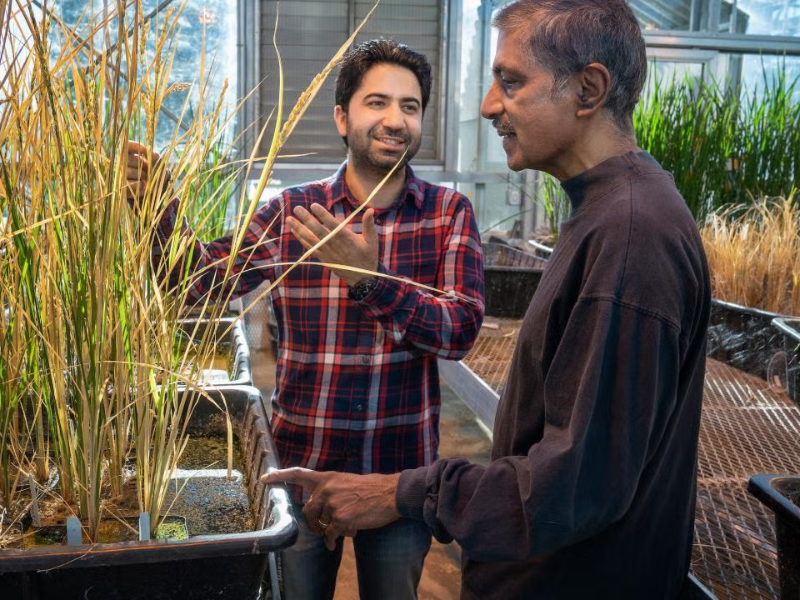 Imtiyaz Khanday (left) and Venkatesan Sundaresan photographed with cloned rice plants in a green house on the UC Davis campus in 2018. The team's work on creating rice plants that can produce clones of themselves as seeds could revolutionize global agriculture by making it cheaper and easier for farmers to plant high-performing hybrid crops. Sundaresan and Khanday's work has now been recognized with the VinFuture Prize Grand Prize. / UC Davis photo
Two Indian-origin plant biologists were awarded the VinFuture Prize for developing self-cloning crop technology that allows hybrid plants to preserve high yields across generations.
Venkatesan Sundaresan, a distinguished professor of plant biology and plant sciences, and Imtiyaz Khanday, an assistant professor of plant sciences, received the VinFuture Special Prize for Innovators with Outstanding Achievements in Emerging Fields at a ceremony held in Hanoi, Vietnam, earlier this month.
Also Read: NYC Mayor appoints 2 Indian Americans to rent guidelines board
The prize, which carries an award of $500,000, was established in 2021 by the VinFuture Foundation to recognize emerging research fields and innovations with the potential to create large-scale societal impact.
The award recognizes the researchers’ work on synthetic apomixis, a method that enables hybrid crops to reproduce clonally through seeds, bypassing sexual reproduction. Hybrid crops can produce significantly higher yields than traditional varieties, but their advantages are typically lost in the next generation, forcing farmers to purchase fresh seed each season.
By enabling crops to clone themselves, the University of California, Davis team demonstrated a way to preserve hybrid vigor over multiple generations.
“I’m honored that the global impact of our research is being recognized in this way,” Khanday said. “I come from a farming family, and I’ve always wanted to develop technologies that help farmers, especially smallholder farmers. We’re trying to make better seeds for the world.”
“Making crop hybrids widely available to smallholder farmers can meet food demands for the 21st century sustainably, without increasing land use or agricultural inputs,” Sundaresan said. “It will have vast impacts on millions of rice farmers and billions of people in developing countries for whom rice is the major caloric source.”
The technique relies on a two-step genetic process. Using CRISPR/Cas9 gene-editing tools, the researchers first switched off genes involved in meiosis so that egg cells retain a full set of chromosomes. They then activated a gene known as BBM1, which triggers embryo development without fertilization.
The approach mimics natural apomixis, a form of asexual reproduction found in certain plant species, resulting in offspring that are genetically identical to the parent plant and able to continue reproducing clonally.
The breakthrough emerged from basic research rather than a targeted effort to redesign crop reproduction. “When we started out, we weren't even working on this problem,” Sundaresan said. “We were just trying to understand how plants make embryos.”
Khanday identified the role of BBM1 in embryo activation while working as a postdoctoral researcher in Sundaresan’s laboratory. Around the same time, parallel work by Raphael Mercier at the Max Planck Institute for Plant Breeding Research, and Emmanuel Guiderdoni and Delphine Mieulet at CIRAD, established a way to prevent meiosis in rice. When the groups combined their findings, synthetic apomixis became possible.
The team first reported the self-cloning technique in rice in 2018 and later identified another gene that increased success rates to about 90 percent. Since then, the method has been demonstrated in maize, and an independent research group has applied it successfully in sorghum.
Sundaresan and Khanday are now working to expand the technology’s reach. Sundaresan is focused on optimizing the approach in rice and other cereal crops, while Khanday is developing self-cloning vegetable crops, beginning with potatoes and tomatoes.
The prize is shared with Mercier, Guiderdoni, and Mieulet, placing the team among previous VinFuture awardees that include researchers behind CAR-T cancer immunotherapy, the AlphaFold protein structure prediction system, and discoveries related to the GLP-1 pathway used in weight-loss drugs such as Ozempic.
Leave A Comment
Related




 (1).jpg)







ADVERTISEMENT

ADVERTISEMENT
E Paper
Video

Comments
Start the conversation
Become a member of New India Abroad to start commenting.
Sign Up Now
Already have an account? Login