ADVERTISEMENT
ADVERTISEMENT


India announces two new consulates, tourist visas to deepen Russia ties
Prime Minister Modi noted that the consulates complement recent outreach efforts.
-
1759163132.png) Anushka Pathak
Anushka Pathak - Fri, 05, Dec 2025
- 12:33 EST
- 107
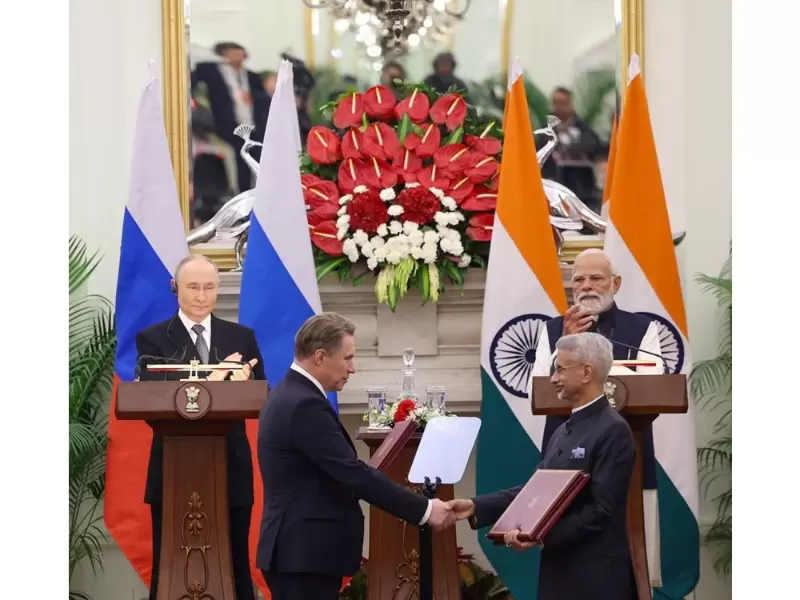 Indian External Affairs Minister Subrahmanyam Jaishankar and Russian Deputy Foreign Minister Andrey Rudenko along with Russian President Vladimir Putin and Indian Prime Minister Narendra Modi / Courtesy: @narendramodi via ‘X’
Prime Minister Narendra Modi described India’s establishment of two new consulates in Russia as a major step in strengthening cultural engagement and people-to-people ties between the two nations during the 23rd India-Russia Annual Summit in New Delhi on Dec. 5.
The consulates in Russia were inaugurated by the Indian External Affairs Minister Subrahmanyam Jaishankar and Russian Deputy Foreign Minister Andrey Rudenko in the cities of Yekaterinburg and Kazan on Nov. 19.
Also Read: Putin offers India 'uninterrupted' oil in summit talks with Modi
A key part of the India-Russia friendship is our cultural and people-to-people ties. This has been strengthened with the opening of two new Indian consulates in Russia and the holy Buddhist relics going to Russia in recent times. There is also immense potential in areas like… pic.twitter.com/b13UjtYK2E
— Narendra Modi (@narendramodi) December 5, 2025
"Recently, two new Indian Consulates have been opened in Russia. This will further facilitate engagement between our citizens and deepen their mutual relations," he said.
Modi said the expanded diplomatic presence would make citizen services more accessible and help deepen longstanding social and cultural bonds. He noted that the consulates complement recent outreach efforts, including the exhibition of sacred Buddhist relics in Kalmykia and new visa initiatives aimed at boosting tourism from Russia.
Modi also confirmed that India will soon introduce a free 30-day e-Tourist Visa and a 30-day Group Tourist Visa for Russian citizens.
Additionally, he announced that two agreements on manpower mobility had been signed, aimed at expanding vocational training, skills partnerships, and exchanges among students, scholars, and sportspersons.
Summit Focus
The Summit highlighted the 25-year evolution of the Strategic Partnership, now designated a "Special and Privileged Strategic Partnership."
The two leaders reviewed bilateral cooperation across trade, energy, and connectivity. Modi announced an Economic Cooperation Program running until 2030, intended to diversify commerce and promote co-production and co-innovation.
Both sides discussed progress on the Free Trade Agreement (FTA) with the Eurasian Economic Union and highlighted the importance of collaboration in agriculture and fertilizers, including joint efforts on urea production.
Connectivity projects also featured prominently. Modi said India would push ahead with the International North-South Transport Corridor, the Northern Sea Route, and the Chennai-Vladivostok maritime link.
He noted that Indian seafarers would now receive training for polar operations, strengthening cooperation in Arctic regions and creating new job opportunities.
On energy, Modi reiterated the durability of India-Russia civil nuclear cooperation and emphasized the importance of securing diversified supply chains for critical minerals essential to clean energy and high-tech manufacturing.
Leave A Comment
Related

ADVERTISEMENT

ADVERTISEMENT
E Paper
Video

Comments
Start the conversation
Become a member of New India Abroad to start commenting.
Sign Up Now
Already have an account? Login