ADVERTISEMENT

ADVERTISEMENT



Viral video of 7-Eleven H-1B worker fuels immigration debate
The clip drew reactions from Republican lawmakers, immigration restriction groups and online users, with some calling for the H-1B program to be abolished.
-
 Malvika Choudhary
 - Tue, 07, Apr 2026
- 17:59 EDT
- 34
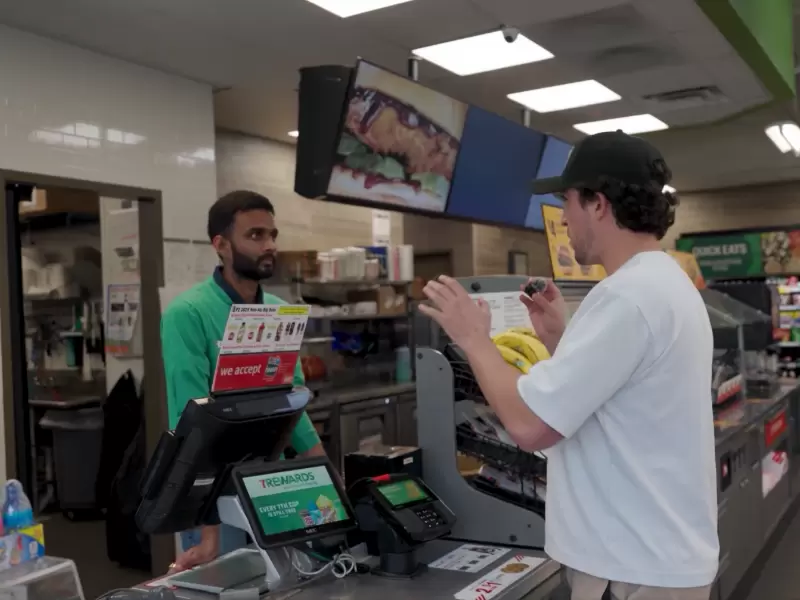 Screengrab from the video / AF Post
A viral video featuring a man who identifies as an H-1B visa holder while working at a 7-Eleven store has renewed online discussion regarding the potential misuse of the employment-based visa program in the United States.
The clip, circulated by AF Post and featuring influencer Tyler Oliveira, shows Oliveira entering a 7-Eleven store and questioning an employee about his immigration status. In the video, the employee says he is on an H-1B visa from Andhra Pradesh, India, and then tells Oliveira, “I’m going to call my manager.”
Also Read: How the new H-1B wage proposal could affect Indians
The video quickly spread across X, where it was amplified by anti-immigration accounts and prompted reactions from Republican lawmakers calling for the visa category to be scrapped altogether.
Congressman Brandon Gill wrote, “H-1B is a scam and should be abolished.” Congressman Greg Steube also reacted adding, “H-1B isn’t helping Americans. It’s replacing them! Our workers shouldn’t be second in their own country. My EXILE Act ELIMINATES the program entirely. This is what America First looks like!”
Steube’s post came days after he announced the EXILE Act, legislation that would end the H-1B visa program altogether, according to a statement from his office.
The video also drew pushback from immigration restriction advocates and users who said the claims accompanying it misstated how the H-1B system actually works.
The Project for Immigration Reform wrote, “There’s no requirement for an employer to prove that no American can fill the job before sponsoring an H-1B visa. It’s amazing that even H-1B critics keep pushing this lie.”
One user similarly wrote, “There is no such requirement, and that dude does not have an H-1B.”
Another user, in a post that drew attention for its inflammatory and caste-coded language, suggested that migration through the visa system was often facilitated through community and family networks rather than merit-based hiring alone.
The competing reactions reflected a broader divide that has long surrounded the H-1B visa program: whether it serves a legitimate labor-market need or has become vulnerable to abuse, outsourcing and political distortion.
The video has drawn particular attention because the H-1B program is legally meant for “specialty occupations”—jobs that generally require highly specialized knowledge and at least a bachelor’s degree or equivalent in a directly related field, according to U.S. Citizenship and Immigration Services.
USCIS says such occupations can include fields such as engineering, mathematics, medicine, education, business specialties and computer-related work.
That has made the clip politically potent, with critics arguing that a cashier position at a convenience store does not appear to match the kind of role the visa was created for.
The H-1B process requires an employer to file a Labor Condition Application with the U.S. Department of Labor and attest to wage and workplace conditions. Employers must generally confirm that they will pay the required wage, provide comparable working conditions, and notify workers at the job site.
But federal rules do not impose a blanket requirement on every H-1B employer to first prove that no American worker is available for the role. Additional recruitment and non-displacement requirements apply only in limited circumstances, including certain H-1B-dependent employers and willful violators.
That distinction has become one of the central fault lines in the argument now playing out online: whether the problem is the law itself, weak enforcement, or misleading public claims about how the program actually works.
The video also raised questions about who, exactly, may have employed the worker shown in the clip.
That uncertainty is relevant because many 7-Eleven locations in the United States are franchise-operated rather than directly run by the company, meaning the worker shown in the video may not necessarily have been employed by 7-Eleven corporate itself.
The clip itself does not independently establish the worker’s visa category, sponsoring employer, approved job title, or whether he may have changed employers under lawful H-1B portability rules.
Discover more at New India Abroad
Related







ADVERTISEMENT

ADVERTISEMENT
E Paper
Video

Comments
Start the conversation
Become a member of New India Abroad to start commenting.
Sign Up Now
Already have an account? Login