ADVERTISEMENT
ADVERTISEMENT



The crucible the numbers do not name
The first wave of second-generation Indian American founders is only now coming of age, and the early signs are mixed.
-
 Prasad Kaipa
 - Thu, 11, Jun 2026
- 11:31 EDT
- 163
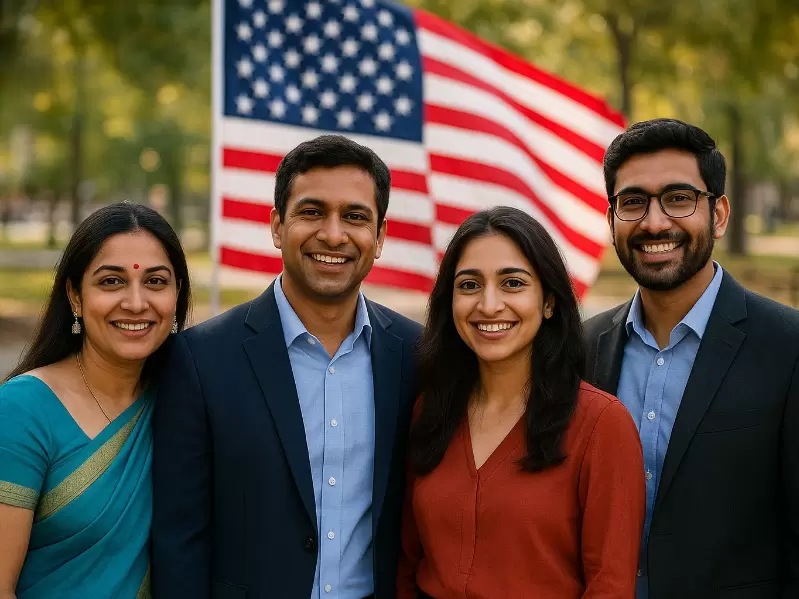 Representative image / AI generated
Earlier this week, the National Foundation for American Policy released a report that, depending on how you read it, is either a celebration or a question. The headline numbers are easy to celebrate.
Of the 775 unicorns in the United States, 455—nearly six in ten—were founded by immigrants. India leads every country of origin with 96. Of the fifteen founders who have built more than one unicorn, six were born in India.
I read the report from San Jose, where I have lived for almost four decades, and where the children of many of the founders the report celebrates are now in their twenties and thirties. Some are building companies of their own. Some are not. The report does not speak about them.
Also Read: Indian immigrants lead U.S. unicorn boom, NFAP report finds
But the more I sat with the numbers, the more I felt it was quietly asking a question it never poses directly. Three observations emerged for me as I read, and a question on the other side of them.
The first lesson is that the crucible was not optional. The report is a story of talent, yes, and of opportunity, but underneath those it is a story of forming. The first-generation founders on this list — the ninety-six from India and the many more from elsewhere — went through something the report does not name. They left home. They navigated visa uncertainty for years and sometimes for decades. They held identity steady in places where the food, the language, the assumptions and the silences were all foreign.
They learned to translate between worlds at the dinner table and in the lab. By the time they sat across from an American investor and made the pitch that would change their lives, something had already been forged in them that no business school can manufacture. The crucible was not the work of building the company. The crucible was everything that came before it. The journey itself became the apprenticeship. The company came later.
This matters because we keep telling the story of these founders as if it were a story of cleverness, hard work and a good idea. It is. But that is not the whole story, and it may not even be the most important part. The most important part is what the journey itself did to the person who eventually built the company. The journey was the apprenticeship. The company was the graduation project.
The second lesson is closer to the surface of the data than people realize. Six of the fifteen founders who have built more than one unicorn are Indian-born. One unicorn can be luck. Two is a capacity. And the capacity, in my experience of working with founders for the better part of four decades, is not a second clever idea. It is something quieter. It is the ability to remain coherent when nothing around you is.
The first-generation founder, having arrived without family nearby, without a domestic safety net, without an inherited sense of belonging, had to learn to hold the inner field together when the outer field offered no support. Years of that practice — unchosen, often painful — produce a particular kind of person.
Also Read: CEO flags U.S. immigration as key hurdle for founders
When the round does not close, when the co-founder leaves, when the market shifts under her feet, she does not collapse into the situation. She remains, in some way that is hard to describe but easy to recognize once you have seen it, separate from the crisis even while she is fully inside it.
Perhaps this is one way to read the numbers. The unicorn may be the visible outcome, but the deeper story may lie in capacities that were formed long before the company existed. The unicorn is a lagging indicator. The founder’s inner steadiness may be the leading indicator. We talk about resilience as if it were a personality trait some people have and others do not. The truth may be simpler. Resilience is often what remains after years of learning to stay inwardly steady when life offers no such steadiness from outside.
The third lesson is the one I almost missed. Each immigrant-founded unicorn in the NFAP study employs, on average, 833 people. Co-founders cluster in the same immigrant communities. Talent and capital concentrate in the same square miles. The report counts this as economic impact, and it is. It is also something else.
The first-generation founder, having developed an inner steadiness through the immigrant journey, then generated a coherent field around her — a workplace, a team culture, a network — that others recognized and entered. The 833 jobs are not a byproduct of growth.
They are the consequence of a founder who became someone other people wanted to work with, and to work for. This is a quieter achievement than the billion-dollar valuation, and arguably the more important one. The valuation can disappear in a quarter. The field a founder generated tends to outlast the company that contained it.
And then there is the question on the other side of these three lessons, which is the question I cannot stop thinking about.
The second-generation American-born child of an immigrant founder has not been through this crucible. She grew up in Cupertino or Fremont or Edison. She attended good schools. She had parents who could explain the system to her by the time she needed to know it. She did not have to wonder whether her visa would be renewed. She did not have to call home across twelve time zones to a parent who could not help her with anything practical, because the parent had also never been here before.
She has every advantage her parents did not have. And she does not have the one thing they did. That does not mean her generation will not face its own crucibles. They may simply look different. Questions of identity, meaning, belonging, distraction and abundance may prove every bit as formative as the uncertainties their parents faced when they first arrived.
This is not a complaint about the second generation. It is a recognition of a structural fact. The crucible that formed her parents will not form her, because the conditions that made the crucible no longer apply to her life. She is not less talented. In many ways she is more so. She is not less ambitious. She may be more so. But the inner work that her parents were required to do because they had no choice, she will have to find a way to do voluntarily, or it will not happen.
This is the question the NFAP report quietly poses, even though it does not pose it out loud.
Can a generation that did not have to leave home find an equivalent crucible by other means? Can coherence be cultivated by choice when it is no longer being forged by necessity? Can a young founder who grew up in Cupertino become the kind of person who can build something of comparable significance to what her parents built, without the years of dislocation that made her parents into who they became?
I do not know the answer. I am not sure anyone does yet. The first wave of second-generation Indian American founders is only now coming of age, and the early signs are mixed. Some seem to have found their own crucibles — through illness, through loss, through deliberate immersion in conditions their parents would have recognized. Others seem to be building competently and well but not yet with the inner steadiness that produced the founders the NFAP report counted. It is too early to draw conclusions.
What I can say is this. The numbers in the report deserve celebration. But the more interesting story is not in the numbers themselves. It is in what they point toward without naming. The immigrant journey did more than move talent across continents. It shaped people through uncertainty, adaptation and responsibility before those people went on to build companies and institutions.
The first generation found its crucible in migration itself. The next generation will almost certainly find a different one. The question is whether it will cultivate the same depth of character by different means. The answer is not yet clear. But the future of entrepreneurship may depend as much on the formation of people as on the formation of companies.
The author is a researcher, former fellow at Apple University and CEO coach.
(The views and opinions expressed in this article are those of the author and do not necessarily reflect the official policy or position of New India Abroad.)
Discover more at New India Abroad
Related










ADVERTISEMENT

ADVERTISEMENT
E Paper
Video

Comments
Start the conversation
Become a member of New India Abroad to start commenting.
Sign Up Now
Already have an account? Login