ADVERTISEMENT

ADVERTISEMENT



Slower US job growth expected in December; unemployment rate likely dipped
The labor market lost considerable momentum last year, with well-below one million jobs estimated to have been added.
-
 Reuters
 - Fri, 09, Jan 2026
- 00:26 EST
- 14
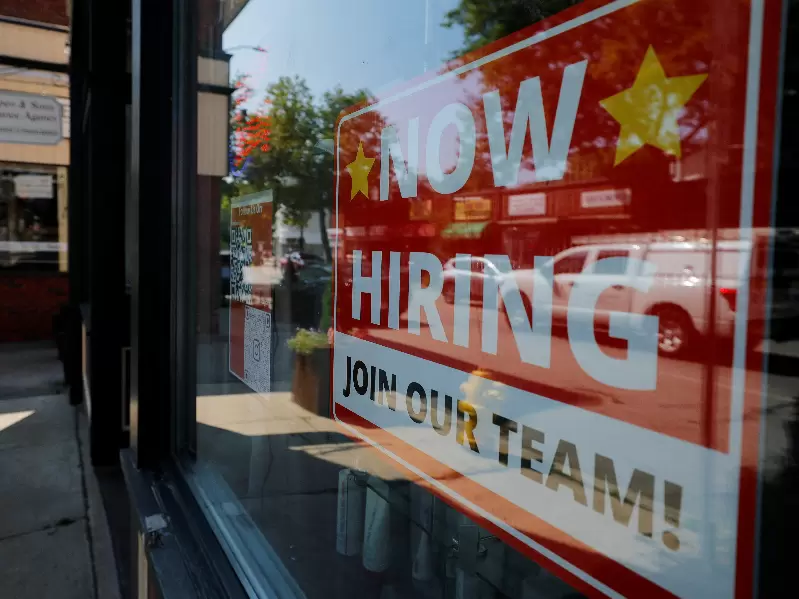 A "Now Hiring" sign hangs in the window of a hair salon in the Greater Boston town of Medford, Massachusetts, U.S., August 12, 2025. / REUTERS/Brian Snyder
U.S. job growth likely slowed in December as businesses remained cautious about hiring amid concerns over import tariffs and rising investment in artificial intelligence, though an anticipated easing in the unemployment rate to 4.5 percent could support expectations that the Federal Reserve will leave interest rates unchanged this month.
The Labor Department’s closely watched employment report, due Jan. 9, is expected to show the labor market remained stuck in what economists and policymakers have described as a “no hire, no fire” mode. The data would also reinforce signs that the economy is experiencing a jobless expansion. Economic growth and worker productivity surged in the third quarter, partly attributed to the boom in AI-related spending.
“It’s not so much weak demand because the economy seems to be doing not bad, but businesses are very cautious about taking on new workers,” said Sal Guatieri, a senior economist at BMO Capital Markets. “That’s possibly related to the desire to keep costs under control, perhaps in the face of tariffs, but also because many businesses believe there will be some productivity payoff from AI-driven automation.”
Nonfarm payrolls are expected to have increased by 60,000 jobs last month after rising by 64,000 in November, according to a Reuters survey of economists. The economy lost 105,000 jobs in October, the largest decline in nearly five years, largely reflecting federal government employees who took deferred buyouts and received their final paychecks at the end of September.
Economists estimate that between 50,000 and 120,000 jobs must be created each month to keep pace with growth in the working-age population.
The labor market lost considerable momentum last year, with well below one million jobs estimated to have been added. About 2 million jobs were created in 2024, though that figure could be revised lower next month when the Bureau of Labor Statistics publishes its payroll benchmark revision alongside the January employment report.
The BLS has estimated that about 911,000 fewer jobs were created in the 12 months through March than previously reported. The overcount has been attributed to the birth-death model, which the BLS uses to estimate job gains and losses from business openings and closures each month.
Last month, the BLS said it would begin incorporating current sample information into the birth-death model each month starting in January.
Job growth slowed sharply last year
The sharp moderation in job growth last year was widely attributed to President Donald Trump’s aggressive trade and immigration policies, which economists and policymakers said reduced both labor demand and supply. Some economists argue that limited labor supply has helped prevent a sharper rise in unemployment.
The unemployment rate rose to a more than four-year high of 4.6 percent in November from 4.4 percent in September, partly distorted by a 43-day federal government shutdown that also prevented the collection of household data for October. As a result, the unemployment rate for October was not published for the first time since the government began tracking the series in 1948.
“There has been continuous uncertainty over tariffs,” said Dan North, senior economist at Allianz Trade North America. “We also have a falling supply of labor since the foreign-born workforce is shrinking fairly rapidly.”
Alongside the December employment report, the government will publish annual revisions to the seasonally adjusted household survey covering the past five years. The unemployment rate is derived from the household survey. Annual population control adjustments, typically included with the January employment report, will be delayed.
While the median forecast in the Reuters poll was for the unemployment rate to ease to 4.5 percent in December, some economists expect it to rise to 4.7 percent, which they say could open the door to a rate cut this month. They cautioned against interpreting any stronger-than-expected December payrolls figure as evidence of labor market improvement, citing challenges associated with year-end data adjustments.
“A 4.7 percent unemployment rate in December would not only confirm that November was relatively free of shutdown-related measurement issues, but that downside risks to the labor market have increased even more since the Fed’s December meeting,” said Veronica Clark, an economist at Citigroup.
The U.S. central bank cut its benchmark interest rate by a quarter percentage point to a range of 3.50 percent to 3.75 percent in December, but officials signaled they were likely to pause further reductions to better assess the economy’s trajectory.
Job growth in December likely remained narrow, concentrated in health care and social assistance. With factors such as tariffs and AI investment discouraging broader hiring, economists increasingly view the labor market’s challenges as structural rather than cyclical.
“Lowering interest rates may help buoy the economy at the margin, but it is unlikely to push companies that are on temporary hold with hiring decisions due to tariff-related uncertainty to add workers,” said Stephen Stanley, chief U.S. economist at Santander U.S. Capital Markets. “The Fed is certainly powerless to counteract concerns related to AI.”
Related












ADVERTISEMENT
ADVERTISEMENT
E Paper
Video

Comments
Start the conversation
Become a member of New India Abroad to start commenting.
Sign Up Now
Already have an account? Login