ADVERTISEMENT
ADVERTISEMENT



Shubhanshu Shukla recalls Hindi aboard ISS, backs space future
Astronaut also urged startups to seize India's rapidly expanding space economy.
-
 Ankita Baidya
 - Fri, 10, Jul 2026
- 05:30 EDT
- 42
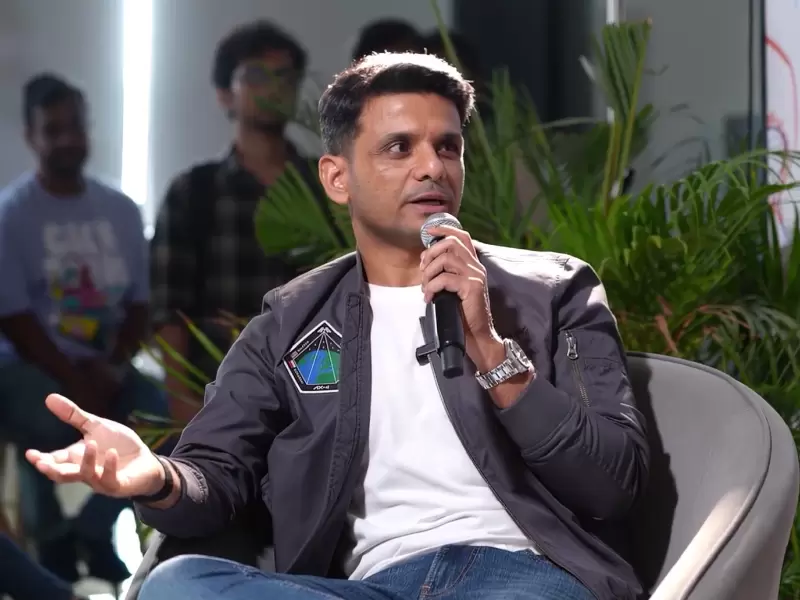 Group Captain Shubhanshu Shukla speaks during a conversation hosted by South Park Commons India. / X/@adityaag
Indian astronaut Group Captain Shubhanshu Shukla recalled the first time Hindi was spoken aboard the International Space Station (ISS), describing his conversation with Prime Minister Narendra Modi from orbit as one of the defining moments of his 2025 Axiom Mission 4 during a conversation hosted by South Park Commons India
Also read: Anil Menon set for first spaceflight to ISS on July 14
Speaking with South Park Commons General Partner Aditya Agarwal in the venture firm's "-1" interview series, Shukla reflected on life in orbit, astronaut training and India's growing space ambitions.
He also encouraged entrepreneurs to build for India's rapidly expanding space sector, saying the country is witnessing a "Cambrian explosion" in innovation driven by startups, human spaceflight ambitions and increasing private-sector participation.
"There are close to 400 startups in the space domain today," Shukla said, adding that India is witnessing "a Cambrian explosion" in the sector.
He encouraged South Park Commons founders to pay attention to emerging space companies, saying the country is entering a period of rapid technological growth.
Shukla said India's human spaceflight program represents an important milestone for the country's ambitions. He noted that once India successfully completes the Gaganyaan mission, it will become only the fourth nation to independently send humans into space.
"There are huge players... countries which have picked up these missions and given up, not successfully being able to execute them," he said.
"The day we pull this off... we become the fourth country to achieve this in the world." He added that if more people choose to contribute to the sector, India could "grow very rapidly" in space technologies.
The discussion also explored Shukla's personal journey to becoming India's second astronaut to travel to space. He told Agarwal that he applied to the National Defence Academy at age 17 without informing his parents because he anticipated they would discourage him from pursuing a military career.
"I did not tell them because I kind of knew that if I told them in advance, then probably I would face some resistance," Shukla recalled.
Describing the astronaut selection process, he said the initial pool consisted of 72 Indian Air Force test pilots before the Indian Space Research Organisation, with guidance from Russian specialists, narrowed the field through extensive medical, physical and psychological evaluations.
Among the unexpected screening criteria, he said, was dental health because dental surgery cannot be performed in space.
Shukla said candidates also underwent demanding physical tests, including running five kilometers in under 24 minutes, completing 11 pull-ups, 30 push-ups and swimming 800 meters in under 20 minutes.
The most difficult challenge, however, was a seven-day isolation exercise conducted without natural light, clocks or phones.
Reflecting on his 2025 Axiom Mission 4 flight to the International Space Station, Shukla described experiencing the "overview effect,” a perspective shared by many astronauts that transforms how they view Earth.
He said that seeing the planet from orbit immediately changed his understanding of home, making him feel connected to Earth as a whole rather than to any single nation.
Shukla also discussed the physical effects of microgravity, explaining that astronauts experience fluid shifts toward the head, temporary facial swelling, appetite loss and what is commonly called "space fog" as the brain adapts to weightlessness. He said he grew about five centimeters taller in orbit because the spine expands in microgravity.
During an audience question about future missions to Mars, Shukla said sustaining human life during long-duration spaceflight remains the greatest challenge.
Radiation exposure, waste management, food systems and long-term habitation all require major technological advances before humans can safely undertake missions to the Red Planet, he said.
Asked what motivates him beyond financial success, Shukla said experiences matter more than wealth once basic needs are met.
"You should work for money... but that should not be the only thing that drives you," he said, encouraging entrepreneurs to pursue ambitious work that excites them rather than focusing solely on financial outcomes.
The event concluded with Shukla offering advice to young people: "Dream big and stay curious."
Discover more at New India Abroad.
Leave A Comment
Related




ADVERTISEMENT

ADVERTISEMENT
E Paper
Video

Comments
Start the conversation
Become a member of New India Abroad to start commenting.
Sign Up Now
Already have an account? Login