ADVERTISEMENT

ADVERTISEMENT



Medical University of South Carolina honors Shikhar Mehrotra for impact
Mehrotra was recognized for his pioneering work in T cell–based immunotherapy.
-
 Malvika Choudhary
 - Wed, 24, Dec 2025
- 12:45 EST
- 13
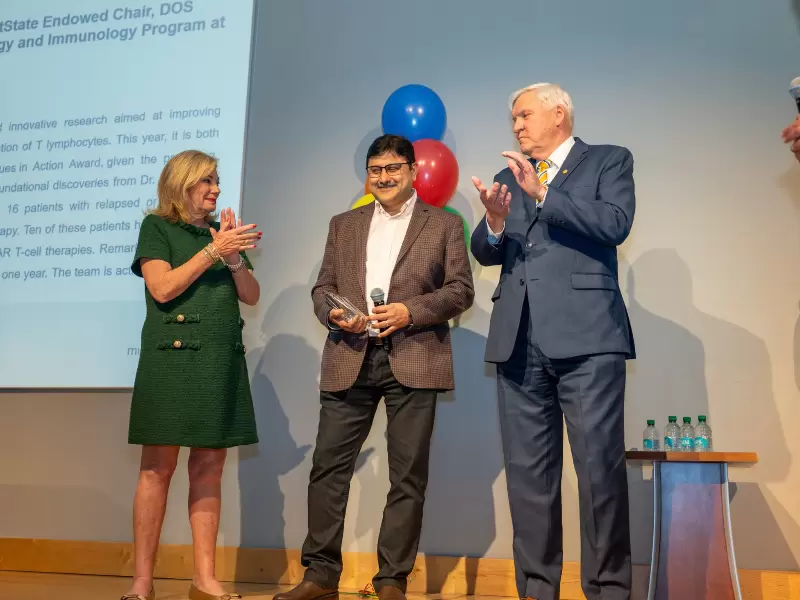 Kathy Cole and MUSC President David Cole applaud as Dr. Shikhar Mehrotra receives the 2025 Impact Award. / Photos by Diego Torres Fajardo/ musc.edu
The Medical University of South Carolina (MUSC) conferred its 2025 Impact Award on Shikhar Mehrotra, recognizing his contributions to cancer immunotherapy and translational research.
The award was presented during the President’s Values In Action Awards ceremony, which marked a decade of the institution recognizing faculty and staff whose work reflects MUSC’s core values.
Also Read: Raghu Mocherla joins Hexaware as SVP, Digital and Software
Mehrotra was recognized for his pioneering work in T cell–based immunotherapy, an area widely regarded as a critical frontier in cancer treatment. He was nominated by Besim Ogretmen, who highlighted Mehrotra’s standing within the scientific community.
“He’s respected with not only the MUSC family but also with national and international immunologists. I learn every day from Shikhar, and this is so well-deserved,” Ogretmen said as quoted by university press.
Mehrotra’s research has drawn national and international attention for advancing the understanding of how immune cell metabolism influences the durability and effectiveness of cancer immunotherapies.
His work is frequently engaged by immunologists and cancer researchers across the United States and abroad, contributing to evolving preclinical and translational strategies aimed at improving patient outcomes and long-term tumor control.
At MUSC, Mehrotra serves as co-scientific director of the Center for Cellular Therapy, where his translational research focuses on understanding T cell biology to enhance immunotherapy efficacy while minimizing toxicity.
A new clinical trial recently opened for recruitment is testing metabolically engineered CAR-T cells designed to improve treatment response and reduce adverse effects. In parallel, related strategies supported by National Cancer Institute STTR funding are generating validation data for future clinical trials using tumor-infiltrating lymphocytes to treat malignant melanoma, breast cancer, and prostate cancer.
His laboratory has produced key findings linking immune signaling pathways with cellular metabolic states to improve the persistence and tumor-controlling capacity of T cells.
These include identifying effector T cell populations with high antioxidant capacity, demonstrating the role of thioredoxin in maintaining central memory T cell phenotypes, and establishing how regulators such as p53 and CD38 influence T cell metabolism and anti-tumor activity.
More recent studies from his group show that combining metabolic pathway inhibition with immune checkpoint blockade can lead to stronger and more durable tumor control.
Accepting the award, Mehrotra credited the institutional environment that has supported his work. “You all have been very supportive and very helpful all through this journey. There are highs and lows in this profession, which we all know, but I think we have kept with it because of the great support system that we have created here at MUSC,” he said.
Mehrotra is an assistant professor at the Medical University of South Carolina. He completed his education at the Sanjay Gandhi Postgraduate Institute of Medical Sciences.
Related


.jpg)




ADVERTISEMENT
ADVERTISEMENT
E Paper
Video

Comments
Start the conversation
Become a member of New India Abroad to start commenting.
Sign Up Now
Already have an account? Login