ADVERTISEMENT

ADVERTISEMENT



Kamala Harris will be the next President—Here’s how
Washington punditry keeps missing the obvious: Harris has been running a go-to-market campaign in plain sight.
-
 Dinesh Sastry
 - Wed, 24, Dec 2025
- 10:33 EST
- 225
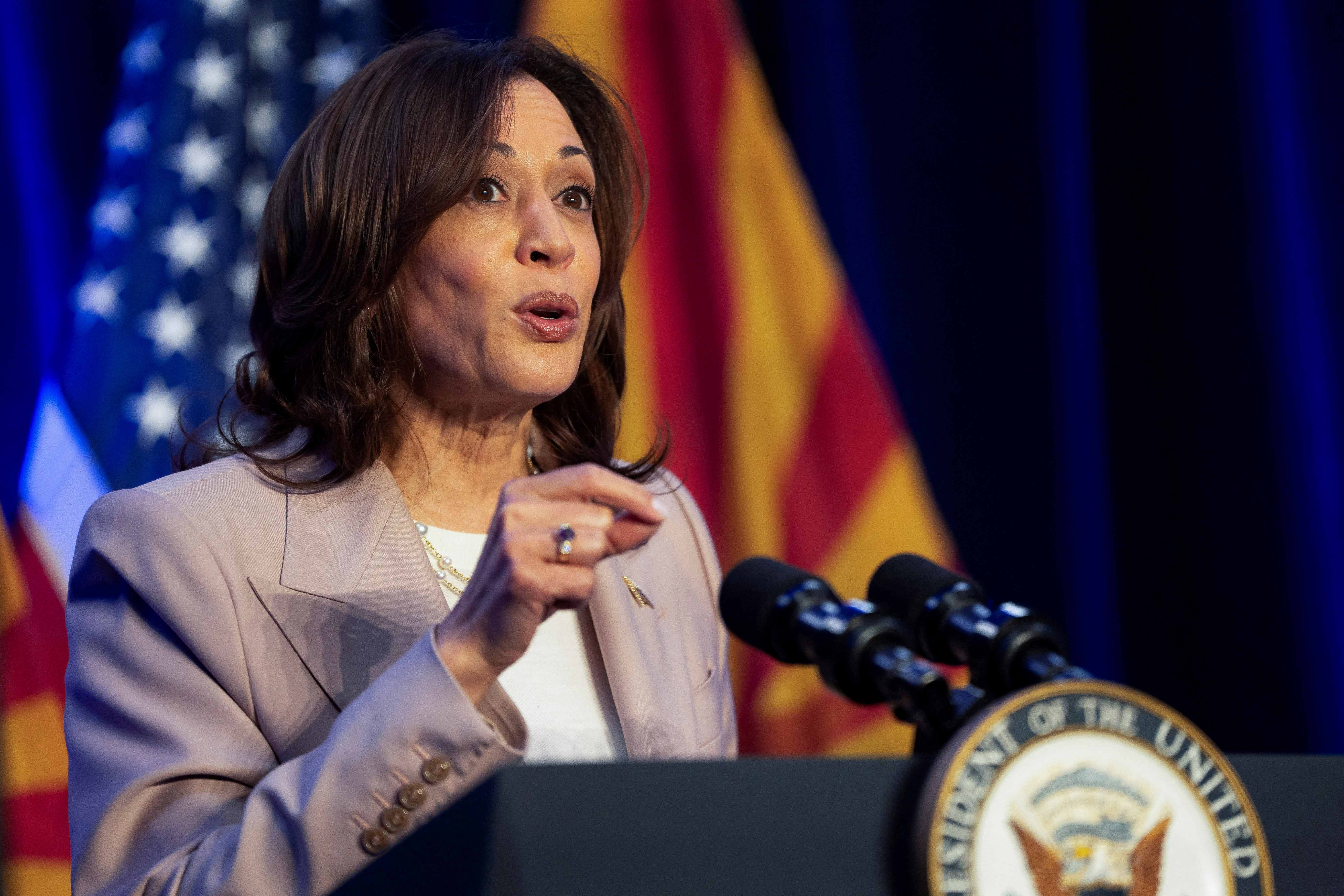 Kamala Harris / REUTERS/Rebecca Noble/File Photo
I’ve spent three decades at the crossroads of Silicon Valley innovation, Wall Street capital, Hollywood narrative power, and Washington policy. From that vantage point—and from a lifetime in the Indian-American community—I’m convinced Kamala Harris will be the next President of the United States.
Not by accident, and not by wishful thinking—but by coalition math, economic realism, and a foreign-policy instinct grounded in discipline rather than performance.
This is a case about how America actually chooses presidents: early trust among the voters who decide Democratic primaries, a pragmatic economic offer that meets people where they live, and a governing posture that competes hard abroad without chaos at home.
It’s also a case about infrastructure—the organizers, donors, small-dollar networks, temple and church communities, diaspora professionals, micro-influencers, union halls, startup hubs, and neighborhood leaders who convert sentiment into votes. That infrastructure already exists. We are living inside it.
Listening tour
Washington punditry keeps missing the obvious: Harris has been running a go-to-market campaign in plain sight. Call it a “book tour” if you like; in reality it’s a listening engine—a structured set of high-density interactions designed to test, refine, and scale the message while building owned media and community lift.
-
In city after city—including a Chicago stop that drew an organizer-estimated crowd in the thousands—the format flipped the old script: Harris hears first; Harris speaks second. That two-way choreography is how you turn applause lines into belonging.
-
Each stop functions like a beta test: A/B messaging in the hall, sentiment sampling in the selfie line, follow-up loops online, and community nodes spun up to carry the message after the lights go down.
-
The result is data-rich and demographically aligned: young voters who don’t want to be talked down to; Black women who have powered Democratic victories for a generation; Latinos and Asian Americans (including Indian Americans) who respond to both dignity and delivery; suburban families who want normalcy with a plan.
Cable bookers may underrate this because it isn’t built for the green room. That’s fine. Quiet momentum is a feature, not a bug. By the time the political class looks up, the demand signal is already there.
Four Capitals
I think about American elections through four interlocking arenas:
-
Silicon Valley (Technology & Talent). The Harris coalition is unusually fluent in the realities of labs, fabs, and AI—where policy must be predictable, not performative. “De-risking” supply chains while keeping channels open to prevent miscalculation is how companies invest and hire again. Her message aligns with what founders and engineers actually need: rules you can model against, not headline whiplash.
-
Wall Street (Capital & Cost of Living). Tariffs used as posture function like taxes for households and friction for firms. Harris’s economic offer focuses on predictability and affordability—time-bound tools with measurable sunsets; family-centered tax relief; drug-price enforcement people can feel at the pharmacy; and housing supply policies that move shovels, not slogans. This is pro-opportunity without chaos.
-
Hollywood (Story & Culture). You don’t win by lecturing culture; you win by inviting people into a story that respects their agency. Harris’s listening-first tour is narrative discipline: each room builds local surrogates and micro-influencers who tell their own stories back into the network. That is culture as infrastructure.
-
Washington (Institutions & Legitimacy). Leverage abroad shrinks when legitimacy at home is squandered. Harris’s instinct is to use power within bounds—keep justice independent, welcome oversight, and let competence speak. That’s how you earn consent for tough deals overseas and protect liberty at home.
Indian-American role
I’ve watched the Indian-American community grow from scattered professionals to a durable civic force that organizes, gives, persuades, and governs. We are not a monolith, but we do build institutions—and we remember who showed up when it mattered.
-
In May 2023, Indian-American fundraising networks helped kick off the Biden-Harris effort, signaling early capacity and staying power.
-
In May 2024, venture pioneer Vinod Khosla hosted President Biden for a major Silicon Valley fundraiser, emblematic of a broader, technology-led donor ecosystem that has matured and diversified.
-
This isn’t new. In 2000, Bay Area Indian-American entrepreneurs raised $600,000 at a Silicon Valley event headlined by Al Gore—an early template for what our civic infrastructure could become.
-
The cultural diplomacy piece goes back decades as well—from Diwali messages at the highest level to a growing recognition of South Asian traditions in America’s public square.
Today, analyses of campaign contributions and representation confirm what we’ve lived: a community over-indexed in technology, finance, medicine, and academia naturally punches above its weight in political organization.
Coalition buliding
Some of this is not about spreadsheets; it’s about people you share tea with. My parents knew Shyamala Gopalan and Donald Harris when so many of us were part of the same UC Berkeley orbit—often gathering, as our families did, in the homes of Professors George and Kausalya Hart, who nurtured generations of South Asian scholars and community leaders.
In those years and the decades after, the Livermore Shiva-Vishnu Temple—which my parents and their friends helped build—was a hub where culture met civic life. Community memory holds that Kamala Harris attended temple events; that’s how diasporic coalitions begin—in rooms where elders talk, kids listen, and a sense of duty takes root.
I share this not as hagiography but as context: Harris’s coalition is not an overnight brand; it’s a lived network of neighborhoods, temples and churches, synagogues and mosques, campus circles and startup garages—in California and far beyond.
Early-state lock
Primary campaigns are decided by voters who actually show up. Harris begins with durable trust among African-American voters—especially women—in South Carolina and across the Southern map.
Add strength with Latinos and Asian Americans, a meaningful slice of union households, and youth who respond to dignity and delivery rather than condescension, and you get a South Carolina → Nevada → California sequence that front-loads inevitability. That’s not mysticism; it’s calendar math.
General election
The four most powerful words in 2028 politics may be: “I told you so.” Harris warned that treating tariffs as a lifestyle rather than a lever would raise prices and freeze investment; households lived that truth.
She warned that authoritarian temptations would trample rights and destabilize institutions; people felt that in their clinics and courtrooms. But she couples that indictment with a forward-looking offer:
-
Predictability: security-driven tools tied to clear metrics and sunsets so businesses can invest and households can plan.
-
Affordability: family-centered tax relief; insulin and drug-price enforcement you can feel; housing supply that accelerates permits and build-out.
-
Civic restraint: keep prosecutors independent; confine executive emergencies to emergencies; stop governing by spectacle.
South Asian women
You can watch the mobilization in real time. South Asian women’s organizations have been convening thousands at a time online and off, turning identity into civic muscle and mentorship into volunteer energy. This isn’t merely symbolism; it’s logistics—rides, childcare networks, text banks, small-dollar bundling—the unglamorous work that wins.
And far from being confined to one ethnicity, that energy bridges outward—to Black church networks, Latino small-business groups, suburban teachers, nurses, and first-generation students who look at the last years and say: never again. (Yes, the toxicity online has been real; communities have endured it—and organized through it.)
Foreign policy
Readers of The National Interest and New India Abroad know the stakes: compete hard with China, protect crown-jewel technologies, diversify critical minerals and semiconductor supply chains, and keep crisis channels hot to avoid miscalculation.
No melodrama, no self-inflicted whiplash—discipline over theater. That’s the posture Harris has sketched and that America’s allies are prepared to meet halfway. The bonus: credibility at home—the one asset that multiplies leverage abroad.
Surprise element
Because this time the demand is bottom-up. The national media can ignore a listening tour because it does not fit the conflict-driven incentives of cable. But organizing beats airtime when the product-market fit is there: rights, affordability, competence, and a foreign policy that treats power like a responsibility.
If you’re waiting for a Sunday-show coronation, you’ll miss the point. The coalition is already being built—in the temples and town halls, venture lofts and union cafeterias, WhatsApp groups and neighborhood PTAs. The “surprise” is only a surprise to people who weren’t in the room.
Getting there
I’ve seen this kind of quiet momentum before—from White House Diwali moments that recognized a community’s dignity, to early Valley fundraisers that tested whether we could organize at scale, to today’s multi-platform networks that can pivot from fundraiser to phone bank in a day.
Kamala Harris’s coalition exists. Her economic message meets the mood. Her foreign-policy instinct chooses competence over chaos. The map from South Carolina to Nevada to California sets up the nomination; a Sun Belt lift plus a Midwestern hold wins the presidency. The identity milestones her election would represent are historic. But the reason she gets there is simpler: coalition math, economic realism, and civic restraint.
The author is the Founder & President of Illuminant Capital Holdings and a longtime advisor across technology, media, and public policy.
(The views and opinions expressed in this article are those of the author and do not necessarily reflect the official policy or position of New India Abroad.)
Related






ADVERTISEMENT

ADVERTISEMENT
E Paper
Video

Comments
Start the conversation
Become a member of New India Abroad to start commenting.
Sign Up Now
Already have an account? Login