ADVERTISEMENT

ADVERTISEMENT



Mark Carney's new package to Ukraine has Canadians divided
Canada has been a staunch supporter of Ukraine since Russia’s full-scale invasion began in February 2022, committing $6.5 billion in military support along with humanitarian aid.
-
 Prabhjot Paul Singh
 - Mon, 29, Dec 2025
- 22:33 EST
- 17
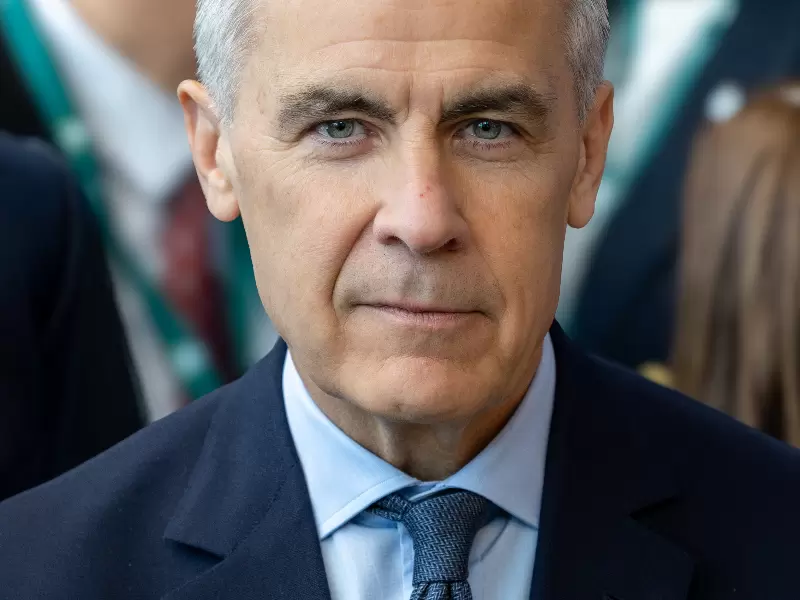 Mark Carney / Wikimedia commons
When Canadian Prime Minister Mark Carney rolled out a new economic package for war-torn Ukraine as he and Volodymyr Zelenskyy met briefly at a Halifax-area airport, a chain of reactions, both for and against helping a nation in distress, started.
The two leaders embraced as Carney welcomed Zelenskyy to Canada. Zelenskyy touched down for a brief stop on his way to Florida for planned peace talks with U.S. President Donald Trump this weekend, which he called “very important and very constructive.”
Though the “intentions” behind aid or economic packages are seldom a subject of debate, this time the questions are being raised as the quantum of economic assistance offered looks beyond the means of the country that just managed to get its budget for 2025 ratified by the House of Commons by a couple of votes.
Canada has been a staunch supporter of Ukraine since Russia’s full-scale invasion began in February 2022, committing $6.5 billion in military support along with humanitarian aid.
The $2.5 billion that Canada committed to providing aid should enable the International Monetary Fund and the World Bank to lend nearly $10 billion to Ukraine to support reconstruction, the Prime Minister’s Office said in a news release. The funding will also be used to guarantee a loan of up to $322 million from the European Bank to assist Ukraine in reinforcing energy security.
“Canada has committed new support to Ukraine, not only to help end this war, but also to help the Ukrainian people recover and rebuild,” said Carney in the statement.
“Canada stands with Ukraine, because their cause—freedom, democracy, sovereignty—is our cause,” he said.
The new economic package has evoked mixed reactions. While it may be a little far-fetched to link the revival of speculations that a section of the wealthy, perturbed by the rising tax slabs, including the wealth tax, plans to move out to safer tax havens, there is a certain undercurrent of discontent among average taxpayers over the government's largesse to nations at war.
They hold that with $2.5 billion in new “offerings” to Ukraine, it is no surprise that the federal government is looking at larger deficits. The 2024 fall statement projected a budget deficit of $42.2 billion this fiscal year. The 2025 budget pegged the deficit at $78.3 billion, with deficits exceeding $50 billion for the next five years. Ultimately, these growing deficits will transform into taxes, direct or indirect, besides accelerating rates of both inflation and unemployment.
Some of the economic erosions may be due to conditions that have deteriorated since last year, but the bulk is from new spending. Overall, higher deficits are translating into more debt. As a result, debt servicing charges as a share of federal revenues are expected to increase from 10.5 percent last fiscal year to more than 13 percent by 2029–30.
ALSO READ: U.S. pledges $2 billion in new UN model for delivery of humanitarian assistance
Nonetheless, given the increases in spending and deficits, the federal government has once again changed its fiscal anchor, which is a target that the government articulates to reassure markets, rating agencies, and the public that its finances remain responsible.
An official communique said that since Russia’s unprovoked, unjustified, full-scale invasion, Canada has provided nearly $22 billion in multifaceted assistance for Ukraine, including over $12 billion in direct financial support—making Canada among the largest contributors to Ukraine’s recovery and reconstruction. As the Ukrainian people endure another winter of Russian aggression, Canada remains steadfast in its support for Ukraine.
Building on Canada’s strong support for Ukraine, Mark Carney announced last weekend new measures to support a just and lasting peace. Canada has announced an additional $2.5 billion commitment for Ukraine, including financing that will enable the International Monetary Fund to lend Ukraine an additional $8.4 billion as part of an extended financing program, besides Canada’s participation in extended and expanded debt service suspension for Ukraine, for up to $1.5 billion in 2025-26.
Canada’s new economic package also includes a loan guarantee of up to $1.3 billion in 2026 to the World Bank’s International Bank for Reconstruction and Development to support Ukraine’s reconstruction and a loan guarantee of up to $322 million in 2026 to the European Bank for Reconstruction and Development to support Ukraine’s gas imports and reinforce its energy security.
In Halifax, Carney and Zelenskyy held a bilateral meeting to discuss the latest developments in ongoing peace talks. Mark Carney affirmed Canada’s full support for Ukraine.
Since the beginning of 2022, Canada has committed $6.5 billion in military assistance to Ukraine. This funding will allow Canada to deliver military assistance to Ukraine through 2029.
“The barbarism that we saw overnight—the attack on Kyiv—shows just how important it is that we stand with Ukraine during this difficult time,” Carney said.
Zelenskyy thanked Canada for its support and called the new attacks “Russia’s answer to our peace efforts” and said it showed that Russian President Vladimir Putin “doesn’t want peace.”
Zelenskyy also called Putin a “man of war.”
Moscow has said the new strike was in response to Ukraine’s attacks on “civilian objects” in Russia.
Related










ADVERTISEMENT
ADVERTISEMENT
E Paper
Video

Comments
Start the conversation
Become a member of New India Abroad to start commenting.
Sign Up Now
Already have an account? Login