ADVERTISEMENT
ADVERTISEMENT



IIT Madras alumni raise $9M for San Francisco AI startup
The funding will accelerate the company's mission, making new materials discovery fast enough to keep pace with AI's demand for compute.
-
1759953093.png) Staff Reporter
Staff Reporter - Tue, 11, Aug 2026
- 01:45 EDT
- 28
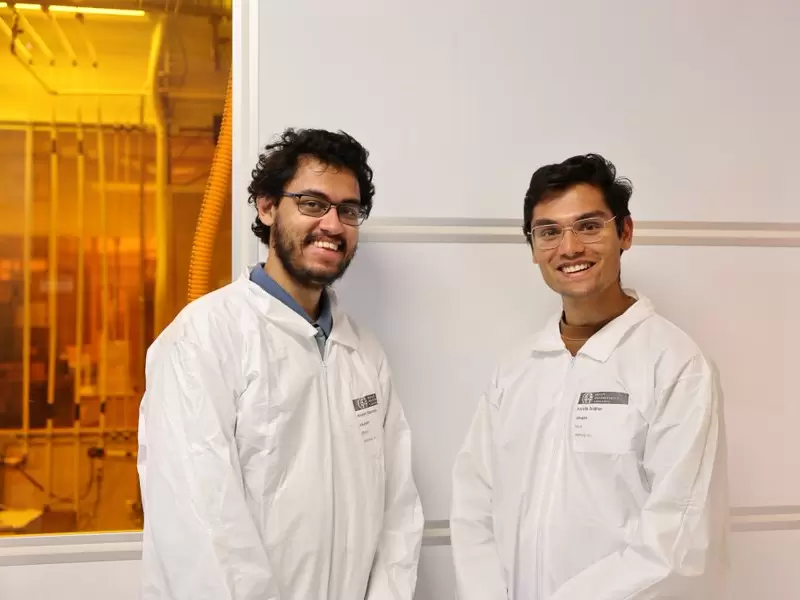 Advaith Sridhar and Akash Ramdas / X/@Advaith Sridhar
Two IIT Madras alumni, Advaith Sridhar and Akash Ramdas, have secured $9 million in seed funding for their San Francisco-based deep-tech startup, Discovered Materials, a significant achievement for the tech entrepreneurs tackling one of hardware's most critical bottlenecks: semiconductor thermal management.
The investment round was led by Lightspeed India Partners, with participation from Y Combinator, Peak XV Partners and prominent global angel investors, including YC co-founder Paul Graham, Gokul Rajaram and Thariq Shihipar.
Alongside the funding, the duo released hundreds of new materials discovered using frontier AI models and launched Material Discovery Bench, a benchmark designed for tracking progress in this domain.
The funding will accelerate the company's mission, making new materials discovery fast enough to keep pace with AI's demand for compute.
Announcing the seed funding, Advaith posted on X, “Today, we're introducing @discoveredmat. We build AI scientists that discover new materials for semiconductor chips. We're starting by releasing our work — hundreds of new materials discovered using frontier AI models, along with our benchmark for tracking progress in this domain, Material Discovery Bench.”
He said semiconductor chips are bottlenecked by heat, and better materials would enable dramatic improvements in chip performance.
“For example, new thermally conductive dielectric materials would make chips 10x more energy efficient by enabling 3D packaging of logic and memory. Several other parts of AI chips — the substrates, interconnects, or the transistor itself — require new materials to push chip performance.”
About their Material Discovery Bench, he said it gives frontier models an open-ended material discovery problem — finding new dielectrics for chips.
Today, we're introducing @discoveredmat . We build AI scientists that discover new materials for semiconductor chips.
— Advaith Sridhar (@advaith_sridhar) August 10, 2026
We’re starting by releasing our work - hundreds of new materials discovered using frontier AI models, along with our benchmark for tracking progress in this… pic.twitter.com/1UdMjgjFQY
Models are equipped with everything a competent PhD student would have access to — atomistic simulation software, a coding environment, property prediction models (MLIPs) and web search. Each model run is long-horizon (100M tokens!), and models are allowed to make unlimited submissions over the run. Sol, Fable, Opus and Kimi-3 are surprisingly capable at this task, generating hundreds of unique materials that are stable and show good thermal, dielectric and mechanical properties.
He said finding new materials is just the beginning.
“Figuring out how to make them in the lab is really hard, and is often the bottleneck in material discovery. On this front, all models struggle. Out of the 500+ new materials discovered by models, only 1 (discovered by Sol) has a plausible synthesis route.”
AI's progress is bottlenecked by heat.
— Gokul Rajaram (@gokulr) August 10, 2026
Semiconductor chips are limited by it, and better materials would change chip performance dramatically. One example: new thermally conductive dielectric materials would make chips 10x more energy efficient by enabling 3D packaging of logic… https://t.co/VqK4mMNnn6
Tech executive and investor Gokul Rajaram, in a post on X, said he is excited for Advaith, Akash and the Discovered Materials team to revolutionize how semiconductor chips are built.
He emphasized that the progress of AI is currently being physically limited by heat. Semiconductor chips, he noted, are reaching performance ceilings because of thermal constraints.
Rajaram argues that "better materials would change chip performance dramatically," specifically highlighting that new thermally conductive dielectric materials could potentially make chips 10 times more energy-efficient by enabling advanced 3D packaging of logic and memory.
Discover more at New India Abroad.
Leave A Comment
Related









ADVERTISEMENT

ADVERTISEMENT
E Paper
Video

Comments
Start the conversation
Become a member of New India Abroad to start commenting.
Sign Up Now
Already have an account? Login