ADVERTISEMENT
ADVERTISEMENT



Tejal Yoga founder pushes a decolonised version of yoga
In a candid conversation with India Abroad, she opens up about how she transitioned from a career in Finance to teaching Yoga
-
 Jeffin T. Kaleekal
 - Sun, 21, Jun 2026
- 00:30 EDT
- 37
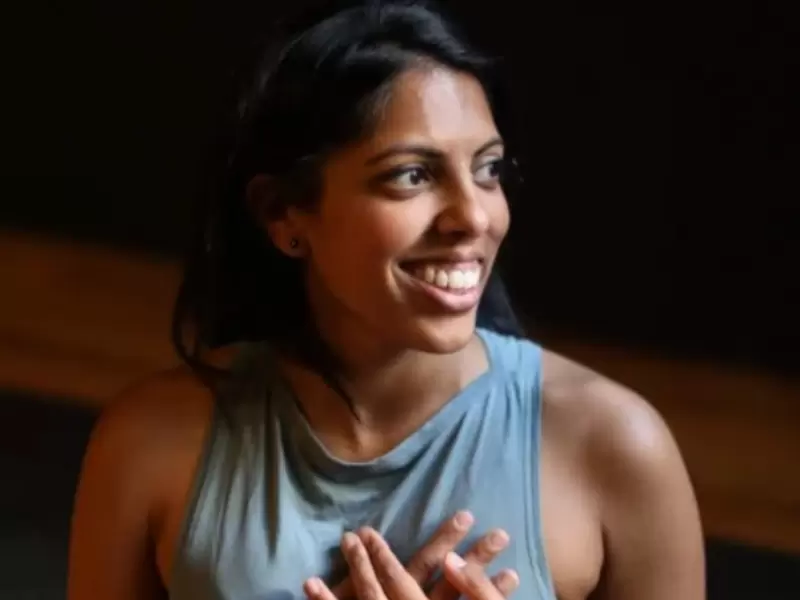 Tejal / Courtesy photo
A first-generation Indian American yoga teacher, writer, podcaster, and community organizer, Tejal embodies a transformative force within the U.S. Yoga space. At times, she comes across as a revolutionary, striving to return yoga to its origins and move away from the Americanized version that distances itself from its Indian heritage.
In a candid conversation with India Abroad, she opens up about how she transitioned from a career in Finance to teaching Yoga and how she is battling stereotypes and narratives with classes, platforms and podcasts.
EXCERPTS:
1. As a first-generation Indian-American, how has your heritage and upbringing shaped your relationship with yoga, and what does being a South Indian-American yoga teacher in America mean to you personally?
I have found yoga to be a connector to my culture, my family, and myself in a way that holds deep meaning. As a teacher of South Asian (Indian) identity as well as being someone born in America, I feel a responsibility to advocate for the roots of yoga. My priority is to teach, practice, and share yoga from a place of spirituality and culture.
2. You left a successful career in consumer finance to pursue yoga full-time. What was the turning point, and how did your Indian family and community initially react to this unconventional path?
I worked in finance for nearly a decade. And what always struck me, even in the middle of a financial recession, was how we were expected to pretend like nothing happening outside the office walls could affect us. We were asked to project growth in economic downturns, when the numbers truly didn't make sense. We were asked to separate ourselves from reality in the name of professionalism.
That kind of disconnect pushed me away from Finance, eventually into my career today in yoga. I learned that my time and energy was precious and I didn’t want to spend my personal resources on a career I liked and enjoyed when I could turn towards yoga and love what I was doing while feeling connected to my culture, my inner wisdom and my passions for emotional and mental wellbeing and community.
My choice to leave a lucrative corporate career was met with both shock and wonder by my parents. Shock that I would step away from my job without something similar to turn to, especially after having studied finance as my undergraduate degree and completing several finance internships. It seemed like a sure thing that I would stay in that field my entire life. The wonder my parents felt was in seeing me exercise such a bold choice, a choice that I know they did not feel was available to them.
3. You’ve trained in places like Kerala. How did coming to India for yoga training influence your practice and teaching philosophy, especially in contrast to the yoga you encountered in the West?
I loved being able to train in India, especially in Kerala for additional yoga training and practice. I studied under Bhoomaji Chaitanya while staying in Panmana Ashram in Kollam. The practice felt honest and the training was one of the most embodied experiences I’ve ever known. While studying Advanced Hatha Yoga Techniques looked like 5 hrs daily of asana and pranayama practice, we also explored lifestyle and ethics of teaching, kriyas like Shat Karma & Shankhaprakshalana practices, chanting and mantra, profound meditations, ayurveda and philosophy study.
What I had not expected was how little value was placed on the slower, more methodical practice styles in the western yoga studio culture. The lack of preference for methods that were not explicitly fast-paced vinyasa felt like a true gap in most establishments and led me further on the path of creating my own yoga platform that offers a wide variety of yogic practices that are more than just movement.
4. What are the biggest issues you see in Western Yoga and how do you approach “decolonizing” yoga without gatekeeping it?
Over the years, outside of my work I've observed how yoga is wielded as a tool of White Supremacy Culture, how people are led to believe that the practice is about perfection, individual performance over the welfare of the collective, exhibiting a polished persona and hiding internal turmoil, rather than a liberatory, spiritual practice that is culturally-rooted.
It looks like appropriation; when South Asian people are erased from their own indigeneity, their own cultural assets.
Sterilized, stripped of culture and whitewashed yoga and yoga spaces that marginalize South Asian people instead of welcoming us in as key stakeholders of the practices. Cherrypicking the singular parts of yoga that are valuable to the West which is a form of white supremacy culture, not a practice of South Asian wisdom holders.
5. How do you make yoga accessible and relevant for busy professionals, parents, and second-generation Desis who may feel disconnected from traditional practices?
At Tejal Yoga, we offer practices from as short as 25 minutes up to 90 minutes to allow for people to drop in with what time they have available. We also remind people that yoga is a practice that extends outside of the time you spend “on the mat”. In every livestream class, there is a community check-in where the teacher invites everyone to share their name, pronouns, location/land, and reflect on that practice’s check-in questions. All sharing is optional and is an effective way to make the practices relational while building a strong community rooted in yogic principles.
Beyond existing as one of the only South Asian led yoga spaces, we honor yoga’s roots by offering meditation, movement, pranayama, spirituality Satsang, mentoring, ayurveda education, kirtan, and activism related talks with guest teachers.
6. In your experience, how do Indian-American families balance modern scientific perspectives with these traditional wellness practices?
I’ve found that South Asian families carry the wealth of their cultural and familial wellness practices from Ayurveda to Yoga and marry them with Westernized standards of care to offer a pluralistic approach.
7. What are the biggest obstacles facing the South Asian yoga community today?
The South Asian yoga community experiences the harms of appropriation in the yoga industry. Through my work with abcdyogi, I interviewed nearly 250 South Asians in the yoga community, a large number being yoga teachers. Every single person I spoke with has experienced harm through racism, othering, and appropriation in the yoga industry.
Yoga and yoga spaces that are sterilized, stripped of culture and whitewashed marginalize South Asian people instead of welcoming us in as key stakeholders of the practices.
There’s harm to everyone when you value cultural assets but not the people of the culture who are the creators of those assets.
Colonialism is deeply embedded into the minds and hearts of many South Asians in the diaspora and until we do the honest and challenging work to confront colonial and unconscious bias we are in danger of recreating the systems of oppression our ancestors valiantly fought to tear down and dismantle.
8. How can the diaspora help preserve and evolve yoga while staying rooted in its Indian origins?
While yoga is a worthwhile and lifelong exploration as a path and once a yoga student, always a yoga student, here are my quick tips to implement authentic practice into your life:
Find teachers who consistently acknowledge the roots of yoga as a practice comes from South Asia
Find teachers that teach social justice history and context and the implications of yoga’s sustained role in society over time
Practice yoga with a holistic approach and not just as a movement practice with physical benefits
Incorporate spiritual and philosophical elements of yoga into your life, through dedicated practice and consistency
9. Give a small outline of your journey, including how you eventually transitioned to yoga.
I’m a first-generation Indian American yoga teacher, writer, podcaster and community organizer.
Growing up in an Indian Hindu household, yoga was a daily spiritual practice. Yet, I faced so many challenges integrating my personal practice with Western yoga studio culture. I experienced racism, othering, and spiritual bypassing teaching and practicing yoga. I was told by a white woman studio owner that what I learned about yoga in my upbringing and study in India was wrong. This wasn't the only time I've experienced cultural erasure in yoga. It's there in yoga programs that prohibit chanting Om or speaking in Sanskrit. Then there's the cultural appropriation that shows up in shady labor practices, incorrectly labeled as karma or seva practices, that studios use to avoid paying fair wages.
I started Tejal Yoga as a mission-driven organization dedicated to preventing discrimination and harm. The Tejal Yoga community offers yoga students and teachers a much needed justice-focused, people-centered, decolonized approach to yoga.
I started the abcdyogi platform as a way to uplift and platform South Asian yoga teachers who are doing excellent work and are not always sought out due to mainstream fitness and wellness culture norms.
I co-hosted the Yoga is Dead podcast as a means of sharing bold and tough critique of the yoga industry and to break down the lesser discussed issues around power, privilege, pay, racism, ableism, veganism, guru culture and sexual and physical harassment, and gatekeeping.
My overall aim is to educate and empower every yoga student in the world to advocate for yoga through a social justice equity lens.
Discover more at New India Abroad.
Related


ADVERTISEMENT

ADVERTISEMENT
E Paper
Video

Comments
Start the conversation
Become a member of New India Abroad to start commenting.
Sign Up Now
Already have an account? Login