ADVERTISEMENT
ADVERTISEMENT



Quad’s Key Challenges: Chinese Aggression, Strategic Incoherence, Leadership Vacuum
In nearly two decades of its existence, the Quad has not been able to garner much attention owing to different priorities by its member states.
-
1744362597.jpeg) Arun Anand
Arun Anand - Wed, 27, May 2026
- 07:51 EDT
- 70
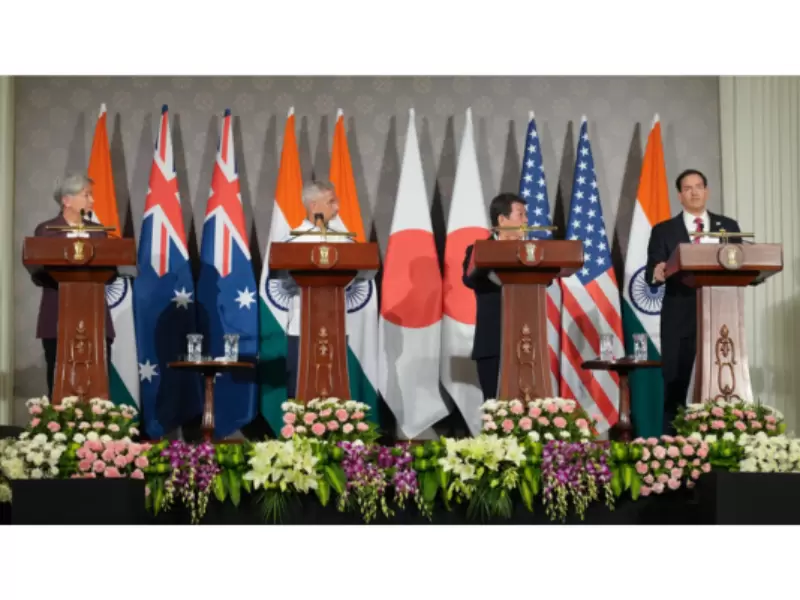 Quad Foreign Ministers Meeting in New Delhi on May 26 / x/@ASDylanJohnson
The sitting of Foreign Ministers of the Quadrilateral Security Dialogue, also known as Quad, comprising the United States of America, Australia, India and Japan, this week has been confronted with some deeply uncomfortable questions. In nearly two decades of its existence, the Quad has not been able to garner much attention owing to different priorities by its member states.
During President Obama's tenure there was serious recalibration happening on the USA pivoting towards the Indo-Pacific, but times are profoundly different now. We have an American President who has publicly questioned whether Taiwan — a democratically governed island that manufactures the world's most advanced semiconductors — is worth defending because it sits 9,500 miles from the United States. China, on the other hand, preaches about the Thucydides' Trap to warn America of the dangers of confronting a rising power, but the evidence on the ground, at sea, and along every disputed border in the region suggests that its own rise is anything but peaceful.
ALSO READ: Ambassador Sergio Gor energises India-US partnership, says experts
The uncomfortable truth the Quad foreign ministers must confront in this sitting is this: while the grouping has busied itself with vaccine diplomacy, infrastructure pledges, and maritime domain awareness frameworks, China has been systematically rewriting the physical and strategic geography of the Indo-Pacific. The spectre haunting this dialogue is not merely Chinese power — it is Quad's own strategic incoherence, and an America that increasingly looks like it would rather invoice its allies than lead them.
Pratas Island Fiasco
The most immediate evidence arrived last week. On May 24, Taiwan's Coast Guard spotted a Chinese Coast Guard ship heading toward the Pratas Islands and immediately dispatched its own vessel; the two sides then engaged in what officials described as an intense verbal confrontation over sovereignty via radio. The Chinese ship asserted that it was on a routine mission and that China held sovereignty and jurisdiction over the Pratas. The situation eased on Sunday when the Chinese ship eventually sailed away, but not before Taiwanese officials noted that the language Beijing's vessel used regarding sovereignty, as well as the extended duration of its presence near the Pratas, was highly unusual.
This episode cannot be read in isolation. The Pratas Islands lie more than 400 kilometres from Taiwan's main island, making them harder to defend and a genuine flashpoint in an escalating regional confrontation. Taiwan's coast guard also reported that it had driven away a Chinese research vessel from nearby waters for the second time within the same month. And the Pratas standoff is merely the visible tip of a far larger and more alarming operational reality. Taiwan's National Security Council Secretary-General Joseph Wu revealed on May 23 that Beijing had deployed more than 100 vessels around the First Island Chain in the days immediately following the Trump-Xi summit in Beijing. Wu put it bluntly: "In this part of the world, China is the one and only PROBLEM wrecking the Status Quo and threatening regional peace and stability."
What makes this particular deployment so strategically significant is its timing and context. Taipei is on high alert following President Xi Jinping's discussions on Taiwan with President Donald Trump during the Beijing summit earlier this month. Beijing has clearly read the diplomatic atmosphere and decided that the post-summit moment was precisely the right time to test the boundaries — deploying a maritime armada while the ink on great-power pleasantries was barely dry.
ALSO READ: Rubio India trip signals strategic push: Experts
China's Salami-Slicing in the South China Sea
To understand why the Pratas standoff matters as much as it does, one must trace China's methodical assertiveness in the South China Sea over the preceding decade. China's behaviour in these waters has followed a consistent doctrine — what strategists have long called "salami-slicing" — incremental acquisitions and coercions calibrated to remain below the threshold of armed conflict while fundamentally altering facts on the ground.
The pattern accelerated decisively in 2012, when China effectively seized Scarborough Shoal from the Philippines through a standoff that American diplomacy failed to reverse — a pivotal failure that signalled to Beijing that US red lines in the South China Sea were decorative rather than operational. By 2014–2015, Chinese dredgers had transformed submerged reefs in the Spratly Islands into fully operational military installations — Fiery Cross Reef, Subi Reef, Mischief Reef — equipped with runways, radar facilities, and surface-to-air missile batteries. In 2016, the Permanent Court of Arbitration categorically rejected China's nine-dash line as having no basis under international law. Beijing dismissed the ruling as null and void, and no meaningful international consequence followed. That non-consequence was perhaps the single most consequential moment in Indo-Pacific security this century.
Approximately 60 percent of Tokyo's energy imports transit the South China Sea. Meanwhile, Chinese coastguard vessels have persistently escalated their presence near the Senkaku Islands in the East China Sea, with incursions into contiguous waters reaching historic highs between 2020 and 2023, at times sustaining a continuous presence of over 100 consecutive days — a relentless grey-zone pressure campaign designed to normalise what was once unthinkable.
India's and Galwan Shock
If Japan's primary challenge is maritime, India's is continental — and it has been bloodier. The June 2020 Galwan Valley clashes in Ladakh fundamentally transformed India's strategic calculus toward China. For the first time since 1975, soldiers died on the India-China border. Chinese PLA troops occupied strategic heights across multiple friction points in eastern Ladakh — Pangong Tso, Gogra-Hot Springs, Depsang Plains, and Galwan itself — in what New Delhi ultimately concluded was a deliberate and pre-planned transgression. Twenty Indian soldiers were killed; China acknowledged only four PLA casualties, a figure most independent assessments consider a significant undercount.
What made Galwan particularly significant was not merely the tactical surprise but the strategic message it carried. The aggression came months after Modi and Xi had met at Mahabalipuram projecting an atmosphere of managed rivalry, and it exposed the fundamental reality that the China-Pakistan axis is not merely a diplomatic inconvenience but a coordinated strategic pincer against India. The China-Pakistan Economic Corridor runs through Pakistan-occupied Kashmir — territory India claims — and connects Chinese strategic depth with a Pakistani security establishment that has historically functioned as an extension of Beijing's regional ambitions. Galwan was a signal: India cannot deepen its Quad commitments without paying a territorial price.
India's response has been structurally significant even if diplomatically calibrated. New Delhi restricted Chinese foreign direct investment, banned hundreds of Chinese applications, accelerated defence procurement from alternative partners, and dramatically increased infrastructure spending in border areas that had been deliberately neglected for decades. The old strategic doctrine — that underdevelopment served as a natural barrier to PLA logistics — is now dead and buried in the rubble of Galwan.
Washington Contradiction
This is the moment where the Quad's most fundamental internal tension becomes impossible to defer. The smaller and mid-sized states of the Indo-Pacific — Vietnam, the Philippines, Indonesia, Malaysia — face a structural bind that no amount of Quad joint statements has addressed honestly. They need Chinese trade, Chinese infrastructure financing, and access to Chinese markets. The Quad's alternative infrastructure frameworks remain chronically underfunded relative to what Beijing can deploy through state-directed capital.
What these countries are asking, often implicitly, is a question the Quad can no longer afford to answer vaguely: if China moves against us — militarily, through grey-zone coercion, or through economic punishment — will the United States lead a meaningful response? The answer arriving from Washington this week is, to put it diplomatically, complicated. Acting Navy Secretary Hung Cao told the US Senate that Washington is temporarily holding back a $14 billion arms sale to Taiwan to ensure it has sufficient munitions for Operation Epic Fury, the US-Israel military campaign against Iran. Crucially, Taiwanese officials said they had not been notified of any pause in the planned sale — meaning America paused arms deliveries to a democratic partner under active Chinese military pressure without even informing that partner. Trump's stated rationale for the pause has itself been contradictory — he indicated he may hold the sale off as a "negotiating chip" with China, saying "I haven't approved it yet. We're going to see what happens."
Senator Mitch McConnell's response upon hearing of the pause — "that's really distressing" — may be the most understated assessment of the strategic moment. Washington has also held off on Tomahawk missile deliveries to Japan and delayed an arms sale to South Korea, suggesting that the munitions crisis arising from the Iran campaign is creating cascading commitments deficits across the entire Indo-Pacific alliance architecture — precisely the moment China has chosen to deploy 100 vessels around the First Island Chain and probe Taiwan's most vulnerable outlying territory.
What’s in the New Delhi Communique
Jaishankar, Rubio, Wong, and Motegi convened at Hyderabad House in New Delhi and issued a communiqué that, read generously, is the most operationally detailed Quad statement in the grouping's history — and, read honestly, confirms almost every anxiety catalogued above. The four ministers expressed serious concern over developments in the East China Sea and South China Sea, citing dangerous and coercive actions, interference in offshore resource development, obstruction of freedom of navigation, and the militarisation of disputed features. They reaffirmed that the 2016 arbitral tribunal ruling remains a valid basis for resolving South China Sea disputes — a pointed rejection of Beijing's long-standing position that it is null and void. On architecture, there is atleast a movement: Rubio announced a new Indo-Pacific maritime surveillance initiative integrating the four countries' surveillance capabilities and strengthening real-time information sharing, India operationalised the Maritime Domain Awareness programme through the Information Fusion Centre in Gurugram, and the Quad announced it would work with Fiji on port infrastructure — its first joint regional infrastructure project. A Quad Critical Minerals Framework and an Indo-Pacific Energy Security initiative were also launched.
There are also long pauses that needs to be confronted for the long term stability of the region. There is no reference to American arms sales pauses, no mention of Taiwan by name, no acknowledgment of the cascading commitments deficits Washington's Iran campaign has produced across the alliance architecture. The meeting came days after Trump's visit to China, closely watched across the region for signs of any shift in Washington's approach toward Beijing, and officials confirmed they were working toward a Quad Leaders' Summit later this year — though no date has been announced, after last year's planned summit was delayed by strains in US-India relations. The absent summit remains the most telling statement. What emerges from New Delhi is a Quad that has sharpened its diagnostic language, taken initial steps toward converting maritime awareness from aspiration to some form of crude architecture, and launched economic frameworks that — if properly resourced — could contest Chinese coercive leverage. What has not been answered here in the Quad Communique is if the USA can be trusted on its treaty obligations, such as with hubs and spokes agreements in South East Asia, or if it is planning for a long-term thaw with China and leaving its allies on its own.
What the Quad Must Decide
The Quad was conceived as a security architecture. It has largely functioned as a diplomatic signalling mechanism. The gap between those two things is precisely the operational space in which China works — and in which Beijing has been remarkably, consistently successful.
The Pratas Islands standoff of May 2026 is not an isolated incident. It is a data in a pattern stretching from Scarborough Shoal to Galwan Valley to the Senkakus — a pattern of incremental assertiveness that tests the credibility of deterrence without crossing the threshold of war. China's deployment of over 100 vessels around the First Island Chain immediately after the Trump-Xi summit, timed to coincide with Washington's pause on Taiwan arms sales, is not a coincidence. It is a strategic communication, delivered in the language Beijing has become most fluent in: the language of calibrated, deniable pressure.
New Delhi has spoken. The words were sharper, the initiatives more concrete, the infrastructure ambitions finally real. But Beijing does not read communiqués — it reads behaviour. It read the pause on Taiwan arms sales. It read the absent leaders' summit. It read a hundred vessels deployed around the First Island Chain while four foreign ministers were still finding their seats at Hyderabad House and lamenting the great Indian summer. The Quad has spent two decades proving it can diagnose the problem and at least can come together when time is required. What the Pratas, the Galwan, the Scarborough, and now a post-Trump-Xi communiqué with no Taiwan and no summit date collectively demonstrate is that diagnosis, however accurate, is not deterrence. The spectre haunting this dialogue was never going to be exorcised by a joint statement. It will only retreat when Beijing calculates that the cost of the next incremental move — the next reef, the next standoff, the next armada — exceeds what the Quad is willing to impose. Nothing in New Delhi changed that calculation.
The writer is an author and a columnist. He has authored more than 15 books including 'Taliban: War and Religion in Afghanistan'.
(The views and opinions expressed in this article are those of the author and do not necessarily reflect the official policy or position of New India Abroad.)
Discover more at New India Abroad.
Related









ADVERTISEMENT

ADVERTISEMENT
E Paper
Video

Comments
Start the conversation
Become a member of New India Abroad to start commenting.
Sign Up Now
Already have an account? Login