ADVERTISEMENT

ADVERTISEMENT



Indian Americans, discrimination, and the question of belonging
Nearly half of Indian Americans say they encounter racist content targeting Indians or Indian Americans on social media very or somewhat often.
-
 Sumitra Badrinathan
 -
1771706543.jpg) Devesh Kapur
Devesh Kapur -
 Andy Robaina
 -
 Milan Vaishnav
 - Sat, 21, Feb 2026
- 16:10 EST
- 23
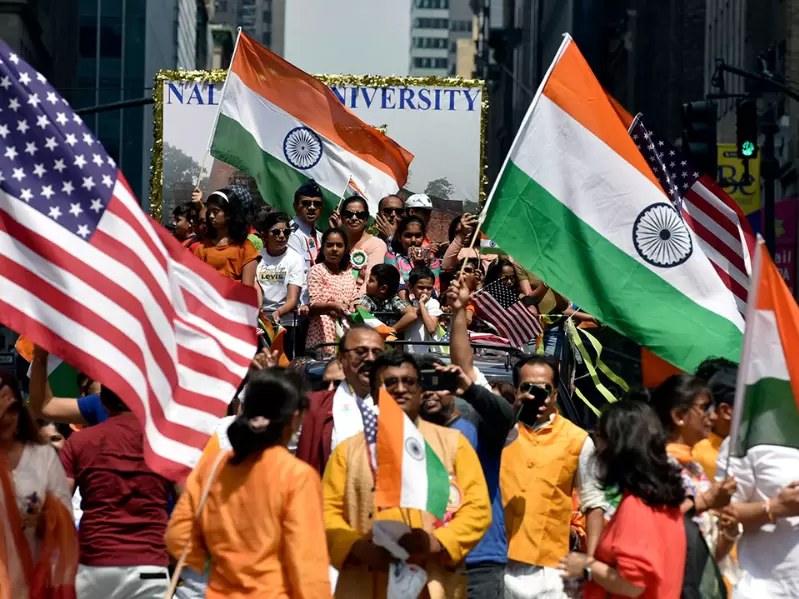 Representative Image / Pew
For decades, the Indian American community has been defined by educational attainment, economic success, and steady integration into American civic life. While those elements remain salient, new data suggest they no longer tell the whole story.
A new nationally representative survey of 1,000 Indian Americans conducted by the Carnegie Endowment for International Peace—the 2026 Indian American Attitudes Survey—captures a community navigating a more unsettled social landscape, marked by frequent exposure to hostile rhetoric and racism. Many Indian Americans report encountering racism—especially online—and say they are adjusting how they live and express themselves in response. Yet most do not frequently contemplate leaving the United States.
Also Read:Why is anti-Indian hate rising - and what should we do about it?
Roughly one-quarter of Indian American survey respondents believe that their community faces a high level of discrimination in American society—a notable figure for a group widely regarded as economically successful and socially integrated. This perception exists alongside an awareness of even sharper bias against other groups, particularly undocumented immigrants, Muslims, and Black Americans, suggesting that Indian Americans view their own experiences within a broader social climate of perceived bias.
These perceptions are matched by a sobering reality: one in two Indian Americans reports having personally experienced discrimination since the start of 2025. The overall prevalence of discrimination is broadly consistent with earlier surveys conducted in 2020 and 2024, with skin color—followed by country of origin and religion—remaining the most cited bases. However, within the steady topline figure, reports attributing discrimination to skin color or country of origin appear to have increased modestly.
Nearly half of Indian Americans say they encounter racist content targeting Indians or Indian Americans on social media very or somewhat often. Exposure to such content elicits strong emotional responses: about half report feeling angry, one-third anxious or fearful, and one in four hopeless. These reactions matter because perceptions of discrimination formed online may influence everyday life—shaping their sense of belonging even if they rarely experience in-person harassment.
Offline hostility, to be sure, is not uncommon. One in four Indian Americans reports being called a slur since the start of 2025. Smaller—but still troubling—shares report being physically threatened, receiving hate mail, or experiencing property damage. While serious violence remains uncommon, verbal harassment remains a concern for many in the community.
One of the most consequential findings of the survey is how concerns about discrimination are changing people’s behavior. Nearly one-third of Indian Americans say they avoid discussing or engaging with politics on social media for fear of being targeted. About one-fifth report avoiding leaving the United States for travel, displaying political signs, wearing Indian attire in public, or attending a political rally or protest. These are individual acts of self-censorship—subtle, but cumulatively consequential adjustments undertaken to reduce perceived personal risk.
Yet for all this, discrimination is not prompting a broad reassessment of life in America. Among those who have considered leaving, the most common reason is frustration with U.S. politics (58 percent), followed by concerns about the cost of living and personal safety. Sustained thoughts of departure remain uncommon: only a small minority—14 percent—say they frequently think about leaving the United States. Among those who have considered leaving at all, most do not envision returning to India. Instead, they contemplate third countries or, more often, choose to remain in the United States despite their concerns.
While discrimination appears to be reshaping how people of Indian origin speak, dress, travel, and participate in public life, it has not (yet) translated into a widespread reappraisal of the American dream. Several factors may help explain this: the belief that the United States remains a land of opportunity; the expectation that current conditions may not be permanent; the fact that the community now has deep roots, which raises the costs of leaving; or simply the lack of attractive alternatives.
That balance, however, could shift. Whether it holds will depend not only on political rhetoric, immigration policy, and broader social developments, but also on whether Indian Americans continue to see safety, dignity, and opportunity as compatible rather than competing ideals.
For a diaspora long defined by educational and economic achievement, the deeper question now may be not just whether America still works, but whether it still feels like home.
Badrinathan, Kapur, Robaina, and Vaishnav are co-authors of a new study published by the Carnegie Endowment for International Peace, “Indian Americans in a Time of Turbulence: 2026 Survey Results.”
(The views and opinions expressed in this article are those of the author and do not necessarily reflect the official policy or position of India Abroad.)
Related




ADVERTISEMENT

ADVERTISEMENT
E Paper
Video

Comments
Start the conversation
Become a member of New India Abroad to start commenting.
Sign Up Now
Already have an account? Login