ADVERTISEMENT

ADVERTISEMENT



Where culture becomes commons
Cultural and heritage platforms can function as cultural commons: shared ground where complexity is not a threat, and where the imperfect work of living together can still take place.
-
 Chaitanya Deshpande
 - Sat, 21, Feb 2026
- 16:42 EST
- 16
 Indian dance performance / India Society of Worcester
It’s cliché to say that we live in polarized times. Clichés endure because they often hold the truth. Public life today feels brittle. Language hardens quickly. Disagreement slips into suspicion. Shared spaces—both physical and digital—are increasingly splintered by ideology, identity, or tribe.
In moments like this, cultural spaces are encumbered with impossible expectations. They are imagined either as safe havens of dialogue or as antiquated stages where old conflicts replay under softer banners.
Also Read: Building bridges: Indian diaspora's role in a divided America
The question is not whether cultural spaces matter in times of tension. Hint: They always do.
Commons for all
At their best, cultural spaces are more like commons than megaphones. The commons is both a place and an idea. Historically, commons were shared land where people gathered, grazed cattle, buried the dead, worshiped, or made collective decisions.
Art, food, language, ritual, and shared experiences slow us down.This deceleration enables building a cultural commons: a space where we encounter one another without being immediately reduced to labels. These moments offer a way of being together that does not demand agreement before connection. In polarized times, this slowing is not decorative. It is essential.
Diaspora for all
Diaspora spaces carry a heavy burden. They are asked to preserve heritage while adapting to new contexts. Within the Indian diaspora, this complexity is intensified by language, caste, religion, region, and the long shadows of subcontinental politics. It would be easy for a cultural organization to collapse these differences into a single narrative, mistaking unity for sameness.
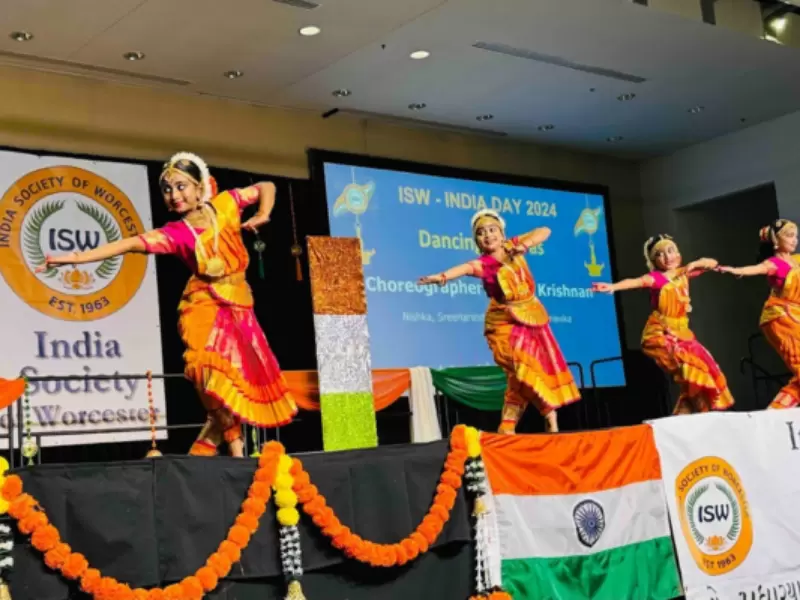
Consider the India Society of Worcester (ISW). Founded in 1963 and run entirely by volunteers, ISW describes itself simply: cultural, social, educational, charitable. It is non-political, non-sectarian, and inclusive across regions, religions, languages, and generations.
This positioning is intentional. At a time when cultural identity is often subservient to ideological service, ISW represents India’s culture while acknowledging that culture itself is plural, contested, and alive.
 Indian culture / India Society of Worcester (ISW)
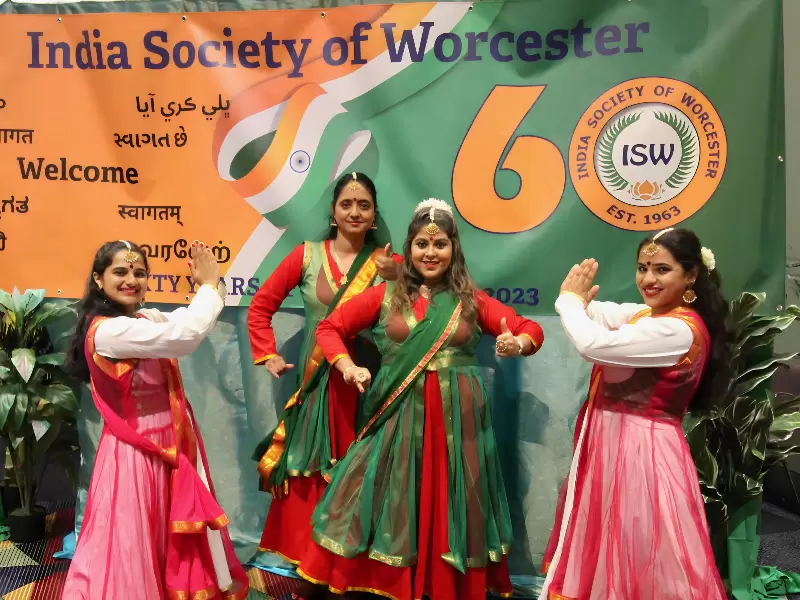
It does so by focusing on practice rather than proclamation, allowing differences to coexist without forcing resolution. Through its Language School, the ISW Symphony, ISW University, and social groups like Humrahee for seniors, Professional Entrepreneurial Network (PEN), and Women Empowering Women (WEW), it builds connections beyond labels. Public rituals like Holi become shared celebrations, proving that community does not require consensus.
Together, these efforts resist flattening identity into a single “Indian” category. A child learning Telugu discovers that difference exists within communities, not just between them. An adult encountering multiple scripts and sounds learns that identity is layered. A non-Indian neighbor attends a festival out of curiosity and leaves with a richer understanding than any media could provide. These are not grand acts of reconciliation. They are small, steady practices of coexistence.
Commons as practice
This offers a broader lesson. We often talk about “fostering dialogue” as if it requires formal conversation. Yet some of the most meaningful dialogue is indirect and non-verbal. Cooking together, watching a dance recital, attending a classical music concert, or participating in a ritual whose meaning you may not fully understand, but whose rhythm you can still feel. These experiences do not erase disagreement. They rehumanize the people with whom we disagree.
The risk, of course, is that cultural spaces can turn inward. When culture becomes a badge instead of a bridge, it can grow exclusionary. In polarized environments, there is pressure to take sides, draw sharper boundaries, and define who belongs.
For organizations like ISW, navigating this pressure requires constant care. Remaining non-political does not mean being disconnected from the world. It means refusing to let the space be used for narrow ends. This refusal has costs. It invites criticism from many directions. Disagreements arise, sometimes sharply. But they are worked through while planning events, teaching classes, or running fundraisers. This is pluralism as practice, not performance.
Paying it forward
Beyond ideological tension, cultural spaces also face intergenerational pressure. For younger diaspora members, culture can feel either heavy with inheritance or thin with distance. Cultural spaces must do more than preserve. They must propagate. Culture survives not by freezing itself, but by inviting reinterpretation. Inclusivity then is not merely erasing differences, but making room for change.
In polarized times, cultural spaces offer a different kind of repair. They do not fix structural injustice on their own, nor should we expect them to. What they can do is sustain the social fabric that makes collective life possible. They remind us that belonging does not require agreement, and that understanding often comes before explanation.
The future of organizations like ISW depends on their ability to remain open and grounded. To welcome newcomers without fear. To acknowledge internal diversity without anxiety. To engage the wider community without losing purpose. In doing so, they model a form of civic life that is plural without being fragmented, rooted without being rigid.
By anchoring itself in service and celebration, the spaces shows that a specific cultural identity need not become a wall separating it from the wider community, but can instead serve as a bridge that connects them.
Discover more at New India Abroad.
The writer is a communications designer based in Shrewsbury, MA and ISW volunteer
(The views and opinions expressed in this article are those of the author and do not necessarily reflect the official policy or position of India Abroad)Related



ADVERTISEMENT

ADVERTISEMENT
E Paper
Video

Comments
Start the conversation
Become a member of New India Abroad to start commenting.
Sign Up Now
Already have an account? Login