ADVERTISEMENT

ADVERTISEMENT



Indian American leaders back birthright citizenship ahead of hearing
Lawmakers and advocacy groups say the order could impact immigrant families, including Indians facing long visa backlogs.
-
 Malvika Choudhary
 - Wed, 01, Apr 2026
- 11:46 EDT
- 50
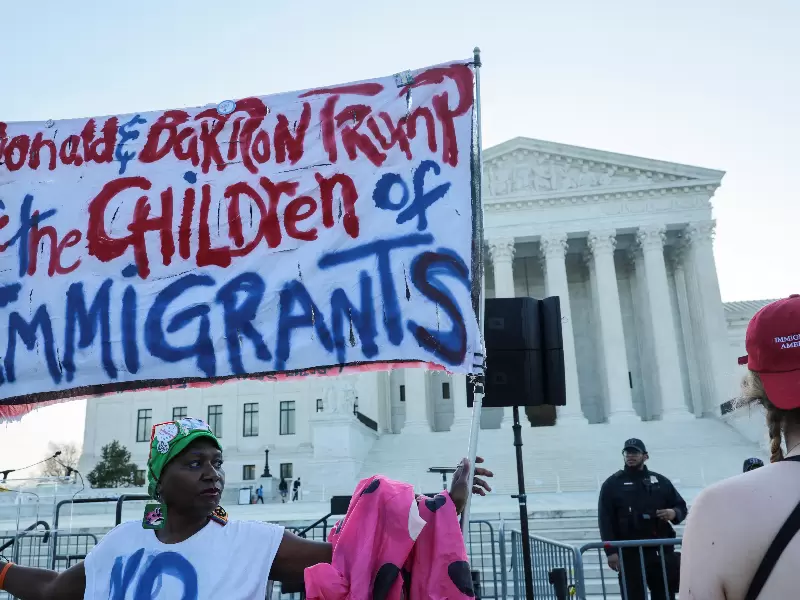
 Birthright citizenship order / NPR
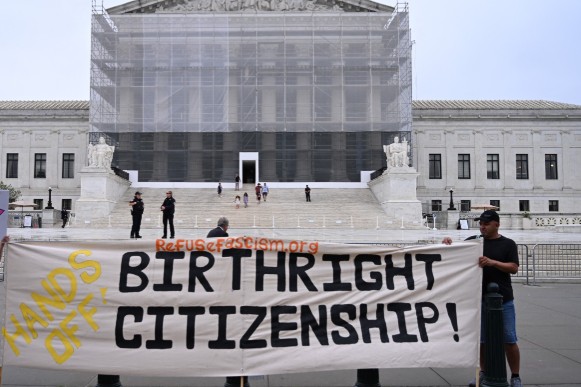
Indian American lawmakers and advocacy groups made a case for birthright citizenship on April 1 ahead of the Supreme Court hearing on President Donald Trump’s executive order seeking to limit it.
Representative Ro Khanna (CA-17), in a social media post, said the case was personally significant to him, noting that he was born in Philadelphia in 1976 to immigrant parents who held green cards.
Today, the Supreme Court will hear arguments on President Trump’s executive order seeking to end birthright citizenship, denying it for those born in the US to parents in the country undocumented or temporarily.
— Rep. Ro Khanna (@RepRoKhanna) April 1, 2026
“While they wouldn't have been affected by Trump's executive order limiting birthright citizenship, this is deeply personal,” Khanna said, adding that his parents had often told him he “won the lottery by being born in America.”
Khanna also pointed to the Supreme Court’s 1898 ruling in United States v. Wong Kim Ark, which held that a child born in the United States to Chinese immigrant parents was a U.S. citizen under the 14th Amendment.
He said the decision came during a period of anti-Chinese racism in the United States and accused Trump allies of trying to revive that legacy to restrict citizenship protections.
Representative Pramila Jayapal (WA-07) said, “The president does not get to decide who is a citizen on a whim — the Constitution does. It’s simple: if you’re born in the United States, you’re a citizen.”
Today, the Supreme Court is hearing oral arguments on Trump's executive order to eliminate birthright citizenship.
— Rep. Pramila Jayapal (@RepJayapal) April 1, 2026
The president does not get to decide who is a citizen on a whim — the Constitution does.
It's simple: if you’re born in the United States, you’re a citizen.
Representative Shri Thanedar (MI-13) said, “As an immigrant myself, today's arguments on birthright citizenship are deeply personal to me. The 14th Amendment is clear: the children of immigrants are guaranteed US citizenship. Despite President Trump's wishes, he cannot rewrite the Constitution.”
As an immigrant myself, today's arguments on birthright citizenship are deeply personal to me. The 14th Amendment is clear: the children of immigrants are guaranteed US citizenship. Despite President Trump's wishes, he cannot rewrite the Constitution.
— Congressman Shri Thanedar (@RepShriThanedar) April 1, 2026
Indian American Impact also criticized the order, calling it “a direct assault on the Constitution and birthright citizenship” that threatens immigrant and South Asian families.
In a statement, executive director Chintan Patel said Trump’s order was “a direct and dangerous assault on the Constitution and one of its most fundamental guarantees.”
He said the measure “remains a blatant attempt to rewrite the Fourteenth Amendment and strip citizenship from children born on U.S. soil,” and warned it would have broad consequences for immigrant communities.
Patel said the move could especially affect South Asian families caught in long immigration backlogs, noting that many Indian nationals remain on temporary visas or green card waitlists for years. He said children born in the United States to such families could be pushed into “legal limbo” if the order were upheld.
“Indian American Impact is proud to stand alongside the many organizations fighting to protect immigrant rights and defend the Constitution,” Patel said. “We reaffirm what has always been true: we belong here.”
The Supreme Court hears oral arguments today in Trump v. Barbara.
— Indian American Impact (@IA_Impact) April 1, 2026
This executive order is a direct assault on the Constitution and birthright citizenship, threatening thousands of South Asian and immigrant families.
We stand firm—we belong here and we will never stop fighting. pic.twitter.com/Lsuo0v4BYy
The case, Trump v. Barbara, centers on the administration’s effort to narrow the scope of the 14th Amendment, which has long been understood to guarantee citizenship to people born in the United States.
The hearing is focused on Trump’s effort to deny automatic citizenship to children born in the U.S. to parents who are undocumented or in the country temporarily. The case is expected to be one of the most consequential immigration rulings of the court’s term, with a decision likely later this year.
Discover more at New India Abroad.
Related


ADVERTISEMENT

ADVERTISEMENT
E Paper
Video

Comments
Start the conversation
Become a member of New India Abroad to start commenting.
Sign Up Now
Already have an account? Login