ADVERTISEMENT

ADVERTISEMENT



India to Pakistan: Will counter terrorism ‘with all its might’
Harish criticized Pakistan for repeatedly raising issues unrelated to the agenda at the United Nations.
-
 IANS
IANS - Tue, 16, Dec 2025
- 00:44 EST
- 50
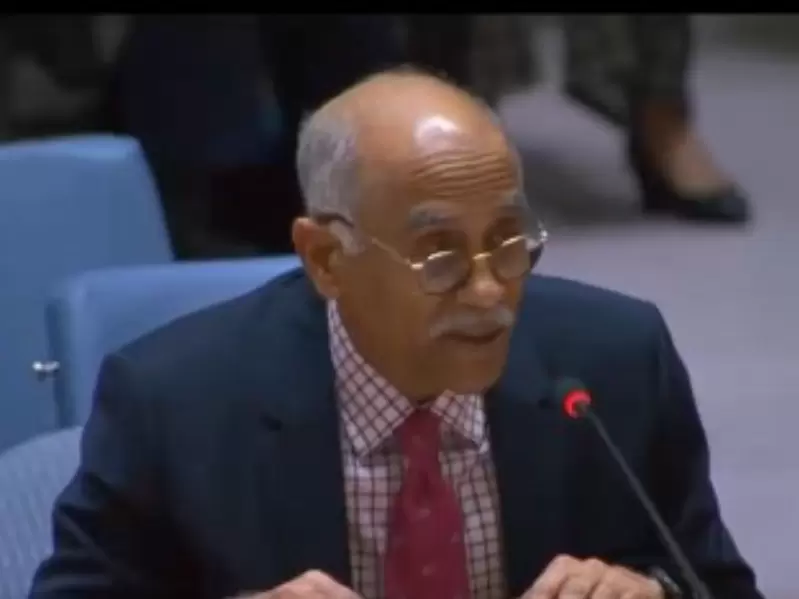 India’s Permanent Representative P. Harish. / X/@IndiaUNNewYork
In a strong rebuttal to Pakistan at the United Nations Security Council open debate, India warned Islamabad that it will not tolerate terrorism and will counter it “with all its might.”
“Let me be clear: India will counter Pakistan-sponsored terrorism in all its forms and manifestations with all its might,” India’s Permanent Representative P. Harish said Dec. 15 (local time).
Responding to Pakistan’s Permanent Representative Asim Iftikhar Ahmad, who departed from the debate’s theme, “Leadership for Peace,” to raise the Indus Waters Treaty, Harish said the treaty “will be held in abeyance until Pakistan, which is a global epicenter of terror, credibly and irrevocably ends its support for cross-border and all other forms of terrorism.”
India put the treaty on hold because of Pakistan’s terrorism and wars that killed tens of thousands of Indians, he said.
“India had entered into the Indus Waters Treaty 65 years ago, in good faith, in a spirit of goodwill and friendship,” Harish said. “Throughout these six and a half decades, Pakistan has violated the spirit of the treaty by inflicting three wars and thousands of terror attacks on India.”
He cited the Pahalgam terror attack in April, in which Pakistan-sponsored terrorists carried out what he described as “religion-based targeted killings of 26 innocent civilians.”
Harish said the attack, in which Hindus and a Christian were killed, was the last straw, prompting Prime Minister Narendra Modi to announce the suspension of the 1960 treaty signed by then-Prime Minister Jawaharlal Nehru.
Harish criticized Pakistan for repeatedly raising issues unrelated to the agenda at the United Nations.
Ahmad’s “unwarranted reference to Jammu and Kashmir in today’s open debate attests to its obsessive focus on harming India and its people,” he said.
“A serving nonpermanent Security Council member that chooses to further this obsession in all meetings and platforms of the UN in pursuit of its divisive agenda cannot be expected to fulfill its designated responsibilities and obligations,” Harish added.
He also questioned Pakistan’s commitment to democracy, pointing to what he described as the recent 27th Amendment to Pakistan’s Constitution, which he said establishes the supremacy of the military over the “will of the people.”
“Pakistan, of course, has a unique way of respecting the will of its people — by jailing a prime minister, by banning the ruling political party and by letting its armed forces engineer a constitutional coup through the 27th Amendment and giving lifetime immunity to its chief of defense forces,” Harish said.
Former Prime Minister Imran Khan, who fell out with Pakistan’s military leadership, remains in prison, and his party, Pakistan Tehreek-e-Insaf, has been banned.
Harish said the amendment grants Field Marshal Asim Munir a new constitutional position with lifetime immunity from prosecution and a guaranteed term through 2030, empowering him to oversee the next general election.
While responding to Pakistan’s remarks, Harish focused his speech on the broader issue of UN leadership, emphasizing the central role of the Security Council.
“The quality and focus of the leadership displayed by members of the Council,” he said, “represents the most important aspect impinging on the maintenance of international peace and security.”
He called reform of the Security Council “an urgent global imperative” to make it fit for purpose to address contemporary challenges.
Harish criticized the Intergovernmental Negotiations process on reform as “barren and bereft of productive outcomes” and said it must move toward time-bound, text-based negotiations at the earliest.
Reform should “enhance representation from underrepresented and unrepresented geographies in tune with today’s realities, in both the permanent and elected categories of membership,” he said.
Harish also called for greater transparency in the selection of the next UN secretary-general, whose term begins after Secretary-General Antonio Guterres completes his tenure at the end of next year.
“The new secretary-general must embody the aspirations of the overwhelming majority of humanity, who are from developing countries of the Global South,” he said.
He questioned the current system of allocating top UN posts on what he described as a “division of spoils” basis that gives some countries — primarily permanent members of the Security Council — a monopoly over certain positions.
“Leadership by definition must be inclusive for it to be representative, legitimate and effective,” Harish said.
Related


.JPG)

ADVERTISEMENT

ADVERTISEMENT
E Paper
Video

Comments
Start the conversation
Become a member of New India Abroad to start commenting.
Sign Up Now
Already have an account? Login