ADVERTISEMENT

ADVERTISEMENT



Architecture of peace: Why the heart must lead where reason cannot
If we wish to see a peaceful world, we must stop looking exclusively at the ballot box and start looking at the "nervous system of our nation"
-
 Pradeep B. Deshpande
 - Sat, 31, Jan 2026
- 10:33 EST
- 28
 Representative Image / Generated using AI
For over a century, humanity has treated peace as a diplomatic puzzle to be solved through the mechanics of democracy and the rigors of logic. Since 1901, the Nobel Peace Prize has been awarded over 100 times, yet as we navigate the complexities of 2026, the global landscape remains as volatile and fractured as ever. We find ourselves trapped in a cycle of external fixes—treaties, policies, and scientific advancements—that fail to address a fundamental internal crisis.
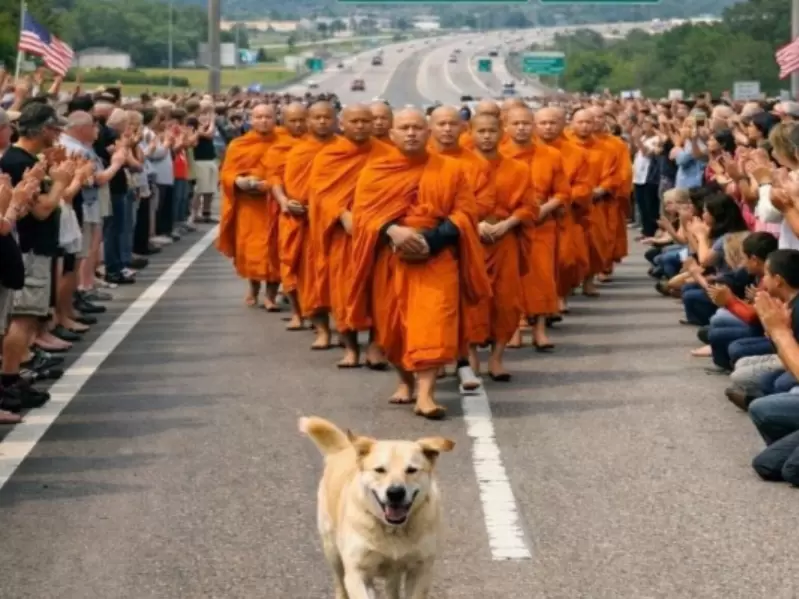
The disconnect lies in what I have often called the "two elephants in the room": the flawed belief that democracy alone ensures peace and the dangerous assumption that reason is the ultimate and highest tool for human progress. As a group of 19 silent monks in orange robes walks 2,300 miles across the American South, accompanied by a stray dog named Aloka, they are providing a living laboratory for a truth that logic has long obscured: where reason fails, Internal Excellence can heal.
Beyond the Limits of Reason
We have long lived under the Kantian shadow that "nothing is higher than reason". In our quest for order, we attempt to solve the scourge of war with better laws and more efficient systems. However, these are merely symptoms of a deeper ailment. The monks currently traversing the highways of America offer a profound "contrast with chaos." While news cycles scream and social media algorithms amplify our divisions, these men offer the radical medicine of silence.
Also Read: World in a mess: Why science must "wake up"
They are a physical manifestation of what Swami Vivekananda described as "something higher than reason". Their journey is not an intellectual argument or a political protest; it is a "vibrational shift". Consider the former Marine, a veteran of two tours in Afghanistan, who stood in the freezing cold and wept as a child as the monks passed. He was not reacting to a new policy or a clever debate; he was responding to a level of internal excellence that the modern world has largely forgotten how to cultivate. Reason can build a skyscraper or a weapon, but it cannot produce the equanimity required to stand in the face of suffering without breaking. See, Why peace remains elusive: Beyond democracy and reason.
Democracy of the Soul
We often view democracy as the ultimate goal, but democracy is merely a vessel. Its contents—and its ultimate success—are determined entirely by the emotional maturity of its citizens. My research into the scientific framework for internal excellence suggests that democracy only ensures peace when the "internal and emotional excellence" of the people is high.
In the video "Why Millions Cry," we witness this principle in action. In South Carolina and Georgia, thousands of people—Christians, atheists, and those who have never meditated—lined the highways. They were not there to convert to Buddhism or study ancient texts. They gathered because they are "exhausted, grieving, and invisible". The monks represent a "societal transformation" that does not require all eight billion people on earth to become meditators. According to the "Maharishi Effect," even a small percentage of individuals achieving true inner peace can serve as a ballast for the whole, stabilizing the collective consciousness. The monks are not just walking for their own peace; they are acting as a tuning fork for the nation’s nervous system.
Silence as Medicine
Our modern culture is defined by the "inhale"—the relentless drive to work harder, be stronger, and consume more. We have forgotten how to exhale, how to let go, and how to simply be. The monks, moving at a deliberate pace of a mere 2 mph, are a living demonstration of the "exhale".
This is where the story of Aloka, the stray dog the monks refused to leave behind in India, becomes a powerful messenger. Aloka is a symbol of unconditional presence. In one of the most moving accounts of this journey, a non-verbal autistic boy in Texas reached out to touch Aloka and then looked his mother in the eye for the first time in months. The "medicine" in that moment was not a lecture, a drug, or a therapeutic technique. It was the monks' ability to maintain a state of presence so profound that it allowed a child to feel safe enough to emerge from his internal world.
Who is Your Aloka?
Conflict is fueled by a preponderance of negative emotions: anger, hatred, and resentment. The scientific antidote to this is found in the ancient concepts of Samarpan (surrender) and Bhakti (devotion). The viral movement #WhoIsYourAloka taps into this deep human need, asking a fundamental question: Who do you refuse to abandon, and who refuses to abandon you?
Peace has become transactional in our society. We have replaced loyalty with scorecards and relationships with contracts. But the monks and their dog remind us that peace is found in the "longing for unconditional presence". When we surrender the need to be "right" or the need to "win," we make room for the internal excellence that allows for true connection.
The Path Forward
If we wish to see a peaceful world, we must stop looking exclusively at the ballot box and start looking at the "nervous system of our nation". As the monks prepare to arrive in Washington D.C. on Feb. 11, they carry a message that aligns perfectly with the wisdom of the Bhagavad Gita: civilizations rise and fall not based on their GDP or military might, but on their internal excellence.
We do not need more arguments; what we need are "moments of peace"—brief pauses in the chaos where we can remember our shared humanity. We must learn that "how gently you lived" is the ultimate metric of success, far surpassing any professional or academic achievement.
The walk toward peace does not end on a highway in Georgia or in Washington, DC. It begins the moment we choose to walk beside one another—silently, slowly, and without the need to "fix" anything but our own hearts.
The author is a professor emeritus and former chairman of the chemical engineering department at the University of Louisville. He is also president of Six Sigma and Advanced Controls, based in Louisville, Kentucky.
(The views and opinions expressed in this article are those of the author and do not necessarily reflect the official policy or position of New India Abroad.)
Discover more at New India Abroad.
Related






ADVERTISEMENT

ADVERTISEMENT
E Paper
Video

Comments
Start the conversation
Become a member of New India Abroad to start commenting.
Sign Up Now
Already have an account? Login