ADVERTISEMENT

ADVERTISEMENT



7 in 10 AAPI adults say Trump abused military power
The findings show widespread concern over enforcement tactics and economic policy.
-
 Malvika Choudhary
 - Tue, 24, Mar 2026
- 18:18 EDT
- 34
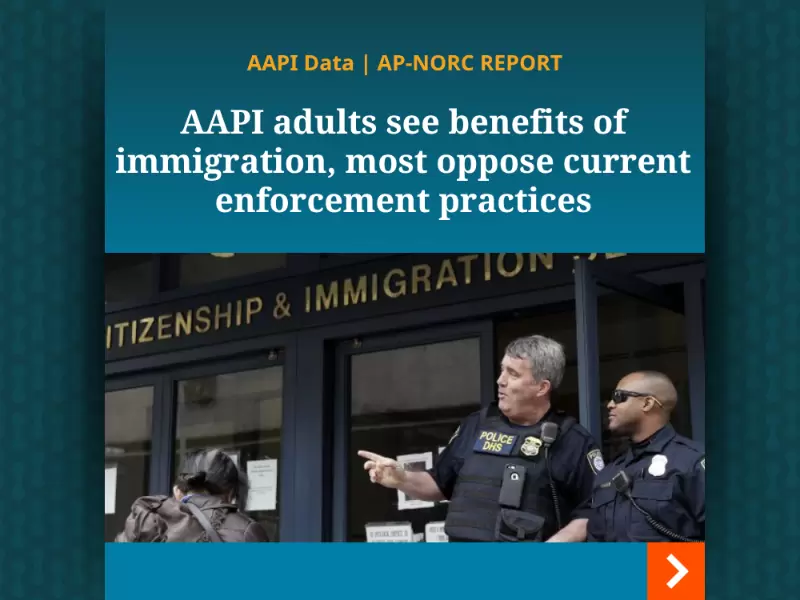 AP-NORC Survey February-March 2026 / AAPI Data
A majority of Asian American, Native Hawaiian, and Pacific Islander (AAPI) adults say U.S President Donald Trump has gone too far in using the U.S. military to intervene in foreign countries, according to a new nationwide survey.
The survey, conducted by The Associated Press-NORC Center for Public Affairs Research and AAPI Data, shows 71 percent of AAPI adults believe Trump has gone too far on military intervention abroad, while only 4 percent say he has not gone far enough.
Also Read: Beyond Dollars: Indian Americans lead in non-monetary giving
The divide is sharply partisan, with 89 percent of AAPI Democrats holding this view compared to 34 percent of AAPI Republicans.
Immigration stance
AAPI adults broadly view immigration as beneficial to the United States, particularly for its economic contributions. Large majorities say legal immigration supports economic growth, brings skilled expertise, and enriches American culture.
Many also see benefits from undocumented immigrants, though to a lesser degree, indicating a distinction based on legal status rather than a wholesale rejection.
Views of immigration enforcement agencies are also negative, with 73 percent of AAPI adults holding unfavorable opinions of Immigration and Customs Enforcement (ICE), a higher share than in the general U.S. population.
At the same time, Trump’s immigration approach faces widespread opposition. About 67 percent of AAPI adults say he has gone too far in deporting immigrants living in the country illegally, while 61 percent say he has done more to hurt than help immigration and border security.
Opposition is strongest toward enforcement methods. Measures such as the use of military or National Guard personnel, workplace raids, and large-scale neighborhood sweeps draw majority opposition, suggesting concerns extend beyond policy outcomes to how enforcement is carried out.
“These findings underscore how distinct AAPI views are when it comes to immigration and immigration enforcement,” says Karthick Ramakrishnan, executive director of AAPI Data and researcher at UC Berkeley.
“AAPI adults are significantly more likely than the general public to hold unfavorable views of ICE, reflecting broader concerns about recent enforcement actions and their potential impacts on communities,” he added.
The survey also reflects nuance within the community: some AAPI adults support targeted enforcement, particularly for individuals who have committed crimes, and AAPI Republicans are more likely than Democrats to favor stricter enforcement.
Rising costs
Economic pressures form the backdrop to these views, with the cost of living emerging as a dominant concern. Around 8 in 10 AAPI adults cite the cost of groceries, housing, and health care as sources of stress, with about half describing each as a major stressor.
The survey also finds strong opposition to Trump’s trade policies, with large majorities saying his tariffs have gone too far. This aligns with broader dissatisfaction over economic conditions: 73 percent say Trump has hurt the cost of living, 69 percent say he has worsened health care costs, and 62 percent say he has negatively affected job creation.
Financial confidence remains low. Only a small share of AAPI adults say they are very confident in their ability to meet expenses, handle emergency medical bills, or save for retirement. Just 29 percent believe younger generations will have a better standard of living than their parents.
Trust gap
The findings point to a wider political trust gap. Trump’s job approval among AAPI adults stands at about 30 percent, and roughly one in five express favorable views of him and other Republican figures, including J.D. Vance, Robert F. Kennedy Jr., and Marco Rubio.
Younger AAPI adults and Democrats are more likely to hold negative views of Trump’s performance across immigration and economic issues, highlighting generational and partisan divides within the community.
The poll of 1,197 U.S. adults who are Asian American, Native Hawaiian and Pacific Islanders was conducted Feb. 2-9, 2026, using a sample drawn from NORC’s probability-based Amplify AAPI Panel, designed to be representative of the Asian American, Native Hawaiian and Pacific Islander population. The margin of sampling error for all respondents is plus or minus 4.6 percentage points.
Discover more at New India Abroad.
Related









.JPG)
ADVERTISEMENT

ADVERTISEMENT
E Paper
Video

Comments
Start the conversation
Become a member of New India Abroad to start commenting.
Sign Up Now
Already have an account? Login