ADVERTISEMENT

ADVERTISEMENT



Why violence against Hindus in Bangladesh is structural, not sporadic
Rights organizations consistently observe that attacks on Hindus in Bangladesh tend to recur during elections, political transitions, or religious controversies.
-
 Dr. Vinay Nalwa
 - Fri, 26, Dec 2025
- 10:42 EST
- 232
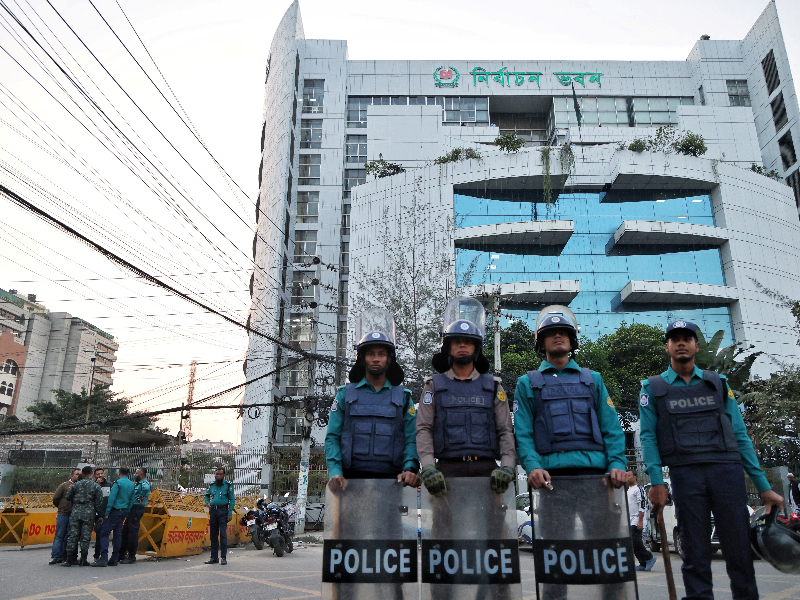 Policemen stand guard in front of the Bangladesh Election Commission office ahead of the expected general election schedule announcement in Dhaka, Bangladesh, December 11, 2025. REUTERS/Mohammad Ponir Hossain / REUTERS/Mohammad Ponir Hossain
Recent attacks on Hindu minorities in Bangladesh have once again drawn attention to a pattern of violence that rights groups argue is structural rather than episodic.
In Chattogram, assailants set fire to the home of a Hindu family, killing animals and destroying everything they owned. The family escaped only after cutting through a fence as the fire spread. A handwritten banner found near the site warned Hindu residents against alleged “anti-Islamic activities,” threatening severe consequences.
Only days earlier, Bangladesh witnessed the lynching of Hindu worker Dipu Chandra Das, beaten to death by a mob of Muslim co-workers at a garment factory after being accused of blasphemy—an allegation authorities later said was unsubstantiated.
No evidence was produced, yet the accusation alone proved sufficient to mobilize lethal mob violence, highlighting how claims of religious offense have become an immediate trigger for collective punishment even in industrial and supposedly regulated spaces.
Violence against Hindus has intensified since political instability followed the removal of Prime Minister Sheikh Hasina in August 2024. Minority organizations have documented killings, arson, sexual violence, and attacks on places of worship across multiple districts.
These incidents are not only grave human rights violations; they are accelerating the long-term demographic erosion of an already vulnerable minority.
According to the Pew Research Center, Hindu populations' reminders have declined sharply in several Muslim-majority countries, including Bangladesh, due to religious intolerance, social repression, forced displacement, and recurring communal violence. Bangladesh’s first post-independence census in 1974 recorded Hindus at 13.5 percent of the population. By 2011, that figure had fallen to 8.5 percent.
Economist Abul Barkat, drawing on three decades of research documented in a 2016 Dhaka University publication and reported by the Dhaka Tribune, estimates that approximately 11.3 million Hindus left Bangladesh between 1964 and 2013 due to religious persecution and discrimination—an average of more than 600 people per day.
Barkat warned that if this pattern continued unchecked, Hindus could effectively disappear from Bangladesh within a few decades, reflecting sustained out-migration driven by insecurity and marginalization rather than economic mobility.
To assess whether recent violence represents an anomaly or continuity, current developments must be situated within Bangladesh’s longer historical experience.
Not Isolated, but Recurrent: A Pattern Across Decades
The surge in violence following Sheikh Hasina’s removal reflects a recurring historical pattern rather than an exceptional breakdown of law and order. The Bangladesh Hindu Bouddha Christian Oikya Parishad (Bangladesh Hindu Buddhist Christian Unity Council) recorded over 2,400 incidents of violence against religious minorities between August 2024 and mid-2025.
These included killings, sexual violence, destruction of religious sites, arrests over blasphemy allegations, and forced occupation of homes and businesses. The scale and nationwide spread challenge claims that such attacks are the work of fringe actors or temporary instability.
Scholars trace selective anti-Hindu violence in Bengal back to the early twentieth century, when communal riots in Dhaka, Calcutta, Noakhali, and Chittagong involved targeted attacks on Hindu neighbourhoods, religious institutions, and women, as documented by Gangopadhyay and Devavrat in The Joy Bangla Deception.
These dynamics intensified during the 1946 riots and the violent Partition of British India. During the 1971 Bangladesh Liberation War, the Pakistani military and local allied militias such as the Razakars, Al-Badr, and Al-Shams systematically targeted Bengali Hindus, with mass killings documented across multiple localities.
Independence did not end this pattern. Post-independence decades saw repeated waves of violence, including large-scale riots in 1989, 1990, and 1992 during the Ram temple movement, and widespread post-election attacks in 2001 marked by killings, mass rape, looting, and arson across districts. A police report submitted to the High Court later recorded 160 attacks on Hindus across 21 districts during the 2014 National Assembly elections, largely involving BNP–Jamaat supporters and allied Islamist groups.
In 2013, following the death sentence of Jamaat leader Delwar Hossain Sayeedi for war crimes, coordinated attacks erupted across 20 districts, damaging at least 50 temples and 1,500 Hindu homes. In October 2021, during Durga Puja, a fabricated provocation—images circulated online showing a Quran placed on an idol—triggered mob attacks on hundreds of temples, particularly in Comilla.
Police later arrested Iqbal Hossain, a Muslim man, for staging the incident. Most recently, 2024 marked by the fall of the Awami League government and the formation of an interim administration under Muhammad Yunus has witnessed some of the worst violence against Hindus in decades, with arson, looting, sexual violence, and displacement occurring on a scale unseen in recent years.
Denial and Impunity
A 2024 study published by Springer Nature by researcher Foysal Shahriar Ratul, titled Trivializing Atrocities: Examining the Phenomenon of Genocide Denial in Bangladesh and the Triumph of Perpetrators, documents how denial of the 1971 genocide and the rehabilitation of perpetrators weakened accountability.
Although Bangladesh enacted the International Crimes (Tribunals) Act in 1973, prosecutions stalled after the assassination of Sheikh Mujibur Rahman in 1975. Several individuals later convicted of genocide-era crimes went on to hold political office, exercise religious authority, or appear in mainstream media while denying past atrocities.
Ratul also notes the erasure or repurposing of mass grave sites and torture centres, contributing to an institutionalised culture of denial that continues to affect minority security.
What “Islamism” Means in the Bangladeshi Context
In Bangladesh, Islamism refers not merely to personal religious belief but to a political ideology that seeks to define national identity primarily through Islam. Although Bangladesh was founded in 1971 as a secular republic, secularism was removed from the Constitution in 1977, and Islam was declared the state religion in 1988. These shifts altered the symbolic and legal position of minorities within the state.
Policy choices reinforced this transformation. The Enemy Property Act, introduced during Pakistan’s rule and retained after independence under the renamed Vested Property Act, enabled the confiscation of property from individuals deemed “enemies” or “absentees” a category that overwhelmingly targeted Hindus who fled communal violence or were accused of disloyalty without judicial process.
Although formally abolished in 2001, the law’s effects were never fully reversed. Barkat estimates in his study that nearly five million Hindus lost around two million acres of land about 45 percent of all Hindu-owned land in Bangladesh. These laws made 60% of the Hindus landless, resulting in economic dispossession and large-scale migration.
A Pattern, Not an Anomaly
Rights organizations consistently observe that attacks on Hindus in Bangladesh tend to recur during elections, political transitions, or religious controversies. Methods of arson, sexual violence, vandalism, and intimidation remain strikingly consistent, as does the limited rate of prosecution.
Viewed together, mob lynchings over unproven blasphemy allegations, systematic land dispossession through the Enemy and Vested Property Acts, and the progressive Islamisation of Bangladesh’s constitutional framework reveal a converging architecture of exclusion rather than episodic disorder.
Blasphemy-related violence functions as an immediate mechanism of intimidation, while property laws have enabled long-term demographic erosion. Constitutional changes since the late 1970s have further altered the legal and symbolic position of minorities within the state.
What is visible today is therefore not a series of isolated incidents, nor merely the by-product of political instability, but the cumulative outcome of longstanding institutional and ideological trends.
Unless this continuum of legal, political, and social exclusion is explicitly acknowledged and addressed, periodic eruptions of anti-Hindu violence will remain predictable outcomes of Bangladesh’s trajectory rather than preventable exceptions.
The writer is an author, columnist, and sociologist.
(The views and opinions expressed in this article are those of the author and do not necessarily reflect the official policy or position of New India Abroad.)
Related










ADVERTISEMENT

ADVERTISEMENT
E Paper
Video

Comments
Start the conversation
Become a member of New India Abroad to start commenting.
Sign Up Now
Already have an account? Login