ADVERTISEMENT

ADVERTISEMENT



Trump's third-country deportation push hits a legal roadblock
The three-judge panel said the administration had failed to satisfy the legal test required to secure a stay while the case proceeds on appeal.
-
 IANS
IANS - Thu, 26, Feb 2026
- 02:29 EST
- 17
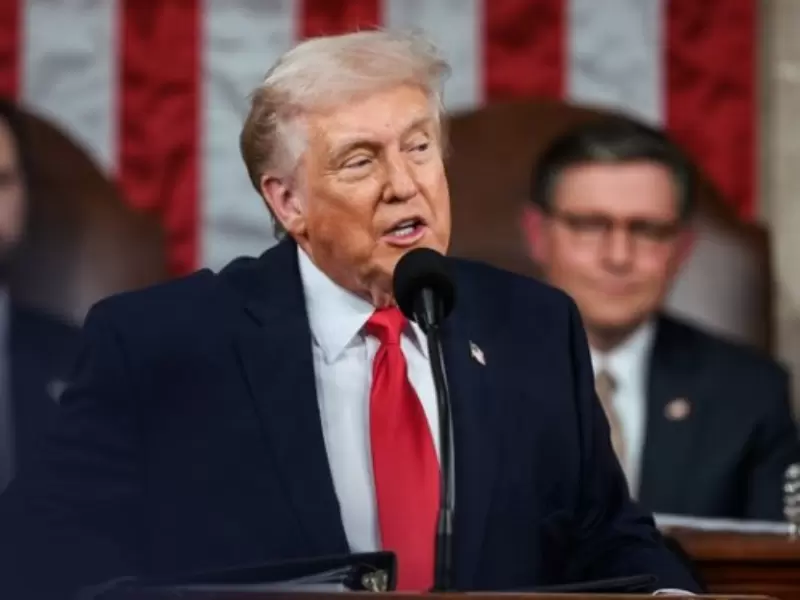 Trump's third-country deportation push hits a legal roadblock / X/@WhiteHouse
The Trump administration’s effort to fast-track deportations to third countries hit a legal setback after a U.S. appeals court refused to pause a lower court order blocking the policy.
The U.S. Court of Appeals for the First Circuit in Boston on Feb. 25 denied the government’s emergency request to lift a preliminary injunction that restricts deportations of certain migrants to countries other than their own.
“The emergency motion for a stay of the Apr. 18 preliminary injunction pending appeal and for an immediate administrative stay is denied, the government not having met the standard for the relief sought,” the court said.
The three-judge panel said the administration had failed to satisfy the legal test required to secure a stay while the case proceeds on appeal.
Citing the Supreme Court’s ruling in Nken v. Holder, the court noted that a party seeking a stay must “make a ‘strong showing that (it) is likely to succeed on the merits’ in its appeal” and demonstrate irreparable harm, among other factors.
The dispute centres on the Department of Homeland Security’s Mar. 30 guidance regarding third-country removals. Under that policy, U.S. authorities sought to deport certain migrants to countries willing to accept them, even if those countries are not their nations of origin.
In its order, the court expressed concern about “the continuing application of the Department of Homeland Security’s Mar. 30 Guidance Regarding Third Country Removals.”
It also pointed to “the irreparable harm that will result from wrongful removals in this context,” signalling unease about the consequences of deportations carried out before full judicial review.
The judges directed both sides to address key legal questions in their briefs. Among them is whether the class-wide injunction improperly “enjoin or restrain the operation of” certain provisions of the Immigration and Nationality Act.
The court also asked whether the relevant section of the Act “presumes the availability of individualised judicial review to individuals subject to third-country removals” and therefore does not bar class-wide injunctive relief where such relief is necessary.
In addition, the panel questioned whether the plaintiffs’ Administrative Procedure Act and due process claims fall outside the scope of that statutory provision.
The case, titled D.V.D.; M.M.; E.F.D.; O.C.G. v. U.S. Department of Homeland Security, names DHS, Secretary Kristi Noem, Attorney General Pamela Bondi, and other officials as defendants.
Discover more at New India Abroad.
Related








ADVERTISEMENT

ADVERTISEMENT
E Paper
Video

Comments
Start the conversation
Become a member of New India Abroad to start commenting.
Sign Up Now
Already have an account? Login