ADVERTISEMENT
ADVERTISEMENT



Trump report flags foreign STEM reliance as security challenge
White House urges greater investment in America's domestic scientific workforce.
-
 IANS
IANS - Wed, 22, Jul 2026
- 04:35 EDT
- 21
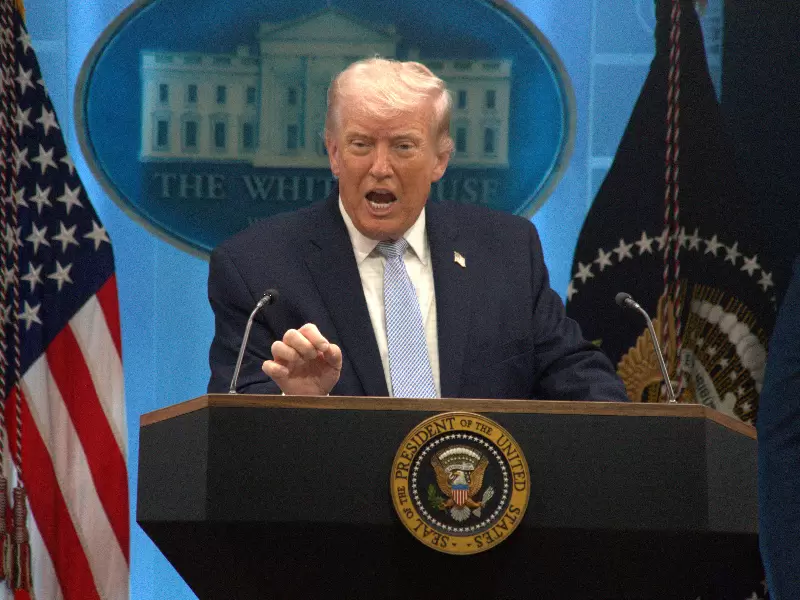 The White House released a report outlining priorities for U.S. scientific research and innovation. / Xinhua via IANS
The Trump administration has described America's reliance on foreign students in science, technology, engineering and mathematics (STEM) programs as a national security challenge, warning that overseas competitors are using the U.S. education system as an entry point into the country's innovation base.
The assessment appears in Science: A New Golden Age, a White House report released Tuesday on restructuring the U.S. scientific research enterprise and preserving American leadership in critical technologies.
Also read: Miami doctor charged in Indian-origin woman's death
"For decades, the United States has funded large cohorts of foreign students and tolerated technology transfer abroad under lax security standards," the report says.
Temporary visa holders accounted for about half of U.S. doctoral graduates in computer science and mathematics with confirmed post-graduation plans in 2024, according to the document.
"This reliance on foreign talent sidelines American students, a deep domestic talent pool that remains under-supported by its own government," it says.
The report argues that the United States spends heavily to train international researchers but sometimes loses the benefits when they leave the country.
"At the same time, we train extraordinary global talent at enormous expense, only to lose this effort when foreign governments recruit them to build up their own technological enterprises," it says.
The document links international participation in American scientific programs to concerns about research security.
"America's over-reliance on foreign students also creates a security challenge our institutions are ill-equipped to address," it says.
The report alleges that U.S. competitors exploit the difference between America's open scientific system and more restrictive systems abroad. It says they use American educational institutions to gain access to the country's research and innovation network while building their own domestic capabilities.
The document does not mention India, Indian students or Indian researchers. It also does not propose changes to student visas, employment visas or permanent residency rules, nor does it recommend nationality-based restrictions on university admissions.
Its findings nevertheless carry significance for Indian students because of their prominent presence in graduate-level STEM programs in the United States. Any future tightening of federally funded research access or security requirements could affect international researchers, including Indians, although the report announces no such measures.
A chart included in the report says the proportion of U.S. research doctorates awarded to temporary visa holders with confirmed post-graduation commitments has doubled over the past four decades.
Their share rose from roughly 20 percent to 40 percent in natural sciences and engineering, and from about 10 percent to 20 percent in social, behavioral and health sciences, according to the report.
The administration's proposed response focuses primarily on expanding America's domestic scientific workforce. It calls for identifying talented students across the country, strengthening advanced mathematics and science programs in schools, and increasing hands-on technical training, apprenticeships and research placements.
The report also recommends greater support for American graduate students, postdoctoral researchers and early-career scientists. It says exceptional talent should be identified through demonstrated technical ability rather than background, institutional credentials or personal connections.
Discover more at New India Abroad.
Leave A Comment
Related







ADVERTISEMENT

ADVERTISEMENT
E Paper
Video

Comments
Start the conversation
Become a member of New India Abroad to start commenting.
Sign Up Now
Already have an account? Login