ADVERTISEMENT
ADVERTISEMENT



The Eternal Sentinel: Trijugi Shikhar and the Sacred Geography of Devbhoomi
Far from being a static monument, the temple, the eternal flame, and Trijugi Shikhar together form a single, living continuum of faith.
-
 Dr. Vinay Nalwa
 - Wed, 12, Aug 2026
- 14:12 EDT
- 28
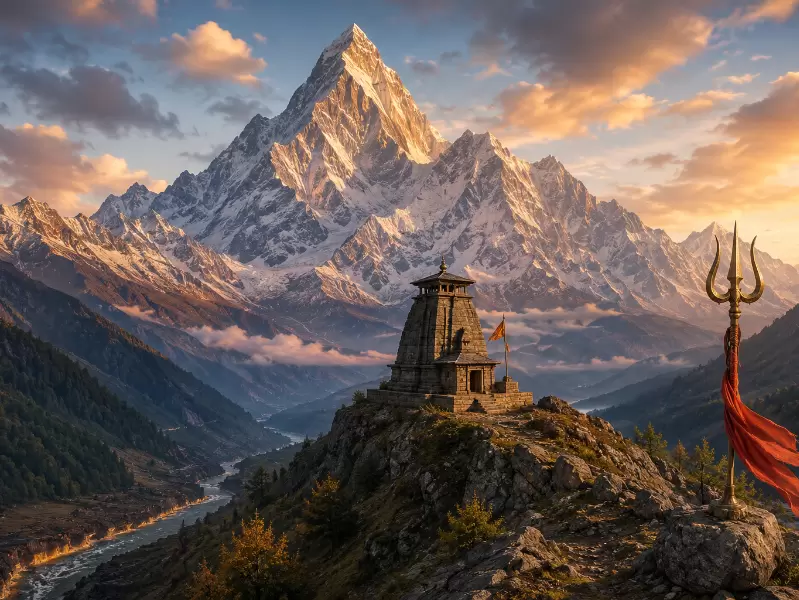 Representative Image / Generated using AI
During the sacred month of Shravan, as devotion to God Shiva reaches its annual peak across the Indian subcontinent, the sacred geography of the Garhwal Himalayas acquires a heightened spiritual resonance.
High in this terrain, rising at coordinates 31°21'51"N, 79°00'42"E stands Trijugi Shikhar. More than a formidable physical summit of stone, snow, and ice, the peak serves as the high-altitude anchor for a living sacred landscape (Tirtha-Kshetra). It stands as an enduring witness to divine synthesis, ecological balance, and the unbroken civilizational consciousness of India.
Within the broader devotional landscape of Kedar Khand lies the temple complex of Triyuginarayan, a sanctuary distinct in its character and profound in its theological integration. Dedicated primarily to Narayana (God Vishnu), the shrine is eternally celebrated as the venue of the celestial marriage between God Shiva and Goddess Parvati. This arrangement presents a striking example of Hindu synthesis.
Also Read: The Hand That Funds the Cradle of Education Rules the World
Even in a season overwhelmingly dedicated to Shaiva pilgrimage, Triyuginarayan embodies a harmonious convergence where a Vishnu sanctum safeguards the memory of a Shaiva cosmic union. According to Puranic tradition, after intense tapas undertaken by Parvati, daughter of Himavan, Shiva accepted the sacred bond. Narayan stepped forward to perform the Kanyadaan as her ceremonial brother, while Lord Brahma officiated as the wedding priest.
The name Triyuginarayan itself captures this timelessness: "Narayan" honours the presiding deity, while "Triyugi" signifies the three yugas through which the sacred fire, the Akhand Dhuni has continuously burned. Far from being a static monument, the temple, the eternal flame, and Trijugi Shikhar together form a single, living continuum of faith.
This sacred geography extends well beyond the temple walls and the central Havan Kund. It integrates a network of ritual water bodies fed by the mountain's glacial streams, most prominently Rudra Kund, Vishnu Kund, Brahma Kund, and Saraswati Kund. This spatial design illustrates how traditional Hindu geography treats a temple not as an isolated stone building, but as an organic environmental unit linking temple, fire, water, and peak.
Historically, Triyuginarayan formed an integral node along the traditional walking routes connecting Sonprayag, Guptakashi, and Kedarnath. Pilgrims traversing these high routes engaged with an interconnected sacred network where every river confluence (Prayag), ridge, and temple reinforced a unified cultural memory.
The physical presence of Trijugi Shikhar mirrors its spiritual depth. The snowpack and glaciers surrounding the peak feed crucial headwater tributaries that merge into the Alaknanda and Bhagirathi systems ultimately nourishing the Ganga. This hydro-geographic reality reflects a fundamental tenet of Indian civilizational thought: Ecology as Dharma.
By venerating high-altitude peaks, glaciers, and water sources as living tirthas, ancient traditions embedded resource conservation directly into daily spiritual duties. Safeguarding the fragile ecology of the Garhwal Himalayas is not a modern administrative directive. It is a continuation of the traditional responsibility to protect the lifelines of the plains below.
Beyond its devotional framework, the high Himalayan passes around Garhwal historically served as vibrant channels of trade and cultural exchange connecting India with Tibet and Central Asia. Traders, ascetics, and travellers carried wool, salt, and medicinal herbs alongside philosophical ideas and scriptural traditions.
During the colonial era, Western survey movements mapped these mountain ranges primarily through a utilitarian lens, but for local communities, they always remained sacred spaces.
The enduring relevance of Triyuginarayan lies in its continuous ritual practice. The story of Shiva and Parvati is not treated as a closed historical account. Today, pilgrims continue to offer wood (samidha) to the Akhand Dhuni, collect its sacred ash (vibhuti) as a blessing, and seek marital harmony in the presence of the eternal flame.
In an era marked by rapid social shifts and transient values, the stability of Trijugi Shikhar and the unbroken flame of Triyuginarayan offer a timeless counterweight. They affirm that true strength is rooted in stability, discipline, and commitment. Bridging ancient Puranic memory with contemporary life.
Trijugi Shikhar remains far more than a geographical peak in the Garhwal range. It stands as a guardian of Hindu civilizational memory, a sanctuary of Tridev synthesis, and a vital ecological watershed. As morning light falls across its snowbound ridges and the Akhand Dhuni continues to burn in the valley below,
Trijugi Shikhar reminds us that some landscapes are not merely part of the earth, they are living manifestations of an eternal Hindu cultural order.
(The views and opinions expressed in this article are those of the author and do not necessarily reflect the official policy or position of New India Abroad.)
Discover more at New India Abroad.
Leave A Comment
Related











ADVERTISEMENT

ADVERTISEMENT
E Paper
Video

Comments
Start the conversation
Become a member of New India Abroad to start commenting.
Sign Up Now
Already have an account? Login