ADVERTISEMENT
ADVERTISEMENT


Stony Brook’s Aruna Balasubramanian earns quantum networking research award
The team’s paper proposes a verification-based protocol to determine whether quantum entanglements remain usable before quantum information is transmitted
-
 Pranavi Sharma
 - Fri, 21, Aug 2026
- 02:41 EDT
- 18
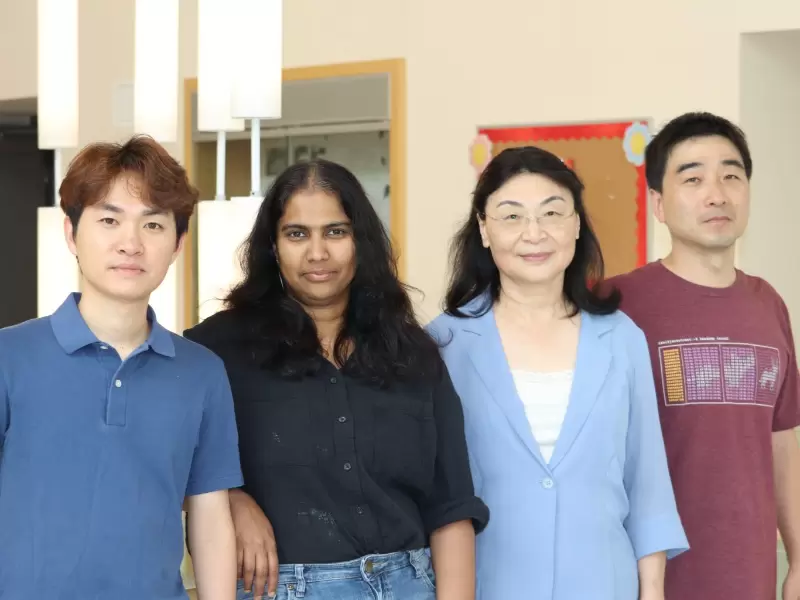 Left to right: SBU researchers: Xuan Du Trinh, Aruna Balasubramanian, Yuanyuan Yang, Nengkun Yu. / Stony Brook University
Indian-origin researcher Aruna Balasubramanian and her colleagues were honored in Seoul for research proposing a new approach to reliable quantum communication.
Indian-origin researcher Aruna Balasubramanian of Stony Brook University and a team of researchers from Stony Brook and Binghamton universities received a Distinguished Paper Award at the IEEE International Conference on Distributed Computing Systems (ICDCS) in Seoul for proposing a new approach to reliable, long-distance quantum communication.
ALSO READ: R&D World names Parans Paranthaman 2026 Researcher of the Year
The recognition was announced Aug. 20. The team’s paper, “Rethinking Quantum Network Design using a Verification-Based Quantum Transmission Protocol,” was one of five papers selected for the distinction. About 145 papers were accepted to the conference from more than 800 submissions.
The research was co-authored by Balasubramanian and Nengkun Yu, faculty members in Stony Brook’s Computer Science Department; computer science Ph.D. students Zhengyu Wu and Xuan Du Trinh; Electrical and Computer Engineering faculty member Yuanyuan Yang; and Yiming Zeng, a Stony Brook ECE Ph.D. graduate who recently joined Binghamton University’s faculty.
Quantum networks are expected to form the foundation of a future quantum internet, allowing quantum computers and sensors to communicate securely over long distances. The networks rely on fragile quantum connections known as entanglements, which can decay quickly and make reliable communication difficult.
The team’s paper proposes a verification-based protocol to determine whether quantum entanglements remain usable before quantum information is transmitted. The researchers said verification is particularly difficult because measuring an entanglement destroys it.
To address the problem, the team creates several entanglements and sacrifices a subset to verify the quality of those that remain. The verified entanglements can then be used to teleport quantum bits.
The researchers also departed from the conventional end-to-end approach to quantum communication. Rather than creating a single entanglement spanning an entire route, their protocol verifies local connections and transmits quantum information hop by hop.
Because each hop uses a verified link, the approach increases the likelihood of successful communication, including in noisy networks. The paper proposes a new quantum network architecture built around this approach.
“We believe the paper stood out partly because the reviewers appreciated its unconventional perspective on long-distance quantum communication,” Balasubramanian said.
“Rather than incrementally improving existing approaches, we propose a new quantum network stack that fundamentally rethinks how quantum information is transmitted across noisy networks.”
The project brought together researchers from Computer Science and Electrical and Computer Engineering and strengthened collaboration across the State University of New York system. Zeng completed his Ph.D. at Stony Brook before joining Binghamton, providing an opportunity for the researchers to continue working together.
Reliable quantum networks could eventually support secure communication, distributed quantum computing, highly accurate clock synchronization and new sensing technologies.
“Beyond the award itself, a recognition like this also means more visibility for our College of Engineering,” Balasubramanian said.
“It also means more researchers will read the paper and hopefully build on it — and, in the process, advance the field.”
Discover more at New India Abroad.
Leave A Comment
Related










ADVERTISEMENT

ADVERTISEMENT
E Paper
Video

Comments
Start the conversation
Become a member of New India Abroad to start commenting.
Sign Up Now
Already have an account? Login