ADVERTISEMENT

ADVERTISEMENT



Rejection to triumph Indian student's Stanford comeback
Dhairyya Agarwal recounts how he transformed his impersonal application into an honest narrative centered on his vulnerabilities, failures and personal growth.
-
 Jeffin T. Kaleekal
 - Tue, 17, Mar 2026
- 06:18 EDT
- 11
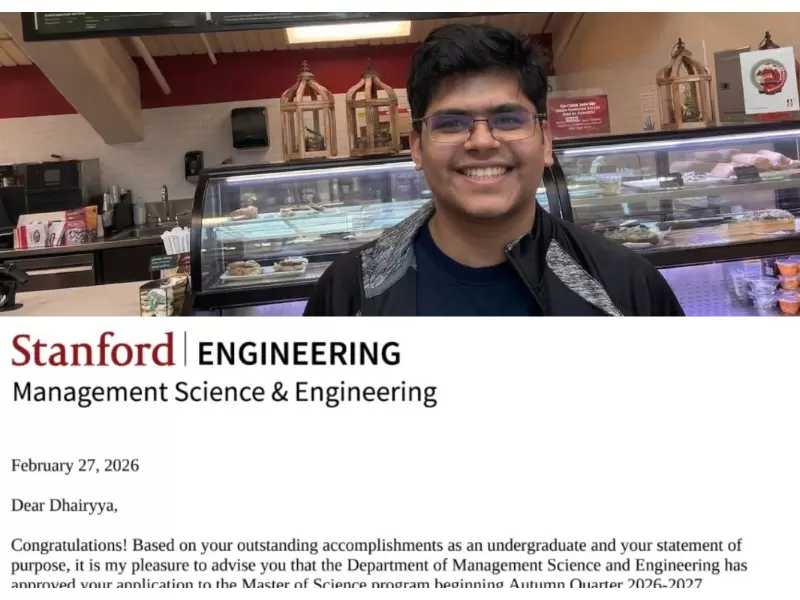 Dhairyya Agarwal (top) and the acceptance letter he received from Stanford / Courtesy photo
Dhairyya Agarwal, in 2025, was told by Stanford University that he was not good enough. Twelve months later, the same university was eager to have him enroll. In this conversation, Agarwal describes the bottomless psychological pit he found himself in after facing rejection from his dream university and, now that he has climbed out of it, he attempts to offer a helping hand to those still grappling with rejection.
Agarwal, who grew up in Kolkata, completed his undergraduate studies at Maulana Abul Kalam Azad University of Technology, proves that rejections are not permanent. He also offers handy insight into why many applications get rejected and how your application can be tweaked to stay ahead of the competition.
He first moved to the US in 2019 on an F-1 visa. After his F-1 visa expired, he moved to Canada in 2024 and subsequently moved back to the U.S.A. in 2025 on an L-1 visa.
Excerpts from an interview with Dhairyya Agarwal:
1. Could you outline the details of the program at Stanford you were rejected from in March 2025 and then admitted to in February 2026?
The program is Stanford’s Master of Science in Management Science and Engineering. The coursework spans strategy, decision-making, entrepreneurship, optimization and operations research. Students build real companies as part of the curriculum, taught by professors who also invest in and advise startups. What drew me to it was both the curriculum and the community: a small, diverse cohort of engineers, working professionals and researchers who sharpen each other every day.
2. What do you believe were the key differences between your 2025 application and your successful 2026 application?
In 2025, I treated each component of the application as separate pieces and leaned heavily on professional achievements. It was polished but impersonal. In 2026, I started over and poured close to eight months into it. I focused on my real “why” and my actual vulnerabilities first, then connected with people already in the program who helped me identify gaps I could not see on my own. I let each essay prompt guide the answer instead of forcing my narrative onto it, and treated the application as one cohesive story that represented me as an actual person someone on the other side wanted to advocate for.
3. Did you take any specific steps to strengthen your candidacy and your application during that one year?
Yes, a lot changed in the year between the applications. I enrolled as a non-degree student and spent time on Stanford’s campus alongside admitted MS&E students. I revamped my letters of recommendation, giving each recommender a distinct focus area so every letter complemented the application. I joined a founding team inside Microsoft building a new cybersecurity product and helped it scale. But the biggest shift was internal: the application stopped leading with achievements and started leading with my failures and what they taught me, and those failures are what ultimately sharpened my real “why.”
4. Rejection letters can be devastating—how did receiving the 2025 rejection affect you emotionally and professionally at the time? What helped you decide to reapply rather than move on?
I will be honest — I was heartbroken. For three days I did not eat or drink much of anything. It felt like a temporary pause on everything I had been working toward. But the “why” behind why I applied never actually left — it just went quiet for a moment. What brought me back were the people around me. My parents, my brother, my sister-in-law, close friends and even a few people at work who knew about the application — they all encouraged me to keep going until I fulfilled that “why.” I picked myself up, started working on the application again and did not stop.
5. Did you apply to other programs in the 2025–2026 cycle? If yes, how did outcomes at other schools factor into your decision to reapply?
Both in 2025 and 2026, I applied exclusively to Stanford MS&E — no other school, no backup plan. I already had a master’s degree from Carnegie Mellon, so this was never about collecting another credential. It was about broadening my intellect, fueling my curiosity and forming a close network with a core group of builders who just wanted to build — because I firmly believe we are the sum of the five people we spend the most time with. Stanford MS&E was the only program that fit the specific “how” I needed to reach my “why,” both in the skills it offered and the community it put me in.
6. What advice would you give to students who applied and are awaiting a response or are planning to apply?
If I could go back and tell myself one thing before applying, it would be this: get clear on why you actually need this degree and how it will specifically help you get where you are trying to go. Talk to students already in the program. Their perspective is something no website or guide can give you, and it will sharpen your “how.” When you start writing, remember that quality matters far more than quantity.
ALSO READ: UPenn’s Rashmi Acharya receives 2025 President’s Prize
7. What advice would you give to students who applied and received a rejection?
If the outcome is a rejection, feel it. Do not pretend it does not hurt. Sit with the disappointment and give yourself the space to process it honestly. The sting of my rejection in March 2025 never fully went away until I submitted my reapplication in November 2025, and it was my family who helped me carry that weight through those months.
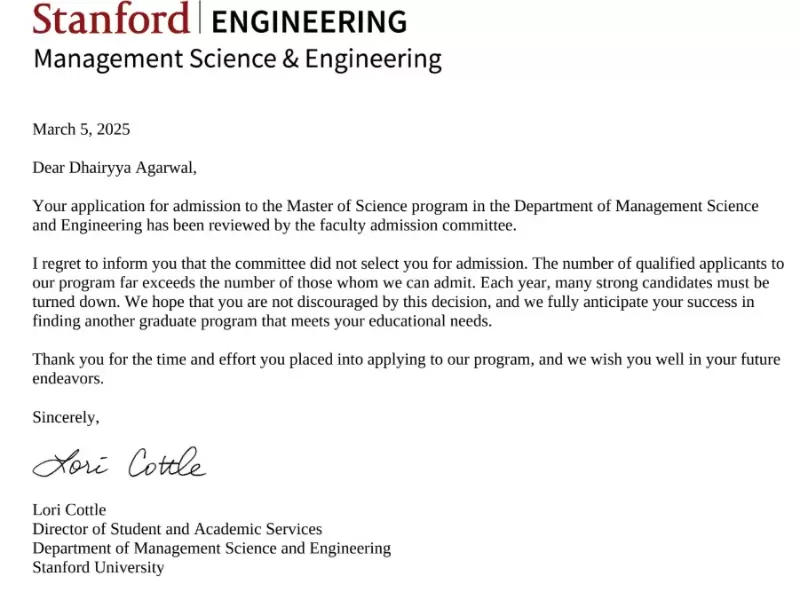 Stanford rejection letter / Courtesy photo
8. In your view, how much do admissions decisions hinge on factors within an applicant's control, like improving the application, versus external factors like competition, institutional priorities or luck?
I was living in Vancouver for over a year due to visa issues, away from friends and my usual support system. One night, I did not have money for groceries, could not reach anyone and went to bed on an empty stomach, having not eaten since the day before. At one in the morning, my housemate came knocking with a plate of home-cooked food from a gathering. Admissions work the same way — external factors like competition, institutional priorities and timing are real, and pretending otherwise is dishonest.
9. What does your current role at Microsoft look like and how does it feel when you look back at the days of struggle?
At Microsoft, I work as a product manager in the cybersecurity space protecting users from malicious attacks. Knowing that my work helps make the world a safer place to live gives every day meaning, and the struggle it took to get here only makes that meaning deeper.
10. Looking back, is there anything you would have done differently in your original 2025 application, knowing what you know now?
If I could change one thing, it would be the thing that took me the longest to learn: stop trying to prove you are good enough and just be honest about who you are. My 2025 application was built on the fear of being seen. Every rough edge polished, every failure hidden, every sentence designed to impress rather than connect. The world around us reinforces this: come across as amazing and hide your failures. But doing the opposite is what actually works. When you are honest, people connect with you, and that matters everywhere. If I could go back, I would let go of that fear on day one, find a coach to challenge my blind spots and trust that being real is more compelling than being impressive. The parts of my story I was most afraid to share in 2025 became the strongest parts of my 2026 application.
Discover more at New India Abroad.
Related



ADVERTISEMENT

ADVERTISEMENT
E Paper
Video

Comments
Start the conversation
Become a member of New India Abroad to start commenting.
Sign Up Now
Already have an account? Login