ADVERTISEMENT
ADVERTISEMENT



No consensus at BRICS foreign ministers' meet as key differences emerge
This is the second time when the BRICS grouping failed to issue a joint statement after a meeting of its participants.
-
1759953093.png) Staff Reporter
Staff Reporter - Fri, 15, May 2026
- 16:52 EDT
- 33
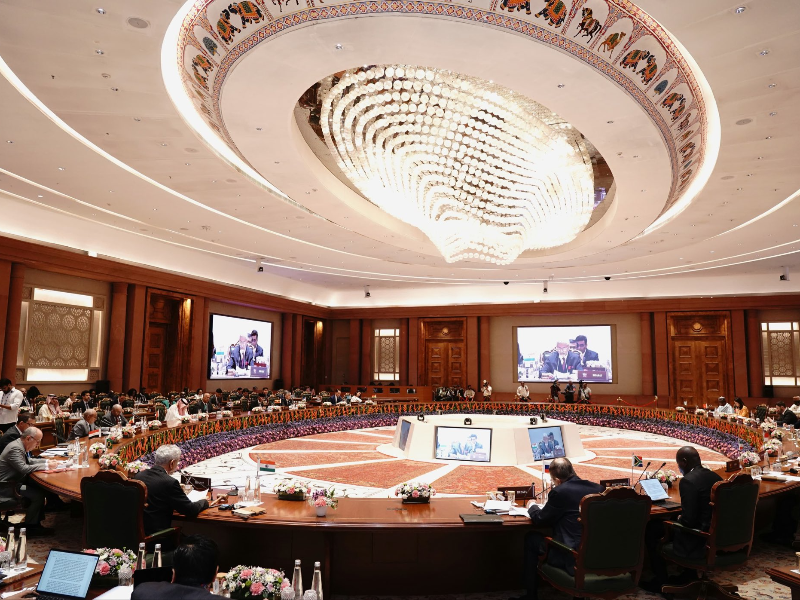 BRICS Foreign Ministers' meeting / X/@DrSJaishankar
New Delhi:The BRICS foreign ministers' meeting ended without consensus as key differences emerged on some burning issues between member states and as Iran dissented on two paragraphs of the statement.
This is the second time when the BRICS grouping failed to issue a joint statement after a meeting of its participants.
Also Read: EAM Jaishankar highlights PM Modi’s address, stresses ‘3Ts’ in diplomacy
Previously, the 11-nation BRICS Deputy Foreign Ministers and Special Envoys meeting held on April 23-24 in New Delhi had failed to reach the stage of issuing a statement amid heated debates and extended talks between the participants. One of the key issues that had led to the failure of the nations to reach a position to issue a joint statement back then was the difference of opinion between Iran and the UAE, which are on opposite sides in the West Asia conflict.
Sources privy to the discussions told New India Abroad that during the meeting held on May 15, Iran expressed reservations on two paragraphs including one that "called on the international community to support the Palestinian Authority in undergoing reforms to fulfil the Palestinians' legitimate aspirations for independence and statehood."
The second paragraph with which Iran had issues included insurance of "exercise of navigational rights and freedoms of vessels of all states in the Red Sea and Bab Al-Mandeb Strait, in accordance with international law."
A statement and "outcome document" issued by India in its capacity as the chair of the BRICS foreign ministers' meeting noted that a BRICS member had reservations on two paragraphs.
One of the paragraphs reads the following:
"The Ministers recalled that the Gaza Strip is an inseparable part of the Occupied Palestinian Territory. They underlined, in this regard, the importance of unifying the West Bank and the Gaza Strip under the Palestinian Authority, and reaffirmed the right of the Palestinian people to self-determination, including the right to their independent State of Palestine. They called on the international community to support the Palestinian Authority in undergoing reforms to fulfil the Palestinians’ legitimate aspirations for independence and statehood," the statement said, adding that a member had reservations on some aspects of this paragraph.
The second paragraph that Iran dissented on read the following:
"The Ministers stressed the importance of ensuring the exercise of navigational rights and freedoms of vessels of all states in the Red Sea and Bab Al-Mandab Strait, in accordance with international law. They encouraged enhanced diplomatic efforts by all parties to that end, including by addressing the causes of the conflict, and continued support for dialogue and Yemen’s peace process under UN auspices. They further underscored the urgency of addressing the humanitarian crisis in Yemen including food security and access to basic services. They stressed the need that efforts to achieve long-term stability, prosperity, and security require roles and contributions of countries of the region," it said.
That Iran dissented on the contents of the second paragraph is significant given the fact that Iran intends to establish a mechanism which can help it "manage the strait"- a euphemism for maintaining some control over the Strait of Hormuz through which about 20 percent of world's energy supplies pass.
The recent blockade of the Strait of Hormuz has sent shockwaves in the oil market and triggered an energy crisis across several Asian, South Asian, Southeast Asian and western countries with several of them forced to resort to austerity measures.
While the chair's statement issued after the conclusion of the BRICS foreign ministers' meeting does not mention the name of the country that dissented on the paragraphs mentioned above, it became clear that there were key differences between Iran and the UAE.
Speaking to mediapersons here in New Delhi, the Iranian foreign minister Abbas Araghchi on May 15 said that in the Strait of Hormuz, "everything is managed by Iran and Oman" and that the Iranians had been trying to ensure better services for the ships passing via the Strait. He added that the Strait of Hormuz was open for vessels of every nation except for those which are "working against" Iran.
Moreover, while he refrained from naming the UAE, Araghchi blamed a country with a "special relationship with Israel" for lack of consensus within the BRICS grouping .
A recent news report in Axios has mentioned about the deepened military, security and intelligence coordination between Israel and the UAE and disclosed how the UAE coordinated with Israel for the deployment of the latter's Iron Dome defence system on its soil.
Araghchi also said that while such countries thought that the relationship with the US and Israelis would secure them, it was driving them towards "insecurity."
"After 40 days of war, we can hope to achieve a goal...we are interested in negotiations but only if the other side is serious. We have no trust on the Americans. All of you know why we have all the reasons not to trust the US but they have all the reasons to trust us," he said, recalling how Iran was attacked even as negotiations had been going on between the two sides during the previous rounds of negotiations held in 2025 and later in February 2026.
Araghchi said that the ongoing negotiations remained fruitless because of the "behaviour of the US" and the "contradictory positions" adopted by the country even as he criticised the US President Donald Trump for "issuing different tweets everyday."
Discover more at New India Abroad.
Related







ADVERTISEMENT

ADVERTISEMENT
E Paper
Video

Comments
Start the conversation
Become a member of New India Abroad to start commenting.
Sign Up Now
Already have an account? Login