ADVERTISEMENT
ADVERTISEMENT



Most AAPI adults say U.S. no longer a great place for immigrants: Poll
Immigration concerns are prompting many AAPI adults to change their daily routines, according to a new poll.
-
 Malvika Choudhary
 - Tue, 16, Jun 2026
- 16:58 EDT
- 47
 AP-NORC Survey June 2026 / AAPI Data
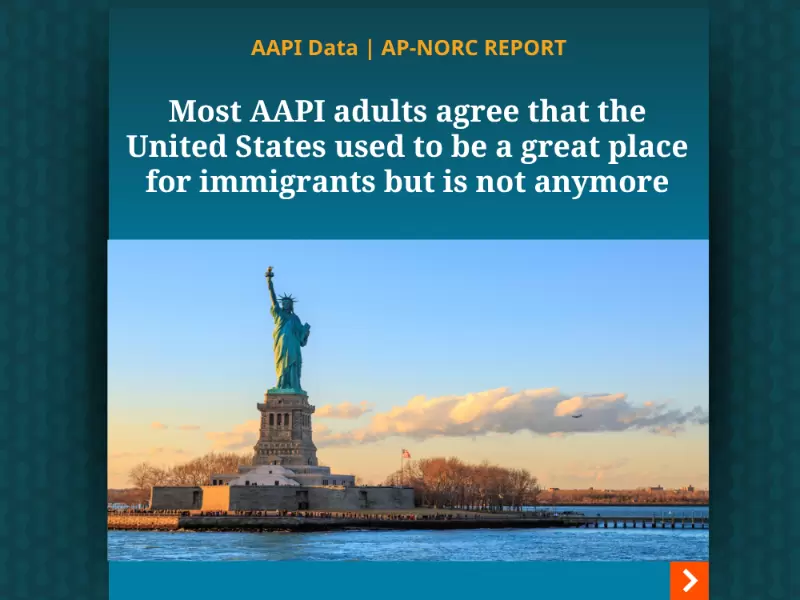
The United States is no longer the welcoming destination for immigrants from around the world, according to nearly two-thirds of Asian American, Native Hawaiian, and Pacific Islander (AAPI) adults in a recent survey.
The findings, released by AAPI Data and The AP-NORC Center for Public Affairs Research come as the country prepares to mark the 250th anniversary of its independence amid ongoing debates over immigration policy and citizenship.
Also Read: 72% AAPI adults say U.S. overspends on immigration enforcement
Immigration concerns
When asked to describe the United States in their own words, respondents most commonly used terms such as "great," "prosperous," and "powerful."
More than half of AAPI adults, 51 percent, said they or someone they know had carried documentation proving immigration status or citizenship, changed travel plans, significantly altered daily routines, or faced detention or deportation concerns because of immigration status during the past year.
Forty-one percent said they or someone they know had begun carrying proof of citizenship or immigration status, compared with 25 percent of the general population. The figure was highest among South Asians, at 53 percent.
The survey also found that 34 percent of AAPI adults said they or someone they know had changed travel plans because of immigration status, nearly double the rate among the general public.
"These findings suggest that many AAPI adults see the United States as having moved away from its decades-long reputation as a beacon for immigrants," said Karthick Ramakrishnan, executive director of AAPI Data. "Nevertheless, most AAPIs still see cultural diversity as essential to American identity, and view maintenance of their culture and traditions as a high priority."
The American dream
Despite concerns about immigration, AAPI adults expressed strong support for several traditional pillars of American identity. Eighty percent said the American Dream is a core part of the nation's identity, 79 percent cited a democratically elected government, and 73 percent pointed to the mixing of cultures and values from around the world.
The survey found AAPI adults were more likely than the general public to view democracy, cultural diversity, and the ability of people to come to the United States to escape violence or seek opportunity as central elements of the nation's identity.
"AAPI adults value core elements of American identity like the American Dream, democratically elected government, and cultural diversity," said Jennifer Benz, director of The AP-NORC Center. "But politics is cited more than any other factor as the cause of what divides the country."
One-third of respondents identified politics as the primary factor dividing Americans, while freedom and liberty were most frequently cited as what unites the country.
The survey also highlighted strong support for cultural and religious pluralism. Only about one in five AAPI adults said a culture grounded in Christian religious beliefs or one established by early European immigrants was central to American identity.
Meanwhile, 58 percent said it was extremely or very important for immigrants living in the United States to maintain their culture and traditions. About half also emphasized maintaining their home language, speaking English fluently, and blending into American society.
Citizenship and identity
As the Supreme Court weighs limits on birthright citizenship, the poll found broad support among AAPI adults for granting citizenship to children born in the United States.
Eighty-one percent said children born to parents legally in the country on work visas should be citizens. A majority also supported citizenship for children born to parents on tourist visas (56 percent) and those living in the country illegally (54 percent).
The survey found that family was the most important component of personal identity, with 80 percent describing it as extremely or very important. More than half said their family's ancestry or country of origin (55 percent) and their race or ethnicity (54 percent) were key parts of their identity, significantly higher than among the general population.
Patriotism
Views of the United States itself were mixed. Half of AAPI adults described the country as one of the greatest in the world, while 18 percent said it stands above all others. Thirty-four percent said other countries are better.
Respondents were similarly divided over the nation's upcoming 250th anniversary. About one-third said they felt indifferent (34 percent), conflicted (33 percent), or proud (33 percent), while 28 percent said they were excited about the celebration.
The nationwide survey was conducted from April 20 to April 28, 2026, among 1,075 Asian American, Native Hawaiian and Pacific Islander adults. The margin of sampling error was plus or minus 4.4 percentage points.
Discover more at New India Abroad.
Related











ADVERTISEMENT

ADVERTISEMENT
E Paper
Video

Comments
Start the conversation
Become a member of New India Abroad to start commenting.
Sign Up Now
Already have an account? Login