ADVERTISEMENT
ADVERTISEMENT


Makkah Pact: Alliance or Strategic Hedging?
The declaration appears more like an ambitious reaction to immediate uncertainty than a plan to establish an institutional mechanism to identify common threats and address them together.
-
1744362597.jpeg) Arun Anand
Arun Anand - Tue, 18, Aug 2026
- 15:53 EDT
- 37
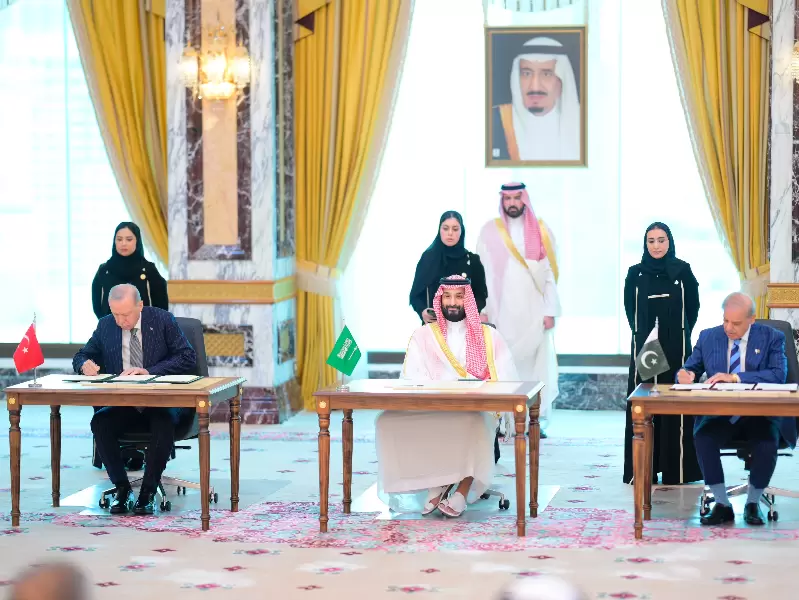 Signing of the Makkah Joint Defence Agreement / X/PakPMO
In a major geopolitical and security development, Saudi Arabia, Türkiye and Pakistan, three large Muslim countries, signed a defence agreement on 7 August in Makkah, the holy place for Muslims across the world.
As has now become a common line in almost every security agreement, the text of the pact, known as the Makkah Joint Defence Agreement or the Makka Pact, stated that it “intended to strengthen collective deterrence against any act of aggression and stipulates that any armed attack against any one of the three states shall be regarded as an attack against them all. It further provides for the enhancement of all aspects of defence cooperation among the three states.”
The claim is essentially the same for any security agreement rolled out. Principally, that is the purpose of the agreement to begin with. Indeed, all security agreements are meant to address the immediate threats that the allied countries face. They are supposed to share the burden when the allied partners are unable to fight the threats individually. Coming together will enhance capabilities, thus warding off the threat. It may also reduce the overall cost of addressing the threat.
How does the Makkah Pact uphold all the razzle-dazzle? The three countries hardly share anything— from common threats to shared interests. They belong to three different regions— Pakistan to South Asia, Saudi Arabia to West Asia, and Türkiye to Europe. There is no prototype of any collaboration or institutional engagements.
Their domestic priorities and external threats are different. The declaration appears more like an ambitious reaction to immediate uncertainty than a plan to establish an institutional mechanism to identify common threats and address them together. It, therefore, is more political hedging than a security agreement.
In the West Asian region, a stable regional order has remained weak and elusive. Although characterised as a Muslim region, the Muslim countries have not been able to come up with a security architecture that would have stabilised the region and immunised it against external actors and shocks. This has created space for alliances whenever a regional country emerges as a threat or threatens to be a regional hegemon.
More often, therefore, an outsider great power has tried to provide security to regional countries that feared being threatened by one or more powerful regional countries. Since the United States (US) emerged as a great power during the Cold War and as the lone superpower at its end, regional countries formed security alliances or bought security from the US. Consequently, the US has maintained a strong military presence in the region, with over 40,000 troops and nineteen bases, eight permanent.
For a long time, the US security umbrella was seen to have deterred threats against the Gulf countries. But in reality, it was never tested. More importantly, some threats popped up because of US policies and adventures. For example, the Israeli refusal to address the Palestine conflict and allow a Palestinian state to exist has been a hindrance to establishing a stable regional order. And the US has not been able or doesn’t want to chastise Israel.
More importantly, Israel has been striking against the regional countries at will. In its latest military operations against the Palestinians, it even went so far as to strike Qatar in September 2025, a close ally of the US. The only offer the US had for Doha was that President Trump was unhappy with Israel. Before that, Israel and the US had attacked Iran in June.
The two incidents remain important because if Qatar was mediating between Israel/US and Hamas at the time of the attack, Iran was negotiating a nuclear deal with the US when it was attacked. This, at least the Qatar incident, was one test of the US as security provider in which it failed not only to rein in Israel but subsequently joined adventures that created instability and threats in the region.
Naturally, once the US failed to provide security to the Gulf countries, they would look for alternatives. Immediately after the Israeli September attack on Qatar, Saudi Arabia and Pakistan signed a Strategic Mutual Defence Agreement (SMDA) within a few days. The core thrust of the agreement was the same line: “any aggression against either country shall be considered an act of aggression against both.” The SMDA didn’t meet the expectations.
Then came the real test for the US security umbrella: On 28 February, the US and Israel launched a military operation, Epic Fury, against Iran to topple the government and force the country into submission. Facing an existential threat, Iran not only retaliated against Israel by carrying out missile strikes deep inside the country, but it also targeted the US military bases and joint infrastructure between the Gulf countries and the US across the region. Apart from the US, the regional countries paid the price for the former’s adventure: the UAE, Saudi Arabia, Bahrain, Qatar, Kuwait, and even Jordan came under the Iranian retaliatory attacks for hosting the US military bases and joint infrastructure.
It was after the signing of the agreement between Islamabad and Riyadh in September 2025 that Saudi Arabia faced retaliatory attacks from Iran in February. Like the US, however, Islamabad couldn’t come to Riyadh’s rescue. More recently, the Houthis carried out some strikes inside Saudi Arabia for its support for the US. No reaction, apart from condemnation from Islamabad. What happened to the defence agreement and to the pledge that “any aggression against either country shall be considered an act of aggression against both?” Why didn’t Pakistan help the Saudis or the other Gulf countries with which Islamabad has been taking billions of dollars in aid?
As far as Türkiye is concerned, its approach overall has been anything but unambiguous. The country is a member of NATO and recently hosted a NATO meeting at which member countries committed to collective defence under Article 5 of the organisation's document. In July, Ankara hosted the meeting, and in August it became a signatory of the Makkah Pact.
How contradictory is the position of Ankara? So, if the NATO countries cannot come to its defence if attacked, what will make the Saudis or Pakistanis do the job? More importantly, if Saudi Arabia or Pakistan is attacked, will, according to the pact, Turkiye come to their defence? And now, being a partner to the conflict, if Türkiye comes under attack, will the NATO countries join the fray?
Pakistan is not new to joining alliances that it sees as helpful in legitimising its role towards the west of the country. They also bring Islamabad some financial support to help its struggling economy. Although Islamabad has some defence equipment trade with Türkiye, their trade is not high, hardly over $1.2 billion. So, if one country is attacked, it doesn’t impact the other financially much, so that it could have joined the war to avoid further losses; nor is there a common immediate threat that would force them to join each other.
With Riyadh, Pakistan has had defence relations. It has sent and also trained Saudi soldiers. But that has not translated into joining any Saudi conflict or military operation. When the Saudi-led alliance attacked Yemen in 2015, Pakistan, despite being asked to join, refused to participate in the military operation, creating a rift in the ties. The same pattern has been observed in the latest incidents, where Saudi Arabia didn’t receive any military help from Islamabad.
Given these ground realities, what is the significance of the new alliance? One might argue, apart from some hedging, it has none. The nature and intensity of the threats that each country faces are different: They don’t unite them. In fact, they may push them further away than bringing them closer. For example, if Riyadh has issues with Iran, Pakistan is unwilling to side with the Saudis on that, as Islamabad and Tehran have no hot conflict as of now. With Türkiye, neither Pakistan nor Saudi share a common threat that would force them to get militarily involved to help the other.
One argument being made is that the three countries bring different strengths to the table: if Saudi Arabia has deep pockets, then Türkiye has a strong defence industry, including drones; and Pakistan comes with a strong military. The point, however, is: are they really so complementary? Pakistan and Türkiye's total trade is hanging around $1 billion. Saudi Arabia has been buying defence equipment from the US, the most advanced defence industry, much better than Türkiye. And even they could not protect the kingdom from the Iranian missiles.
As far as the military of Pakistan is concerned, it is claimed the country has a powerful military with nuclear weapons: when have these claims been vindicated? The Pakistan military has lost every single war that it waged against India, including the humiliating defeat in 1971.
It has miserably failed to defeat insurgencies in Balochistan and now in Khyber-Pakhtunkhwa (KP). Survival is not victory for an aggressor; it is for the victim of the aggression. This is an adage in international wars. Moreover, the Islamic Military Counter Terrorism Coalition (IMCTC), formed in 2015 and headed by the former Pakistan Army chief, Gen. Raheel Sharif from the beginning, didn’t change anything.
One important lesson from the US-Israeli invasion of Iran is that the nature of warfare has changed: neither the number of active military personnel nor advanced technology is enough to win victories. The Pakistan military has a record of failures, not of success. If it joins any adventure in the region, it will not necessarily bring victory for the trio.
The Makkah Pact does not appear to be different from other such pacts or efforts made in the past. In all likelihood, the Makkah Pact will not deliver either.
The reasons for that are various: structural, the nature of the threats and differences in transnational costs. Having a common, Muslim identity will not necessarily yield to commitments; in the end, they are three different states and have had their differences. They don’t even share an inch of border: they belong to three different regions. History is witness to the fact that the territorial understanding of nationalisms/identity prevails over all other affiliations. The same three Muslim countries couldn’t do anything to stop the ongoing persecution of Palestinians, apart from verbal condemnation.
In his seminal book on alliance formation, The Origins of Alliances, Stephen Walt argued that “The forces that bring states together and drive them apart will affect the security of individual states by determining both how large a threat they face and how much help they can expect.” The latter part underlines what leads to an alliance. In the case of the Makkah Pact, neither is there a clear, common threat, nor is there any clarity over the kind of help that the allied countries will provide to each other.
It seems an ambitious move, without weight or clarity about what it wants to achieve. More importantly, the best way to assess its credibility is to put it to the test. Given the volatile situation in the region, it is likely to happen sooner rather than later. It is prudent, therefore, to wait for that test to check the credibility of the Makkah Pact. On paper, it is hedging rather than anything else.
(The views and opinions expressed in this article are those of the author and do not necessarily reflect the official policy or position of New India Abroad.)
Discover more at New India Abroad.
Leave A Comment
Related






.jpg)



ADVERTISEMENT

ADVERTISEMENT
E Paper
Video

Comments
Start the conversation
Become a member of New India Abroad to start commenting.
Sign Up Now
Already have an account? Login