ADVERTISEMENT
ADVERTISEMENT



India’s global rise and U.S. ties take center stage at Stanford conference
The discussions reflected the growing global interest in India’s political and economic trajectory
-
 Vidya S
 - Wed, 13, May 2026
- 02:25 EDT
- 16
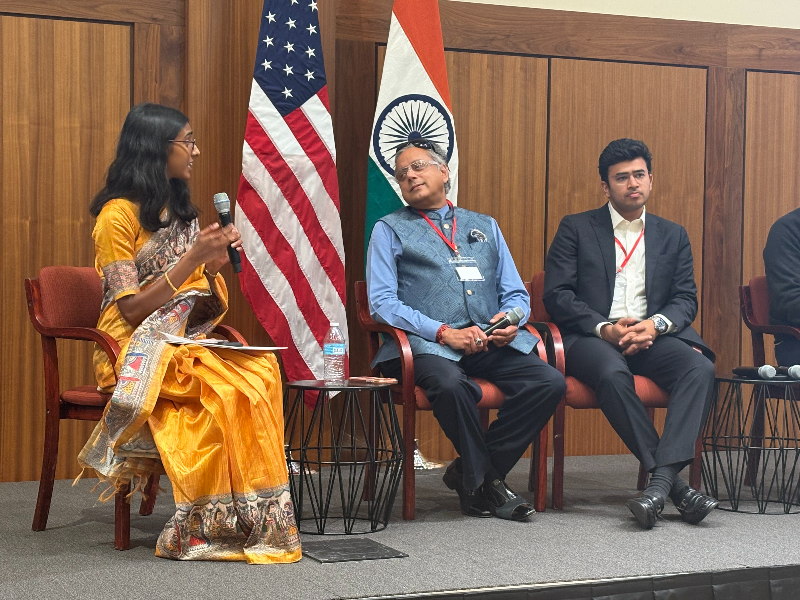 Dr. Shashi Tharoor, MP, Lok Sabha and Tejasvi Surya, MP, Lok Sabha. / Courtesy photo
The Stanford India Policy and Economics Club (SIPEC) recently concluded its 2026 flagship event, the Stanford India Conference, held May 9-10, 2026. SIPEC is a student-led organization founded in 2021. It aims to empower students with the knowledge and networks needed to influence India’s policy and economic landscape.
The event commenced with opening remarks by the San Francisco Consul General of India, Dr. K. Srikar Reddy. The consul general outlined India’s emergence as a global hub for manufacturing, semiconductors and AI-driven industries, underpinned by Digital Public Infrastructure, including UPI, that is transforming governance and financial inclusion at scale. He highlighted the deepening India-U.S. collaboration across deep tech, space and frontier technologies, the acceleration of global companies investing and scaling operations in India, and the country’s growing prominence as a destination for GCCs, R&D and startup innovation. He also pointed to India’s MANAV (human-centric AI) framework and the India AI Mission, focused on building inclusive, ethical and large-scale AI capabilities for public good.
Consul General Dr. K. Srikar Reddy described the India-U.S. partnership as “one of the most consequential partnerships of the 21st century” at a time when the world is navigating AI disruption, geopolitical uncertainty, energy security challenges and climate change.
The conference convened innovators, policymakers, scholars and students across the India-U.S. corridor, featuring speakers such as Dr. Shashi Tharoor, MP, Lok Sabha; Vinod Dham, venture capitalist and father of the Pentium chip; K. Annamalai, former BJP president, Tamil Nadu; Dr. Arvind Panagariya, chairman, 16th Finance Commission of India; and Tejasvi Surya, MP, Lok Sabha.
Dr. Arvind Panagariya, former NITI Aayog vice chairman and current 16th Finance Commission chairman, holds an optimistic “bullish” outlook on India’s economic future. He projects India to become the world’s third-largest economy by 2030 and potentially reach a $10 trillion economy by 2034-2035, driven by strong sustained growth, democratic stability and structural reforms.
A vibrant discussion on India’s evolving political landscape, youth leadership, governance and global influence took center stage at Stanford University as prominent Indian political leaders Congress MP Shashi Tharoor, former Tamil Nadu BJP President K. Annamalai and BJP MP Tejasvi Surya participated in separate engagements and interactions with students, academics, professionals and members of the Indian diaspora.
The events drew significant interest from the Bay Area’s Indian American community and Stanford students eager to hear diverse perspectives from some of India’s most recognized political voices representing different ideologies and generations.
MP Tharoor spoke extensively on India’s democratic traditions, global diplomacy, technological innovation and the importance of liberal discourse in a rapidly changing world. His interaction emphasized India’s role on the global stage and the need for constructive engagement between nations and cultures.
K. Annamalai addressed leadership, governance reforms, anti-corruption initiatives and grassroots political engagement. Drawing from his background in public service and law enforcement, he highlighted the aspirations of India’s youth and the transformation underway in Indian politics. Annamalai defended Tharoor’s argument for larger representation for northern states based on census numbers, while stressing the need for a balanced consensus that protects southern states’ interests.
MP Tejasvi Surya focused on entrepreneurship, innovation, India’s startup ecosystem and the increasing political participation of young Indians. He encouraged students and young professionals to actively contribute to nation-building and civic leadership.
A sharp debate over delimitation and political representation unfolded, with Congress MP Shashi Tharoor cautioning that southern states could feel “disenfranchised” if parliamentary seats are redistributed solely based on population growth, while BJP leader K. Annamalai argued that northern states “naturally deserve” a larger share of MPs under the upcoming census-linked exercise.
The discussions reflected the growing global interest in India’s political and economic trajectory and demonstrated how institutions like Stanford University continue to serve as important platforms for international dialogue and democratic exchange.
Attendees described the sessions as insightful, energetic and intellectually engaging, showcasing the diversity of viewpoints shaping the future of Indian politics.
Discover more at New India Abroad.
Related





ADVERTISEMENT

ADVERTISEMENT
E Paper
Video

Comments
Start the conversation
Become a member of New India Abroad to start commenting.
Sign Up Now
Already have an account? Login