ADVERTISEMENT
ADVERTISEMENT



Indian-origin student's art featured on Academic Medicine cover
Sneha Akurati, now a fourth-year medical student, said the artwork was inspired by an early clinical interaction with a patient
-
1759953093.png) Staff Reporter
Staff Reporter - Thu, 16, Jul 2026
- 02:47 EDT
- 18
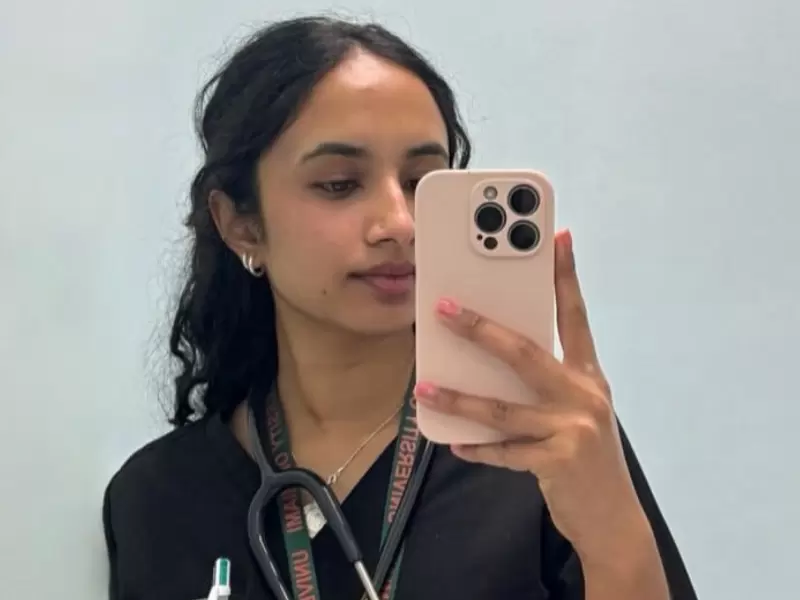 Sneha Akurati / Instagram
A patient encounter during her first year at the University of Miami Miller School of Medicine inspired Indian-origin medical student Sneha Akurati to create 'Bedside,' an artwork selected for the cover of the June 2026 issue of Academic Medicine, according to the Miller School of Medicine.
Akurati, now a fourth-year medical student, said the artwork was inspired by an early clinical interaction with a patient while learning how to conduct patient conversations under the guidance of a faculty advisor.
"This was very early in our medical training of what questions to ask and how to guide a clinical conversation," Akurati said, according to the Miller School of Medicine.
She recalled that she initially did not know what to say to the patient but eventually started a conversation about the patient's kidney transplant and yellow socks. Afterward, she wrote about the encounter in her journal before turning it into a drawing. Several years later, 'Bedside' was chosen for the cover of the June 2026 issue of Academic Medicine.
According to the Miller School of Medicine, Akurati submitted three pieces after responding to the journal's open call for cover artwork and said she felt honored that 'Bedside' was selected.
Akurati, who previously earned a dual major in global health studies and studio art as an undergraduate at the University of Miami, said studying both disciplines shaped her approach to medicine. She said art strengthens intuition that can help physicians at the bedside, while science provides the discipline and rigor needed in artistic work.
During her second year of medical school, Akurati was elected president of Medical Humanities. According to the Miller School of Medicine, she also served as editor-in-chief in reviving 'Obliterants,' a humanities and social sciences journal for students, residents and faculty after a four-year hiatus.
Akurati said keeping a journal has become an important part of processing patient experiences.
"You don't want to forget," she said. "Being a doctor is a unique career. You get to meet so many people and learn about their stories and the most vulnerable parts of their lives. It gives insight into the human struggle and human resilience."
She said writing and creating art help her reflect on difficult experiences and strengthen her understanding of patient care.
"Art has helped me connect with my patients and with myself when I witness difficult patient stories," she said. "Some patients are at the lowest point of their lives and art helps me process that. It fosters empathy and intuition. It helps me become the doctor I want to be."
Reflecting on her clinical rotations, Akurati said art continues to help her honor patients' experiences.
"I've met patients who have gone through so much," she said. "Art helps me connect with that."
According to the Miller School of Medicine, Akurati is applying for internal medicine residency programs and is considering several subspecialties. She also said she hopes to pursue a career that includes teaching, building on years of experience instructing art classes, tutoring science subjects and serving as an MCAT tutor.
"I'm also in the medical education elective," she said. "I see myself going into academics in my future career."
Discover more at New India Abroad.
Leave A Comment
Related


.jpg)
ADVERTISEMENT

ADVERTISEMENT
E Paper
Video

Comments
Start the conversation
Become a member of New India Abroad to start commenting.
Sign Up Now
Already have an account? Login