ADVERTISEMENT

ADVERTISEMENT



Indian-origin MIT prof. develops AI sensors for early cancer detection
Sangeeta Bhatia is a member of MIT’s Koch Institute for Integrative Cancer Research and the Institute for Medical Engineering and Science.
-
Rwittika Chakraborty
- Thu, 08, Jan 2026
- 03:03 EST
- 184
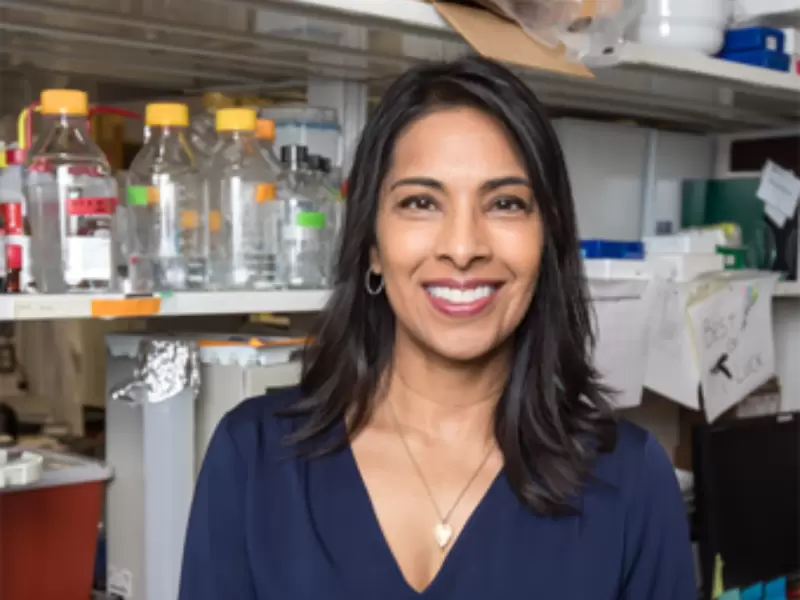 Indian-origin MIT professor, Sangeeta Bhatia. / Massachusetts Institute of Technology (ki.mit.edu/)
Sangeeta Bhatia, an Indian-origin MIT professor, along with other MIT and Microsoft researchers, has developed an artificial intelligence model to design molecular sensors for the early detection of cancer.
This developed AI model is to design peptides (short proteins) that are targeted by enzymes called proteases, which are overactive in cancer cells. Nanoparticles coated with these peptides can act as sensors that give off a signal if cancer-linked proteases are present anywhere in the body.
ALSO READ: MIT’s Deblina Sarkar unveils injectable brain chip for Parkinson’s
Depending on which proteases are detected, doctors would be able to diagnose the particular type of cancer present, and these signals could be detected using a simple urine test that could even be taken at home.
Bhatia and Ava Amini ’16, a principal researcher at Microsoft Research and a former graduate student in Bhatia’s lab, are the senior authors of the study.
Providing some insight about the research, Bhatia, the John and Dorothy Wilson Professor of Health Sciences and Technology and of Electrical Engineering and Computer Science at MIT, told the university,
“We’re focused on ultra-sensitive detection in diseases like the early stages of cancer, when the tumor burden is small, or early on in recurrence after surgery.”
Bhatia is a member of MIT’s Koch Institute for Integrative Cancer Research and the Institute for Medical Engineering and Science (IMES).
She is also the director of Marble Center for Cancer Nanomedicine, an investigator at the Howard Hughes Medical Institute, an institute member of the Broad Institute of MIT and Harvard, associated faculty member at the Wyss Institute, and a biomedical engineer at Brigham and Women's Hospital, Department of Medicine.
Related









ADVERTISEMENT
ADVERTISEMENT
E Paper
Video

Comments
Start the conversation
Become a member of New India Abroad to start commenting.
Sign Up Now
Already have an account? Login